
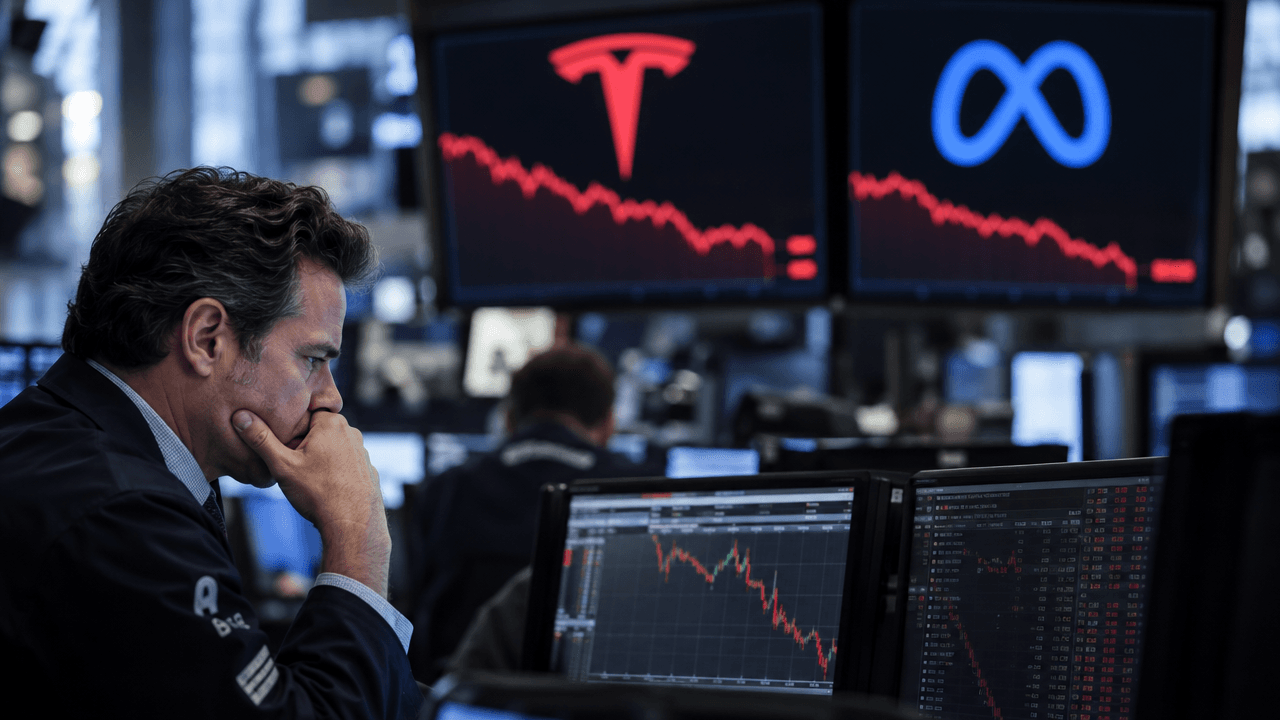
Nasdaq and S&P 500 futures weakened as investors reassessed the durability of the artificial intelligence stock rally following mixed results from Tesla and Meta. Nasdaq 100 futures fell roughly 0.9%, while S&P 500 futures declined about 0.5%, reflecting renewed concern that aggressive AI investment may not produce sufficient returns quickly enough to justify elevated technology valuations. [1]
The retreat does not necessarily signal the end of the AI trade. Instead, it highlights a shift in investor expectations. Markets are no longer rewarding companies simply for announcing ambitious AI plans. Investors increasingly want evidence of revenue growth, improving margins, disciplined spending, and a credible path toward long-term profitability.
What Drove The Market Reaction
Tesla and Meta offered two different perspectives on the AI investment cycle.
Tesla’s shares came under pressure after the company reduced its annual capital expenditure forecast. The company has positioned AI, autonomous driving, robotaxis, and robotics as important parts of its future growth strategy. However, lower planned spending raised questions about the pace of that expansion and whether Tesla can fund its ambitions while managing pressure in its core electric-vehicle business. [1]
Meta delivered a different message. The company reported stronger-than-expected revenue and increased its capital expenditure outlook, with planned 2026 spending of approximately $135 billion to $145 billion. That spending is intended to support data centers, computing capacity, and broader AI development. [3]
At first glance, higher investment and stronger revenue might appear positive. However, the market is also asking how much capital technology companies must spend before AI produces meaningful incremental earnings. When spending rises faster than profits, investors may become less willing to assign premium valuations to growth stocks.
The Ai Rally Faces A Profitability Test
The central issue is not whether AI will influence business and the economy. It almost certainly will. The more immediate market question is whether the financial returns from AI will arrive quickly enough to support current share prices.
Building AI infrastructure requires enormous investment in processors, energy, data centers, networking equipment, and specialized talent. These costs are incurred well before many products generate substantial revenue. Companies may need to spend billions today to create services that become profitable several years from now.
That creates a difficult balance for investors. Strong capital expenditure can indicate confidence in future demand, but it can also reduce free cash flow and increase execution risk. Meta’s spending plans demonstrate its commitment to competing in AI, yet they also give shareholders a larger financial target to evaluate.
Tesla’s reduced spending forecast creates the opposite concern. If a company cuts investment, investors may question whether management is becoming more disciplined or whether growth plans are being delayed. The market response depends on whether the reduction improves financial efficiency or signals weaker confidence in future demand.
Valuations And Market Concentration Matter
The latest decline also reflects the concentration of major U.S. indexes in a relatively small group of technology and growth companies. When large companies such as Meta and Tesla move sharply, their influence can extend beyond their individual share prices.
The Nasdaq is particularly sensitive to changes in expectations for technology earnings and interest rates. Growth companies derive much of their value from profits expected in the future. If investors demand a higher return for holding those future earnings, valuations can come under pressure.
The S&P 500 is broader, but its largest constituents are also heavily represented by technology and communications companies. As a result, concerns about AI spending can affect both indexes, even when other sectors remain relatively stable.
This is why futures markets are useful but limited indicators. A decline before the opening bell reflects current expectations, not a guaranteed outcome for the full trading session. Futures can change as investors digest additional earnings reports, economic data, bond-market movements, and company guidance.
What Traders Should Watch Next
Traders should focus less on headlines about AI and more on measurable operating data. Important indicators include revenue growth from AI-related products, operating margins, free cash flow, capital expenditure guidance, and management commentary about customer demand.
Earnings guidance may be especially important. A company can report strong historical results while warning that future costs will rise or growth will slow. Markets generally price future performance, so forward guidance can matter more than the previous quarter’s headline numbers.
Traders should also monitor Treasury yields. Rising yields can place additional pressure on long-duration technology stocks, while falling yields may provide some valuation support. Energy prices, currency movements, and broader risk sentiment can also influence index futures independently of corporate earnings.
For SimFi traders, this environment provides a useful opportunity to practice scenario-based decision-making. Rather than immediately buying or selling after a futures decline, traders can define several possible outcomes: a deeper technology selloff, a rapid recovery after the opening bell, or a rotation into defensive and value-oriented sectors.
A practical plan might include identifying key overnight highs and lows, setting a maximum risk per trade, and waiting for confirmation from price action and volume. Traders can also compare the Nasdaq’s performance with the S&P 500 to determine whether weakness is concentrated in technology or spreading across the broader market.
The Bigger Lesson For Market Participants
The AI investment story remains powerful, but enthusiasm alone is no longer enough to support every company associated with it. Investors are beginning to distinguish between businesses with visible monetization and those still spending heavily in anticipation of future returns.
That distinction can create both volatility and opportunity. Pullbacks may expose weaker companies, while firms that demonstrate disciplined investment and consistent earnings growth may attract capital. The process is likely to produce a more selective market rather than a uniform retreat from AI-related assets.
For traders, the key lesson is to separate narrative from evidence. A compelling technology story can influence sentiment, but earnings, cash flow, valuation, and risk management ultimately determine whether a trade is sustainable.
Nasdaq and S&P 500 futures weakening after the Tesla and Meta results is therefore more than a routine premarket move. It is a reminder that the next phase of the AI rally will be judged by returns on investment. As earnings season continues, markets will reward companies that can show not only what AI might become, but what it is already delivering.