
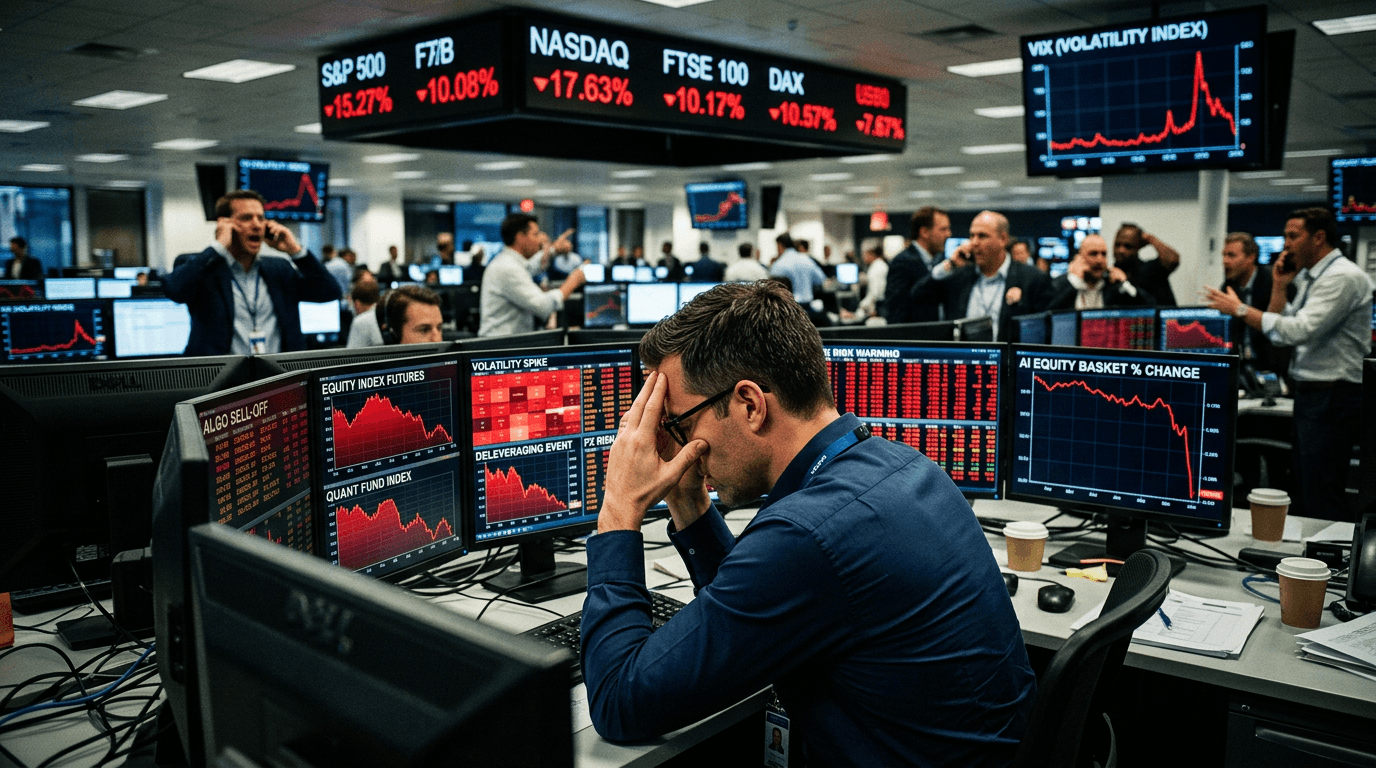
The latest selloff in AI-linked equities is more than a story about tech stocks suddenly cooling off. It has triggered some of the worst performance for major quant funds since last August, exposed how crowded the AI trade had become, and raised the risk that volatility will spill over into currencies, index futures, and volatility markets as systematic players cut risk across the board.[1][3][4] Understanding why this happened – and why it matters beyond AI – is crucial for both live and simulated finance traders.
What Just Happened In Ai Equities
AI-related stocks, particularly chipmakers and high-beta tech names, have reversed sharply after an extended run of outsized gains and lofty valuations.[1][3] Concerns about whether massive AI capital expenditures are sustainable and warnings from regulators about overheating in key semiconductor names have pushed investors to question the narrative that “AI only goes up.”[3]
As that narrative cracked, baskets of AI momentum stocks – those that had been steadily trending higher – saw some of their steepest single-session losses since 2021.[5] Goldman Sachs had flagged momentum positioning in AI equities at the 100th percentile of its five-year history in May, effectively warning that the trade was about as crowded as it could get.[5] When selling started, there were simply too many investors in the same names, all trying to exit at once.
The impact has been particularly acute in markets like the U.S. and Asia, where AI and chipmaker stocks had delivered triple-digit gains and attracted heavy leverage from both hedge funds and retail traders.[3] As prices fell, that leverage became a key amplifier, forcing margin calls and stop-outs that deepened the rout.
Why Quant Funds Took The Biggest Hit
Systematic managers – quant funds that trade using models rather than discretionary stock picking – had ridden the AI theme hard. They entered the selloff with sizable exposure to momentum, growth, and high-beta AI-linked equities.[1][3][5] When the trend reversed, those same models began to work against them.
Prime brokerage data show that quant funds have given back roughly a quarter of their year-to-date returns in a matter of weeks, with performance dropping from about 14.4% in late June to 10.8%, still positive but notably weakened.[1][3][4] For many, this is the worst stretch since last August.[1][4] Similar pattern have appeared earlier in the year: in the first two weeks of January, systematic long-short equity managers lost around 2.8%, the worst start since October, as crowded U.S. positions unwound.[5][8]
The underlying issue is crowding. As AI and quant investing have gone mainstream, more firms are running similar strategies on similar datasets. The alpha premium that systematic strategies once enjoyed has eroded as signals become commoditized.[5] When those signals point to the same trades – long the same AI winners, short similar high-beta losers – the portfolio structures converge. That makes the system fragile: a shock to one theme can trigger simultaneous losses across many funds.
Risk models compound the effect. Once losses breach certain thresholds, many quant funds are required to reduce leverage and cut positions to meet volatility or value-at-risk (VaR) limits.[6][8] These de-risking rules are mechanical, so the selling is not just about changing market views; it is hardwired into the strategies.
How Deleveraging Spills Across Asset Classes
Importantly, quant funds are not confined to single markets. Many run multi-asset books that span equities, equity index futures, FX, rates, and volatility products. When their equity sleeves are hit by a sudden drawdown, risk limits do not just apply to stocks – they apply to total portfolio risk.
That is where cross-asset volatility risk arises. A sharp equity loss can trigger broad deleveraging: funds cut long positions in index futures, unwind relative-value trades in FX, and trim exposure in options and volatility strategies to bring overall risk back in line.[6][8] In recent AI-related turbulence, prime brokers reported some of the sharpest one-day deleveraging moves in months, echoing previous episodes of quant stress.[8]
The mechanics are straightforward but powerful
When equity losses spike, total portfolio volatility rises.
Risk systems demand lower exposure, prompting systematic selling across multiple asset classes.
As positions are reduced, liquidity can thin out, widening bid–ask spreads and amplifying price moves.
Other leveraged players (such as CTAs and risk-parity funds) may then respond to the new volatility regime, further reinforcing cross-asset moves.[6]
Even traders with no direct exposure to AI equities can feel the impact via wider swings in major FX pairs, sudden gaps in equity index futures, and jumpy behavior in volatility indices and options markets.
Lessons For Traders And Simulated Finance Participants
For traders on both live and simulated platforms, this episode offers several practical takeaways.
First, watch thematic concentration. If most of your P&L comes from a single narrative – AI, clean energy, crypto – you are effectively running a macro bet on that theme. Scenario testing how your portfolio behaves under a 15–20% drawdown in that theme can highlight hidden risks before the market does.[4]
Second, monitor crowding indicators. When the same stocks dominate top holdings across funds, factor indices, and retail flows, the probability of a disorderly unwind rises.[5][8] In simulation environments, you can stress-test how crowded factor baskets would perform under volatility shocks, helping you learn to recognize vulnerability in real time.
Third, treat volatility spikes as information, not just noise. A sudden pickup in cross-asset volatility often signals pressure points where leverage and conviction are concentrated.[4][6] Studying how AI-linked names, index futures, and options trade during these episodes can sharpen your understanding of market microstructure and liquidity.
Finally, diversify not just across names, but across styles and time horizons. If your strategies all depend on momentum in the same sector, your diversification is more optical than real.[5] Combining trend-following, mean-reversion, and macro overlays – even in a simulated setting – can reduce the risk that one narrative dominates your entire portfolio.
What To Watch Next
The critical question now is whether this AI-driven shakeout is a healthy reset of valuations or the beginning of a deeper correction in the broader tech and quant complex.[3][4] Leverage in some retail segments, particularly in markets where derivatives are widely used, remains elevated and could drive further volatility if prices slide again.[3]
For quant funds, the challenge is structural. As more capital crowds into similar AI-driven models, the industry’s edge narrows and risk becomes more correlated.[5] That makes each future stress episode more likely to have cross-asset repercussions.
Traders should keep an eye on
Flows into and out of AI thematic ETFs and chipmaker baskets.
Prime brokerage reports on leverage and risk usage across systematic funds.
Behavior of volatility indices and options skew around AI earnings and macro events.
Whether fundamental stock pickers begin to take the other side of forced quant selling, potentially stabilizing some names while leaving others exposed.
In both live and simulated markets, the message is clear: in an era where AI and quant strategies dominate flows, shocks in a single equity theme can quickly become a portfolio-wide risk event. Building robust, scenario-tested strategies now is the best defense against the next crowded unwind.