
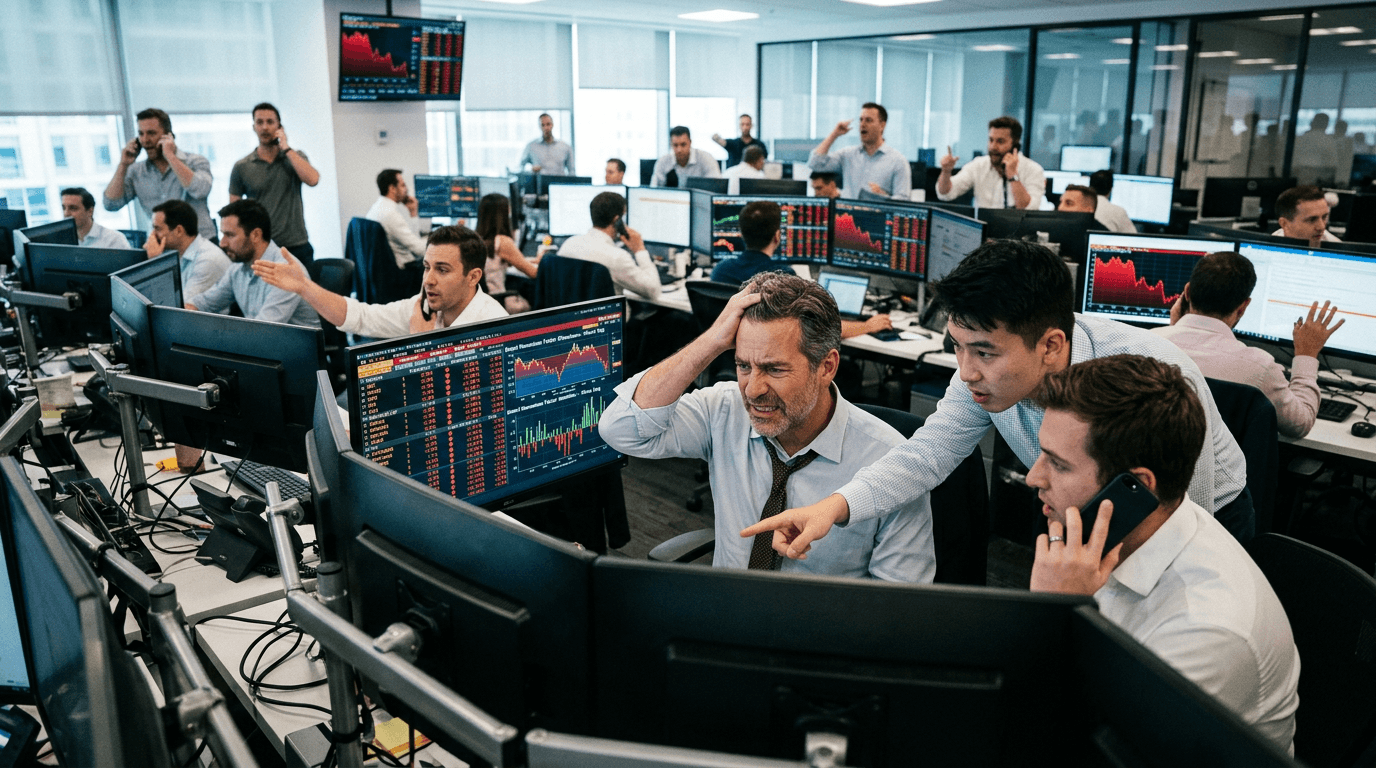
An abrupt selloff in AI‑linked equities has just delivered the worst stretch of performance for major quant funds since last August, underscoring how quickly crowded trades can reverse when a dominant market theme stumbles.[1][2] Systematic managers—hedge funds that use algorithms to trade trends—have given back roughly a quarter of their year‑to‑date gains, with returns dropping from 14.4% in late June to 10.8% despite still being positive for the year.[1][2] For traders and investors, the episode is a vivid reminder that even the most sophisticated models are exposed to narrative shifts, liquidity squeezes, and herding behavior.
What Just Happened In Ai-linked Stocks
The AI story has been one of the most powerful market drivers in recent years, lifting chip makers, cloud platforms, and software names as investors priced in aggressive growth in AI infrastructure and applications.[5][8] That enthusiasm set the stage for a sharp reversal when concerns emerged about stretched valuations, slower-than-expected spending, and the pace at which companies can monetize AI.[5][8]
In recent sessions, selling in AI chip stocks has spread across global markets, pressuring indices and triggering a broader risk‑off move.[5] South Korea, for example, has seen AI‑fueled volatility in some of its fastest‑growing names, many of which had previously posted eye‑catching returns in the first half of the year.[7] As investors rushed to reduce exposure to overheated segments, equity index futures sold off and cross‑asset volatility picked up, as hedging flows rippled into options, credit, and rates.
Goldman Sachs highlighted that systematic managers were heavily exposed to this AI and tech complex, and their performance damage reflects how concentrated the trade had become.[2] The key takeaway: when a dominant theme like AI drives outsized gains, any shift in sentiment can produce an outsized correction—especially when large pools of capital are positioned in similar ways.
Why Quant Funds Were So Vulnerable
Quant funds use rules‑based strategies—often built around momentum, value, volatility, and other factors—to select and size positions across thousands of securities.[2] Over the past decade, these systematic approaches have grown rapidly, and search interest in quant investing has surged more than 1,000% in five years as investors look to harness data and algorithms.[3] Today, quant funds account for a meaningful share of hedge fund activity, making their positioning an important driver of market behavior.[1]
Many of these strategies had significant exposure to technology and AI‑linked stocks because those names screened well on factors such as price momentum and earnings revisions.[1][2][8] As the AI trade became more crowded, quant models—often calibrated to recent performance and volatility—continued to allocate capital to the same winners, reinforcing the trend.
When the AI sector suddenly corrected, those same models responded by de‑risking, systematically unwinding positions as signals flipped from “buy” to “sell.”[2] Because many quant funds rely on similar inputs and risk constraints, their trades can become synchronized, intensifying short‑term moves. Goldman Sachs noted that systematic managers have now experienced their weakest patch since last August, giving back roughly a quarter of their year‑to‑date performance in a matter of days.[2]
Key takeaway: the power of systematic investing cuts both ways. Algorithms can capitalize on persistent trends, but they also amplify reversals when many funds are following comparable signals in crowded trades.
Ripple Effects Across Hedge Funds And Indices
The AI‑led selloff has not been confined to pure quant funds. Multi‑strategy hedge funds—those that combine equity long/short, macro, credit, and quant books under one umbrella—have also reported sharp losses.[9] One recent bout of selling saw equity books down about 1.9%, marking their worst day since April 2025, when markets were rattled by macro shocks.[9]
Because AI and tech names make up a large portion of major indices, de‑risking in those sectors affects index futures, volatility surfaces, and sector rotation in a meaningful way.[5][8] As systematic and discretionary managers cut risk, they often hedge via index derivatives, which can push implied volatility higher and influence options pricing and skew. Cross‑asset investors may respond by rotating into perceived “safety” assets like high‑quality bonds or defensive sectors, further reinforcing the risk‑off tone.
At the same time, the impact on quant funds’ performance needs context. Despite the recent drawdown, systematic managers are still up more than 10% for the year, reflecting strong gains earlier in the AI and tech rally.[1] The move is painful but not catastrophic—more a reminder of cyclical risk than a systemic crisis.
Key takeaway: theme‑driven corrections in major sectors like AI and tech can quickly spill over into broader hedge fund performance and index behavior, but the magnitude of the impact depends on how extended positioning and leverage were before the shock.
What This Selloff Teaches Us About Ai Themes
The AI equity reset is also a story about the gap between narrative and fundamentals. Research from fundamental managers has described the recent software and AI‑related selloff as a “rapid reset” driven by concerns about how quickly companies can turn AI innovation into revenue.[8] They argue that disruption rarely unfolds as fast as markets expect, and that earnings quality and business‑model resilience will ultimately separate durable winners from short‑lived hype.[8]
Even as AI‑linked stocks correct, longer‑term evidence still points to AI’s transformative potential in investing. One academic study of an AI “analyst” simulated 30 years of stock selection and found that the machine‑driven approach beat 93% of human fund managers by roughly 600% over that period.[6] That does not mean AI trades will move up in a straight line, but it does suggest that AI as a productivity and analytical tool is likely to remain central to capital markets.
For traders, the lesson is to distinguish between owning “the AI narrative” indiscriminately and owning specific businesses with robust cash flows, competitive moats, and credible AI monetization strategies.[8] Valuation discipline, diversification, and an understanding of crowding risk are crucial—especially in sectors that have already delivered extraordinary gains.
Key takeaway: AI is a long‑term structural force, but its equity story will be punctuated by narrative‑driven booms and busts. Successful traders focus on fundamentals, risk control, and position sizing rather than assuming a one‑way path.
Practical Takeaways For Traders And Simulated Investors
Whether you trade live markets or practice on a simulated finance platform, this AI‑driven selloff offers several practical lessons:
First, stress‑test your portfolio against theme reversals. If much of your performance comes from a single narrative—AI, clean energy, biotech—ask how your equity and futures positions would behave if that theme corrected 15–20% in a short period. Scenario analysis can highlight concentration and liquidity risks before markets do.
Second, pay attention to crowding indicators. When similar stocks dominate top holdings across funds, factor indices, and retail flows, the risk of a crowded unwind rises. Quant strategies can be powerful, but they are not immune to “everyone running for the exit” at once.[2][9]
Third, treat volatility spikes as information, not noise. A sudden jump in cross‑asset volatility often reveals where leverage and conviction are highest. Observing how AI‑linked names, index futures, and options markets react can help you understand the structure of positioning and refine your risk management.
Finally, use simulated trading environments to rehearse decision‑making in fast markets. Practicing how you would respond to a crowded trade unwinding—when to cut risk, how to rebalance, which hedges to deploy—can build the discipline and playbook you need when real capital is on the line.
Key takeaway: events like the AI‑driven quant selloff are not just headlines; they are live case studies. Traders who analyze them carefully and incorporate the lessons into their strategy design gain an edge in both real and simulated markets.