
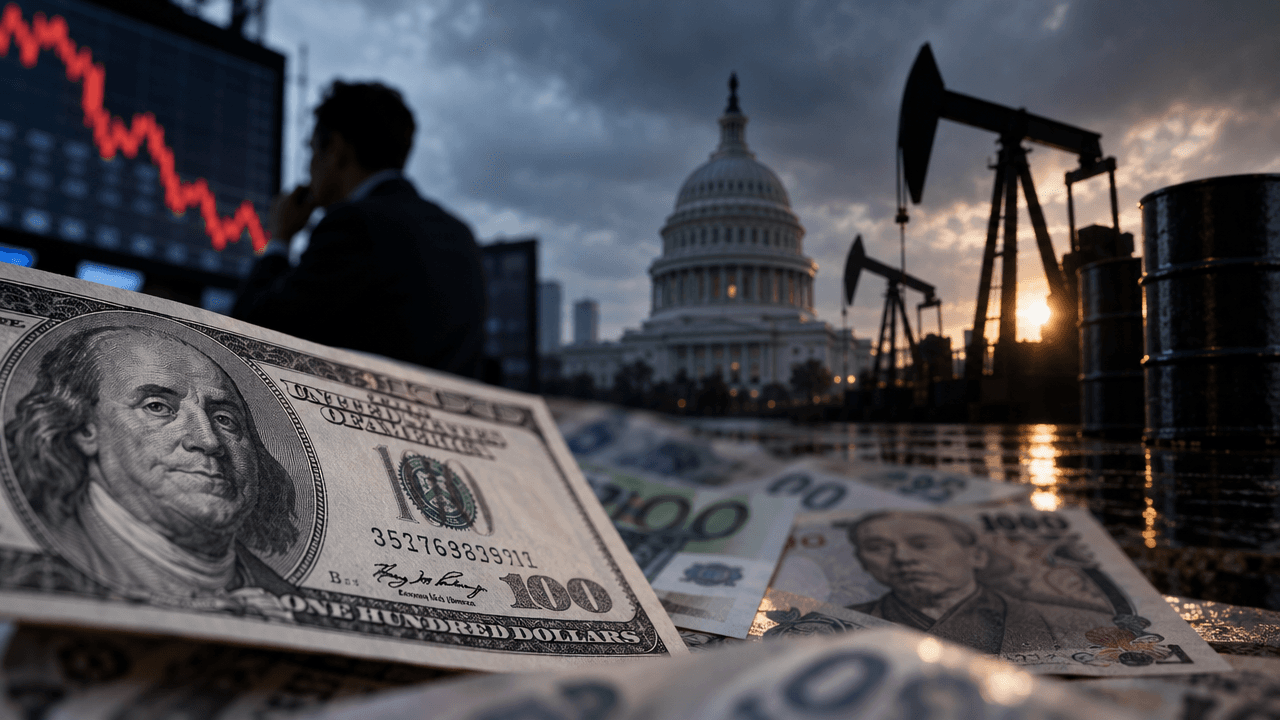
Risk-off sentiment has returned to the forefront of global markets as a wave of doubt over AI-driven equity valuations pushes traders out of growth-sensitive assets and into perceived safety.[1][5][8] This rotation is not just a story for tech stocks; it is increasingly shaping FX, commodities, and rates, creating a complex backdrop that demands disciplined, scenario-based thinking from traders.
Markets Shift To Risk-off Mode
The latest bout of volatility has been triggered by renewed selling in AI-linked and semiconductor names, from Wall Street through Asia, after an extended period of exuberant capital expenditure and stretched valuations.[1][2][5][8] Investors are reassessing whether hundreds of billions in AI infrastructure spending can deliver earnings quickly enough to justify current price levels, leading to sharp moves whenever expectations are revised.[2][5][14]
This reconsideration comes on top of rising oil prices, persistent geopolitical tensions, and policy uncertainty in several major economies, all of which reinforce a cautious macro tone.[3][6][9][12][15] Equity indices have slipped or drifted sideways as investors rotate towards cash, shorter-duration bonds, and defensive sectors rather than committing fresh capital to high-beta plays.[3][9][11] The result is a market environment where risk appetite is fragile and cross-asset correlations are changing quickly.
How Ai Equity Jitters Spill Into Fx
When equity markets move into risk-off mode, FX often becomes the transmission channel for global risk sentiment, and that is exactly what is playing out.[1][4][8] As AI-related equity weakness builds, traders cut exposure to cyclical and commodity-linked currencies and add to positions in traditional havens, amplifying the impact of the equity move.
Higher-beta currencies such as the Australian and New Zealand dollars, along with Scandinavian units like SEK and NOK, tend to underperform when liquidity dries up and volatility rises.[1][2] These currencies are closely tied to global growth and trade, so an AI-led tech correction that raises questions about the durability of the cycle can have outsized effects on them. At the same time, flows into the U.S. dollar and, selectively, the Japanese yen and Swiss franc reflect a search for stability and depth of liquidity as risk aversion spreads.[1][4][8][10]
For traders, the key point is that FX is no longer just reacting to local data; it is being driven by global narratives around technology, capital expenditure, and earnings visibility. Currency pairs linked to AI-heavy equity markets or export-driven chip industries can move sharply even in the absence of domestic headlines.
Dollar Strength, Oil, And Policy Uncertainty
The U.S. dollar has found support as investors seek liquid defensive assets and reassess the policy path of major central banks.[1][3][6][9] Rising energy prices are reviving inflation concerns, particularly as Brent crude trades in the mid-90s and approaches the psychologically important $100 mark, keeping the possibility of further rate hikes on the table.[12][15] Oil-related inflation risk makes the relative policy stance of the Federal Reserve, the European Central Bank, and the Bank of Japan more significant for FX pricing over the coming weeks.[3][6][10][15]
In Japan, markets are assigning a high probability to a near-term rate increase and the prospect of additional tightening later in the year, contributing to episodes of yen strength when risk appetite deteriorates.[3][6][10] In the U.S., shifting expectations around whether the Fed will deliver another hike or pause as inflation data evolves are feeding into the dollar’s appeal as a safe, yield-bearing asset.[3][9][15] Europe, meanwhile, faces its own mix of political uncertainty and sensitivity to higher energy costs, leaving regional equities and the euro more vulnerable when risk sentiment sours.[3][6][9]
For FX traders, this means dollar strength is being reinforced by at least three forces at once: risk-off flows, relative interest-rate expectations, and the inflation impulse from higher oil prices. Any data or news that alters one of these drivers can reprice multiple currency pairs quickly.
Implications For Simulated Traders And Risk Management
On simulated finance platforms such as E8 Markets, this environment is an ideal live-fire exercise in managing cross-asset risk while capital is still virtual. It offers a chance to practice robust processes without the psychological pressure of real drawdowns. The current backdrop highlights several practical lessons.
First, scenario planning matters more than point forecasts. Traders should outline specific paths for AI-related equities, oil, and central bank policy, then map how those scenarios might affect key currency pairs—particularly USD versus higher-beta FX, and the traditional havens.[1][3][4][8] Second, position sizing needs to reflect volatility regimes; when equity-led risk-off episodes emerge, FX ranges tend to widen and intraday swings become more aggressive, making fixed position sizes dangerous.
Third, diversification within FX becomes critical. Concentrated exposure to a single high-beta currency or one region’s tech narrative can turn idiosyncratic headlines into outsized P&L impacts. Balancing positions across havens, cyclicals, and carry trades, and testing their performance under stress in a simulated environment, builds resilience. Finally, traders should pay close attention to correlations: when AI jitters are driving both equities and FX, strategies that assume independence between asset classes may underperform or fail outright.
Practical Takeaways For The Days Ahead
Several concrete steps can help traders navigate this phase of risk-off sentiment more effectively:
1) Track AI and semiconductor headlines alongside FX price action. Moves in AI-linked stocks often precede or coincide with shifts in high-beta currencies; treating them as part of the same narrative improves timing.[1][2][5][8]
2) Monitor oil and inflation-sensitive data releases closely. Energy-driven inflation risk can change the trajectory of central bank expectations in a single session, impacting the dollar, yen, and euro simultaneously.[3][6][12][15]
3) Use simulated trading to stress-test strategies under risk-off and risk-on transitions. E8-style environments let traders rehearse how portfolios behave when AI enthusiasm swings to skepticism, or when policy surprises hit, without jeopardizing real capital.
4) Maintain clear rules for reducing risk when volatility spikes. Pre-defined thresholds for cutting leverage, tightening stops, or reducing correlated positions help avoid emotional decision-making during rapid market moves.
Conclusion
The latest wave of risk-off sentiment shows how quickly a focused concern—AI equity valuations—can ripple through global markets and reshape FX dynamics.[1][5][8][14] As higher oil prices, geopolitical tensions, and policy uncertainty intersect with that theme, traders face a complex environment in which macro, tech, and currency narratives are tightly intertwined.[3][6][9][12][15] For both live and simulated traders, success will hinge on staying attuned to cross-asset links, managing leverage with discipline, and continuously updating scenarios as the AI story and policy outlook evolve.