
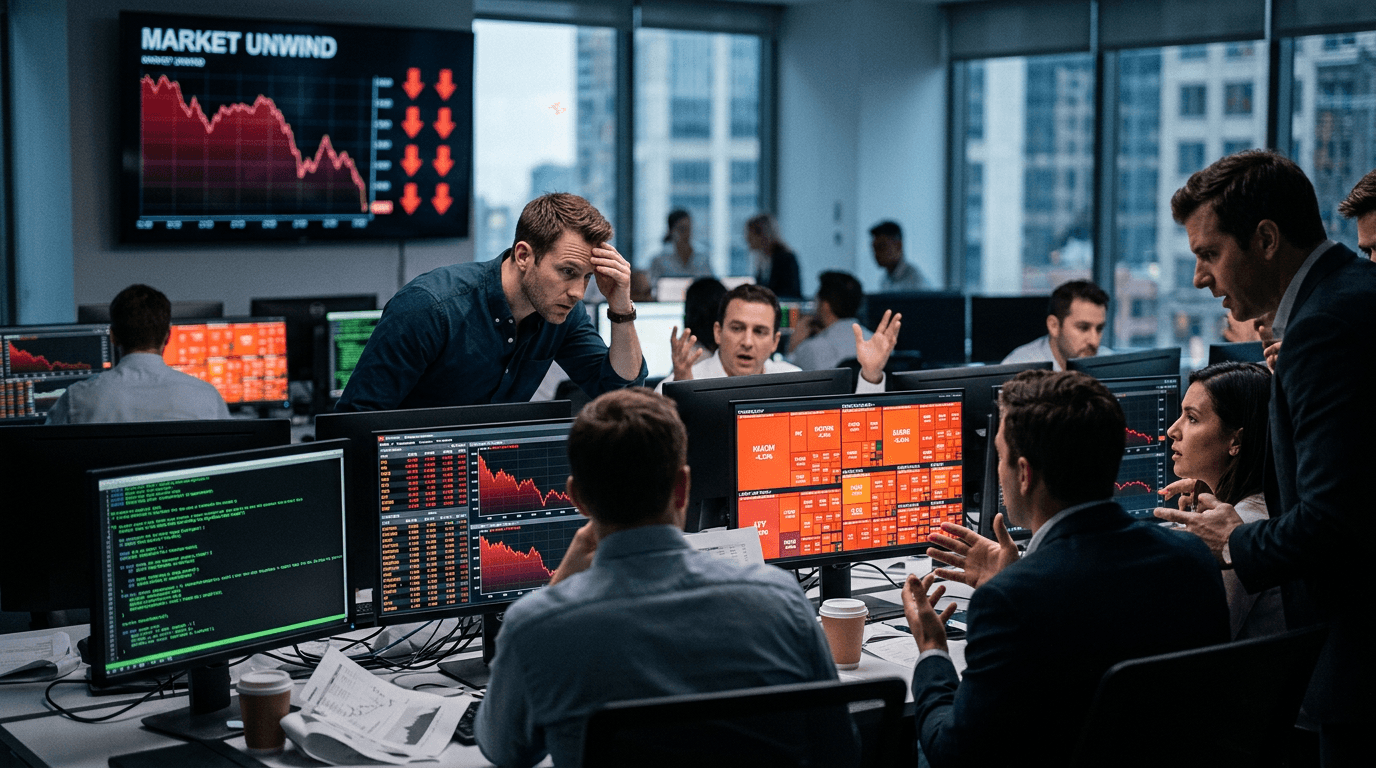
AI-linked stocks have just reminded markets that even the hottest themes can become fragile when positioning gets crowded and volatility spikes. A concentrated selloff in AI-related equities has triggered the worst run of quant fund performance since last August, with knock-on effects now clearly visible in major stock index futures and broader risk assets.
What Just Happened In Ai-linked Equities
Over recent weeks, AI and chip-related equities have reversed sharply after an extended period of strong performance and heavy institutional buying.[1][3] This reversal has been particularly painful because many systematic and quantitative strategies were heavily exposed to these names, having steadily increased positions as momentum and trend-following signals strengthened.[1][3]
Goldman Sachs noted that systematic managers—often referred to as quant funds—have given back roughly a quarter of their year-to-date gains since late June.[1][3] Returns for this group fell from around 14.4% to 10.8% over that short window, marking their weakest stretch since August.[1][3] In other words, what looked like a robust year for trend followers and AI-focused strategies quickly turned into a meaningful drawdown once the theme stumbled.
The impact has been global. In China, quantitative hedge funds suffered one of their worst weeks in more than two years as the AI rout spread to local markets.[2][5] A CSI 1000-focused quant fund affiliated with the DeepSeek founder’s firm reportedly slumped about 15.7% in a single week, underscoring how quickly systematic portfolios can move from outperformance to significant underperformance when crowded trades unwind.[2][5]
Takeaway: AI is not just a technology story—it is now a major macro factor. When AI-linked equities sell off, the impact can cascade through quant strategies and spill into broader markets.
Why Quant Funds Were So Exposed
The pain in quant funds is not simply about “bad algorithms.” It is largely about positioning, correlations, and how systematic strategies respond to changing regimes.
Many quant funds lean heavily on signals such as trend, momentum, volatility, and relative strength. In a long-running uptrend, these models tend to accumulate exposure to winners—in this case, AI-related stocks, chipmakers, and adjacent growth sectors.[1][3] As more funds pile into similar signals, trades become crowded, meaning a large share of capital is leaning in the same direction at the same time.[1][3]
When prices begin to fall, these same models often trigger de-risking rules such as stop losses, volatility targeting, or value-at-risk limits. That can lead to synchronized selling. During prior AI-related corrections, AI-focused hedge funds have posted their worst months on record, in part because cross-asset correlations shifted abruptly and undermined the assumptions embedded in their models.[4] Strategies that historically saw AI and tech as reliable drivers suddenly faced a regime in which those signals inverted.[4]
This latest slump shows a similar pattern: crowded positioning, a volatility shock, and then mechanical selling as systems respond to new price and risk inputs.[1][3] The result is not only losses but also a rapid change in liquidity conditions around the affected names.
Takeaway: The edge in quant trading depends on regime awareness. When many models converge on the same trades, the market’s reaction function can change quickly and painfully.
Ripple Effects Into Index Futures And Other Assets
An important—and often underappreciated—dimension of this episode is how the quant unwind is rippling into index futures and cross-asset volatility. Large systematic portfolios frequently express their macro and equity exposure via futures on major stock indices, using them to adjust beta, hedge single-name risk, or implement trend-following signals at scale.
As AI-linked names sold off and volatility spiked, quant funds have had to recalibrate their overall risk. A common response is to cut gross and net exposure via index futures, leading to heavier-than-usual flows in contracts such as S&P, Nasdaq, Euro Stoxx, or CSI index futures. That activity affects intraday price action, widening bid-ask spreads and amplifying short-term swings, especially during liquidity pockets.
Because these futures markets anchor broader risk sentiment, the turbulence has not stayed confined to equities. Higher cross-asset volatility has spilled into FX—where pro-growth, high-beta currencies can weaken when risk appetite declines—and into crypto, where leveraged positioning and sentiment are highly sensitive to equity market stress. The pattern is familiar from previous episodes: an equity shock disrupts systematic strategies, futures markets transmit that shock, and other risk assets adjust to the new volatility regime.
For discretionary traders, this can look like “random” intraday chop. For systematic traders, it is a reminder that models built on historical correlations and vol patterns can be stressed when the underlying flows are dominated by forced or highly correlated positioning changes.
Takeaway: Index futures are the transmission line between AI stock volatility and broader market risk. When systematic flows surge, intraday swings and cross-asset ripple effects are almost inevitable.
What This Means For Traders And Simfi Participants
For active traders—and especially those learning within SimFi environments—this kind of event is a powerful case study in risk management and regime shifts.
First, it shows why relying solely on recent performance can be dangerous. AI-linked strategies and themes that looked “safe” or “proven” in prior months quickly ran into trouble when positioning became crowded and the market narrative shifted. The same logic applies to retail strategies that chase performance without understanding the underlying risk drivers.
Second, it highlights the importance of monitoring positioning and correlations, not just price. When multiple strategies are known to be long the same theme, traders should expect higher crash risk and more violent reversals if sentiment changes.
Third, it underscores the value of practicing in simulated markets. A SimFi platform allows traders to experience conditions like sudden volatility spikes, slippage in index futures, and cross-asset swings in FX and crypto without putting real capital at risk. That environment can be used to test how different strategies behave when volatility doubles, correlations flip, or a dominant theme such as AI undergoes a rapid de-rating.
Scenario analysis is particularly useful here. Traders can replay periods of prior AI-related corrections—such as the historically bad month for AI hedge funds during an earlier equity correction—and examine how trend strategies, mean reversion systems, and hedging approaches would have fared.[4] Doing this in a simulated setting helps build intuition about when to cut risk, when to diversify, and when to step back from crowded trades.
Takeaway: Use episodes like this as training grounds. Simulated trading can turn a live market shock into a learning laboratory for strategy robustness and risk control.
Key Lessons For Navigating Quant-driven Markets
Several practical lessons emerge from the AI-linked selloff and the quant fund slump:
Crowding matters. When a theme is widely owned by systematic and discretionary investors, the path of returns can become as important as the destination. Fast moves are more likely.
Volatility is a signal, not just noise. Sudden jumps in realized and implied volatility often reflect changes in positioning and regime, not mere randomness. Treat them as information.
Index futures are not “just” hedges. They are central to how large portfolios adjust risk. Watching flows, volume, and intraday price action in key futures can provide early clues about systematic de-risking.
Cross-asset awareness is critical. Equity shocks can propagate into FX and crypto via risk sentiment and funding conditions. Strategies that ignore these linkages risk being blindsided.
For traders and investors, the AI-linked equity selloff is more than a headline. It is a live demonstration of how themes evolve, how crowding amplifies moves, and how quant-driven flows shape the modern market ecosystem. Understanding these dynamics—and rehearsing responses in a simulated environment—can turn volatility from a threat into an opportunity to refine discipline, test models, and build more resilient trading approaches.