
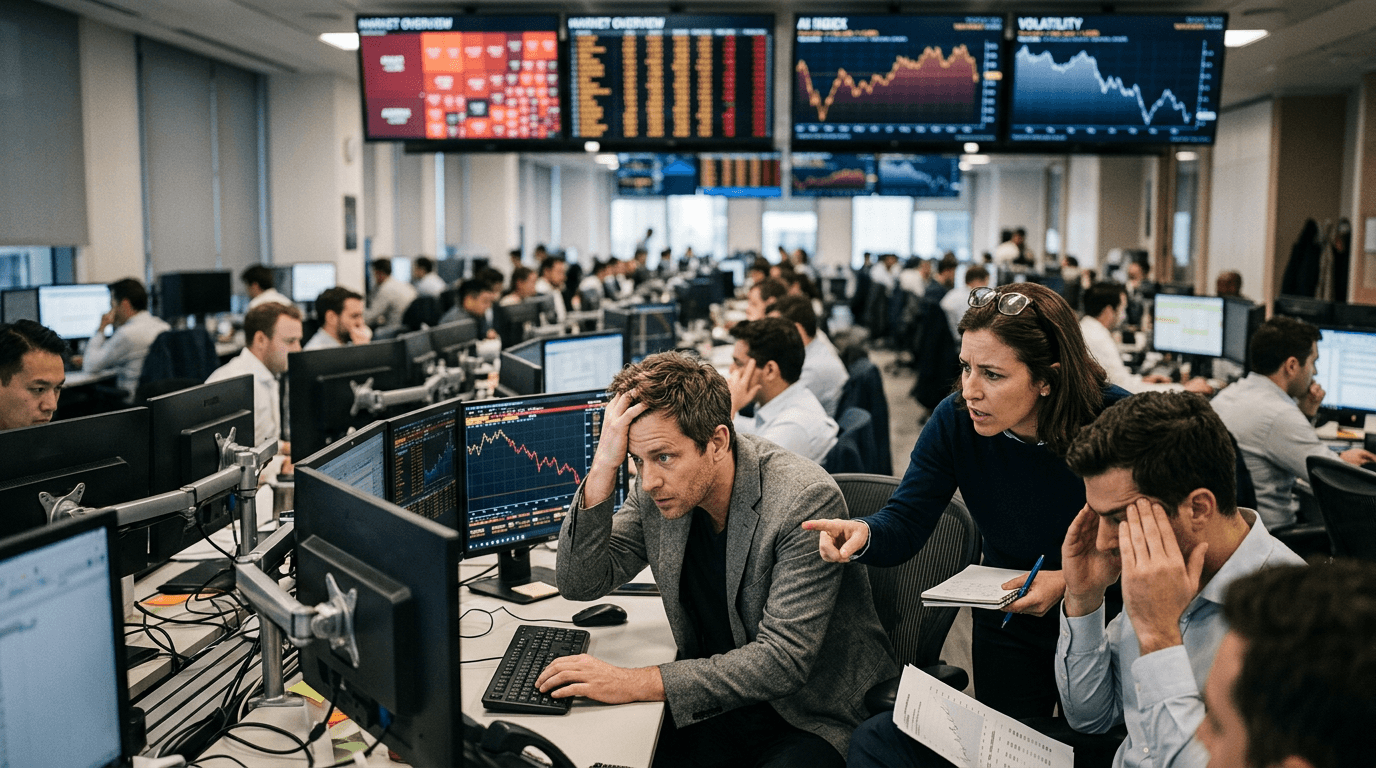
A sharp reversal in AI-linked equities has just delivered the worst stretch for many quant funds since last August, exposing how crowded the “AI trade” had become and how quickly systematic strategies can give back months of gains. The selloff has not only hit headline chipmakers and Big Tech; it has rippled through index futures, risk-parity portfolios, and trend-following systems in both equities and FX.
WHAT TRIGGERED THE AI-LINKED SELLOFF?
AI-related stocks had been priced for perfection, with investors paying rich multiples for any company seen as a beneficiary of the AI boom.[6] In that kind of environment, even strong earnings or upbeat guidance can disappoint if they fail to clear sky-high expectations, and recent price action has shown that “better than expected” is no longer good enough for some marquee AI names.[6]
At the same time, macro conditions became less friendly for long-duration growth stories. Rising Treasury yields and higher oil prices have pushed up the implied discount rate for future cash flows, pressuring the valuations of AI winners just as earnings season ramps up.[6] That macro backdrop provided the spark for profit-taking in the most extended AI trades.
The result was a familiar cross-asset chain reaction: chip stocks and broader tech rolled over, the dollar firmed, and volatility picked up across equity index futures.[6] In this environment, algorithmic strategies that had been heavily long AI and technology momentum were forced to reassess risk quickly, helping accelerate the move as they de-levered.
Why Quant Funds Were Hit So Hard
Quant funds—systematic managers that rely on algorithms to detect and exploit patterns—had become significant holders of AI-linked equities through trend-following, momentum, and factor models.[1][3] As those signals all pointed in the same direction for months, AI exposure became a classic “crowded trade.”
When the AI complex turned lower, the unwind was fast and painful. Data compiled by a major investment bank show that systematic managers have given back roughly a quarter of their year-to-date returns in just a few weeks.[1][3] Their aggregate performance is now up about 10.8% for the year, down from 14.4% on June 22, marking the worst patch since last August.[1][3]
The damage has been global. In China, quantitative hedge funds targeting smaller-cap names saw some of their steepest drawdowns in more than two years as the AI reversal hit locally dominant themes.[5] Seventy-three funds designed to beat the CSI 1000 Index fell an average of 14% in just one week.[5] One high-profile quant fund linked to the founder of AI firm DeepSeek slumped about 15.7% over the same period.[2]
This episode echoes prior stress events for AI-driven and quant strategies. In an earlier equity correction, hedge funds that relied heavily on AI and machine learning suffered their worst month on record as cross-asset correlations shifted abruptly, breaking the relationships their models were built on.[4] Traditional CTAs and other systematic macro funds also took large hits in that phase.[4]
The common thread is that when many models respond to similar signals—valuation, momentum, volatility—positions become highly correlated. That works well in steady trends but turns dangerous when the underlying narrative cracks and liquidity thins.
How Systematic Strategies Are Repositioning
As AI stocks broke down, trend-following and momentum models began cutting long exposure, often automatically. Once price signals move from positive to negative on the time frames those systems track, they are forced to sell, regardless of the fundamental story. That mechanical de-risking amplified the move in AI-related equities and equity index futures.[3][6]
Risk-parity portfolios—balanced allocations that size positions by volatility—have also had to adjust. Rising equity volatility and higher bond yields push these frameworks to scale down leverage in risk assets and, in some cases, rebalance toward bonds or cash.[3][6] For managers running strict vol targets, the spike in realized volatility means reducing gross exposure, even if their long-term view on AI remains bullish.
The spillover is not confined to equities. Systematic strategies in FX that respond to risk sentiment and rate differentials tend to add to “risk-off” currencies and the dollar when stocks sell off and yields rise.[6] This helps explain why the AI unwind has been associated with a stronger dollar and choppier moves in growth-sensitive currencies, affecting global portfolios well beyond technology stocks.
For intraday and high-frequency quants, the main challenge is microstructure. When many players try to exit similar positions at once via the same index futures and liquid single names, spreads can widen and slippage increases. That translates directly into worse execution and performance, even if a strategy’s signals are unchanged.
Key Lessons For Traders And Investors
The first lesson is crowding risk. The trades that feel safest—because “everyone” is in them—often carry the most hidden risk. AI leaders and chipmakers became consensus longs across discretionary, quant, and retail flows, so when the narrative faltered, there were few natural buyers left on the way down.[1][3][6]
Second, correlations are not constant. Many quant models assume that relationships between stocks, sectors, and asset classes stay reasonably stable. Episodes like this show how quickly those relationships can break when a dominant macro force (such as rising yields) collides with an over-owned theme.
Third, risk management matters more than the story. Position sizing, leverage limits, and pre-defined drawdown thresholds are critical when trading momentum and thematic exposures. Systematic managers that capped single-theme or single-factor exposure have fared better than those who allowed AI-related bets to dominate their risk budget.[1][3]
For traders using simulated finance and paper trading environments, this is a live case study. It is an opportunity to backtest how your strategies would have behaved through the AI unwind: What happens to your P&L if momentum signals flip suddenly? How quickly do your risk rules force you to cut exposure? Does your diversification truly help, or are you effectively long the same theme in multiple ways?
Using The Dislocation Constructively
For longer-term investors, the AI selloff is a reminder to separate theme from timing. The structural case for AI may remain intact, but entry price and crowding determine whether a position is resilient or fragile. Periods like this can reset expectations and offer better long-term entry points—provided you have a clear process and risk framework.
For active traders, the current environment may increase short-term opportunity. Elevated volatility, wider dispersions within the AI complex, and shifting factor leadership can all create fertile ground for relative-value, pair trades, and diversified systematic approaches that do not rely solely on AI momentum.
The core takeaway: trends end, narratives evolve, and even the most compelling themes are not immune to sharp corrections. In AI-linked equities, that adjustment just delivered the worst quant-fund performance since last August. How you respond—by diagnosing your exposures, tightening your risk process, and stress-testing your strategies—will matter far more than the headline itself.