
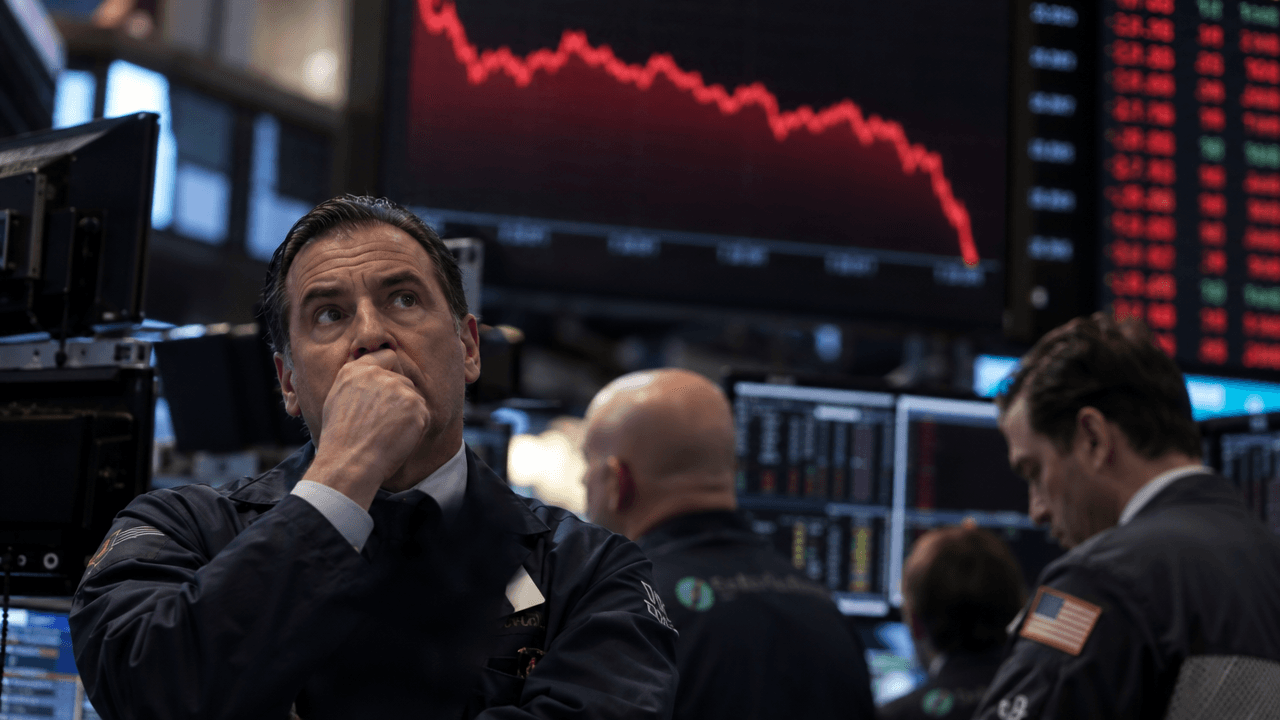
US equities have entered correction territory, marking a sharp change in market sentiment after months of gains powered by artificial intelligence enthusiasm. On Friday, November 20, the S&P 500 fell 3.7% to 6,910.39, while the Dow Jones Industrial Average dropped 1.9% to 48,147.33. Both indexes closed more than 10% below their October records, meeting the standard definition of a market correction. [3]
The Nasdaq Composite suffered an even steeper decline as investors reassessed the value of AI-related companies, semiconductor manufacturers, and the enormous capital spending required to build data centers. The technology-heavy index also turned negative for the year, highlighting how quickly leadership can reverse when crowded trades lose momentum. [6]
What A Correction Means For Traders
A correction is generally defined as a decline of at least 10% from a recent peak. It is more severe than a routine pullback but less extreme than a bear market, which is commonly associated with a decline of 20% or more.
The label itself does not predict what happens next. Some corrections stabilize and become buying opportunities, while others develop into longer downturns if corporate earnings weaken, credit conditions tighten, or investor confidence continues to deteriorate.
For traders, the most important lesson is that percentage declines can accelerate as markets move lower. A stock that falls 10% requires an 11.1% gain to return to its original price. A 30% decline requires a recovery of approximately 42.9%. Managing position size and avoiding excessive leverage therefore becomes more important than trying to identify the exact bottom.
Why Ai Stocks Are Under Pressure
The current sell-off reflects growing doubts about whether the financial returns from AI investment will justify the extraordinary spending involved. Technology companies have committed vast sums to chips, cloud infrastructure, energy, and data centers. Investors are now asking when that spending will translate into sustainable revenue and profit growth.
The disappointing debut of Anthropic shares intensified those concerns. The company’s stock fell more than 10% during its first full trading day, adding to anxiety about the durability of the AI trade. [1]
This does not necessarily mean that artificial intelligence is losing its long-term importance. It means investors may be separating the technology’s potential from the valuations assigned to companies associated with it. A powerful innovation can still produce disappointing returns when expectations become too optimistic or prices move far ahead of fundamentals.
Other pressure points include concerns about slowing data-center construction, reduced funding for AI projects, and a slower path toward technology earnings growth. [12] When a market has been driven by a small group of highly valued companies, weakness in those names can spread rapidly through indexes and portfolios.
The Sell-off Is Broader Than Equities
The risk-off move has not been limited to stocks. Bitcoin fell below $60,000, while other cryptocurrencies also weakened as investors reduced exposure to speculative assets. Gold futures reportedly declined by nearly 4% on Friday, demonstrating that even traditional defensive assets can experience forced selling when investors seek cash or reduce leverage. [12]
This cross-asset pressure is important because it suggests that the market is responding to more than a single disappointing stock or earnings report. Investors may be unwinding crowded positions across equities, crypto, commodities, and other assets simultaneously.
When correlations rise, diversification can provide less protection than expected in the short term. A portfolio spread across several risk assets may still fall together during a broad liquidation. Traders should therefore monitor portfolio exposure by risk factor, not just by asset category.
Practical Lessons For Simfi Traders
Simulated finance offers a useful environment for studying correction dynamics without putting real capital at risk. The objective should not be to predict every market move, but to build a repeatable process for managing uncertainty.
First, reduce position size when volatility expands. A trade that is appropriate during a calm market can become too large when daily price swings increase.
Second, define the invalidation point before entering a position. A stop level should reflect the trade thesis rather than an arbitrary percentage. If the market breaks the level that would disprove the idea, exiting may be more rational than averaging down automatically.
Third, distinguish between index weakness and company-specific weakness. A profitable business with strong cash flow may respond differently from an unprofitable company whose valuation depends on distant growth expectations.
Fourth, track correlations and concentration. A portfolio holding several AI-linked companies may appear diversified while remaining exposed to the same factor: falling technology valuations.
Finally, keep a trading journal. Record the entry, thesis, risk, expected catalyst, and exit decision. During volatile periods, reviewing these details can reveal whether losses came from flawed analysis, excessive leverage, poor timing, or a failure to follow the plan.
What To Watch Next
Investors will focus on corporate earnings, capital-spending guidance, credit conditions, inflation data, and Federal Reserve policy. Strong earnings may help stabilize high-quality technology companies, but results that fail to justify elevated expectations could produce additional selling.
Market breadth will also matter. If declines remain concentrated in a handful of AI leaders while more stocks begin recovering, the correction may be moving toward stabilization. If weakness spreads across industrials, financials, consumer companies, and smaller firms, the risk of a broader economic slowdown could increase.
The current correction is a reminder that compelling technology narratives do not eliminate valuation risk. AI may remain one of the most important forces shaping the economy, but markets can still reprice sharply when expectations, financing conditions, or projected returns change.
For traders, the priority is not to chase the next rebound or predict the perfect bottom. It is to preserve flexibility, control downside risk, and use disciplined analysis while the market determines which companies have durable fundamentals and which were supported mainly by momentum.