
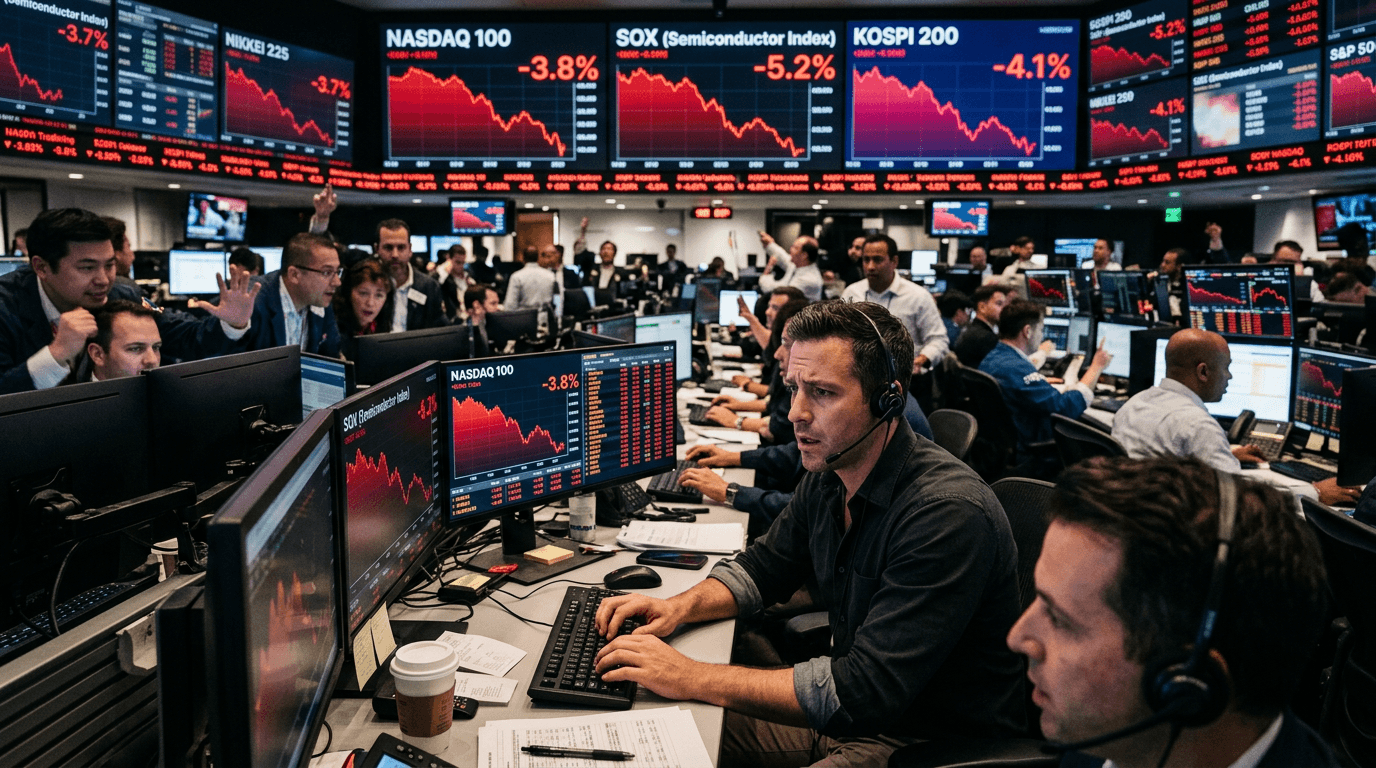
Equity index futures are under pressure as the high-flying AI and semiconductor trade finally hits turbulence, sending ripples across U.S. and Asian markets. A more than 10% plunge in the Philadelphia Semiconductor Index has shaken confidence in one of the most crowded themes of the cycle, with Nasdaq and Kospi futures trading nervously and some Asian contracts down as much as 6–8%. The message from futures pricing is clear: investors are actively de-risking, and volatility is back on the agenda.
What Just Happened In Equity Index Futures
The latest leg of selling started in the global technology complex, particularly in AI-linked semiconductors and infrastructure stocks. Chip and AI infrastructure names have already been under pressure in recent sessions, with several high-profile U.S. stocks in storage, memory, and crypto-related tech dropping 5–6% in a single day.[1] That weakness has now broadened from individual names into the major chip indices and futures markets.
A sharp drop of more than 10% in the Philadelphia Semiconductor Index has triggered mechanical and discretionary de-risking across equity index futures. Nasdaq 100 futures, which are heavily weighted toward mega-cap tech and AI beneficiaries, have led U.S. declines, falling more than broader benchmarks as investors reassess lofty growth and valuation assumptions in the AI trade.[3]
The shock has not stayed contained to the U.S. Asian futures, particularly contracts linked to tech-heavy markets such as Korea’s Kospi, have seen outsized moves, with some down 6–8%. That scale of decline in futures indicates more than just profit-taking—large players are using index futures to cut risk quickly and cheaply ahead of the cash sessions, signaling elevated volatility and uncertainty in the near term.
Why Ai And Semiconductors Now Drive Global Indices
The intensity of the move reflects how central AI and chips have become to global equity benchmarks. Semiconductors sit at the core of the AI value chain, powering everything from cloud data centers to edge devices. Earnings from major chipmakers—especially those leveraged to AI accelerators and networking—now routinely move entire indices when they surprise or disappoint.[3]
Recently, when a leading AI chip supplier delivered results that failed to match sky-high market expectations, semiconductor and AI infrastructure stocks sold off sharply and pulled Nasdaq futures lower even as Dow futures stayed modestly positive.[3] Similar dynamics have played out around AI-related disruptions in software and services, where fears over new automation tools have triggered a global rout in stocks seen as vulnerable to disintermediation.[2]
Valuation is the other key piece of the story. Many leading semiconductor and AI beneficiaries have rallied hundreds of percent in a short period, leaving them trading at well above their historical forward price-to-earnings multiples.[4] When growth expectations are “priced for perfection,” any hint of slower demand, capacity bottlenecks, or pricing pressure can spark an outsized reaction. The current futures wobble is in part a repricing of this optimism, as investors test how robust the AI narrative really is under stress.
How Futures Transmit Shocks Across Regions
Index futures are the market’s preferred instrument for expressing fast views on macro and thematic risk. They trade nearly around the clock, provide leverage, and are deeply liquid in major contracts such as S&P 500, Nasdaq 100, Euro Stoxx 50, Nikkei, and Kospi. That makes them the first place large investors turn when sector-specific shocks, like an AI-led tech slump, need to be translated into index-level risk management.
When the semiconductor index drops double digits, systematic strategies—like volatility targeting or risk-parity funds—often respond by cutting exposure using index futures rather than selling hundreds of individual stocks. Dealers and market makers hedging options positions may do the same. This creates a feedback loop: sector stress leads to index hedging, which pushes futures lower, which then signals to global investors that risk aversion is rising.
Time zones amplify the effect. A tech-led selloff in the U.S. cash session quickly shows up in Asian and European overnight futures, even before those markets open. That is why, for example, Asian futures can trade 6–8% lower while the local equity markets are still closed: global participants are marking down risk in advance, using futures as the transmission channel. By the time the cash market opens, much of the repricing has already occurred in derivatives.
This interlinked futures ecosystem also explains why some regions can be relatively insulated. In earlier episodes, European indices have held up even as U.S. tech slumped, particularly when sector composition favored energy, financials, or cyclicals over growth and AI.[1] Today’s reaction is more global precisely because AI and semiconductors have become core holdings across geographies, from U.S. mega-cap tech to Asian foundries and memory makers.
How Traders Can Navigate An Ai-led Selling Wave
For both real-money and simulated traders, an AI-led futures wobble is less a surprise and more a stress test: can your process handle sharp but potentially temporary drawdowns in crowded themes?
One starting point is separating narrative from numbers. The long-term case for AI adoption—across cloud, enterprise software, industrial automation, and beyond—remains powerful, but the pricing of AI winners can deviate significantly from underlying fundamentals. Valuation metrics, earnings revisions, and capacity build-out data matter more than headlines when volatility spikes. Recent commentary has highlighted how several leading semiconductor names now trade at 60–70 times forward earnings, far above their five-year averages.[4]
Risk management should adjust to higher volatility. Wider intraday swings in index futures change the dynamics of leverage, margin, and position sizing. Traders using simulated markets can practice:
- Reducing gross exposure when volatility regimes shift higher.
- Hedging concentrated tech exposure with broader index futures.
- Using options or volatility indices to define maximum downside rather than relying solely on stop-losses, which can be vulnerable to gaps.
Another practical tactic is time-frame diversification. Short-term traders may choose to focus on intraday mean reversion opportunities—such as oversold bounces in futures after panic spikes—while longer-term investors reassess whether their AI and semiconductor holdings still fit their risk and return targets after the repricing.
Key Lessons For Index And Simulated Traders
Periods like this are valuable classrooms for anyone learning to trade via SimFi platforms, where capital is virtual but the market dynamics are very real. A few key lessons stand out.
First, theme concentration cuts both ways. The same AI and chip exposure that drove outsized gains when the trade was in favor can magnify drawdowns when sentiment turns. Index futures may feel “diversified,” but benchmarks like the Nasdaq 100 are heavily skewed toward a small set of mega-cap AI beneficiaries.
Second, futures lead, cash follows. Watching overnight futures across regions provides early signals of how risk is migrating. A synchronized drop in U.S., European, and Asian tech-linked futures is a sign that the de-risking is systematic, not just local. For simulated traders, building the habit of checking cross-market futures before designing daily strategies can significantly improve situational awareness.
Third, volatility is an opportunity as well as a risk. Elevated implied volatility, as seen in indices such as the Nikkei Volatility Index during tech selloffs, reflects demand for protection and uncertainty about the path forward.[1] For advanced traders, this can open the door to volatility-selling strategies with defined risk parameters; for newer traders, it is a reminder to respect leverage and position size.
Finally, every AI-led correction invites the same core question: is this the end of the theme, or a reset within a longer structural trend? There is rarely a simple answer in real time. But traders who frame scenarios, stress-test their portfolios, and use index futures thoughtfully—as tools for risk management rather than blunt speculation—are best positioned to navigate the next chapter of the AI story, whichever way it breaks.