
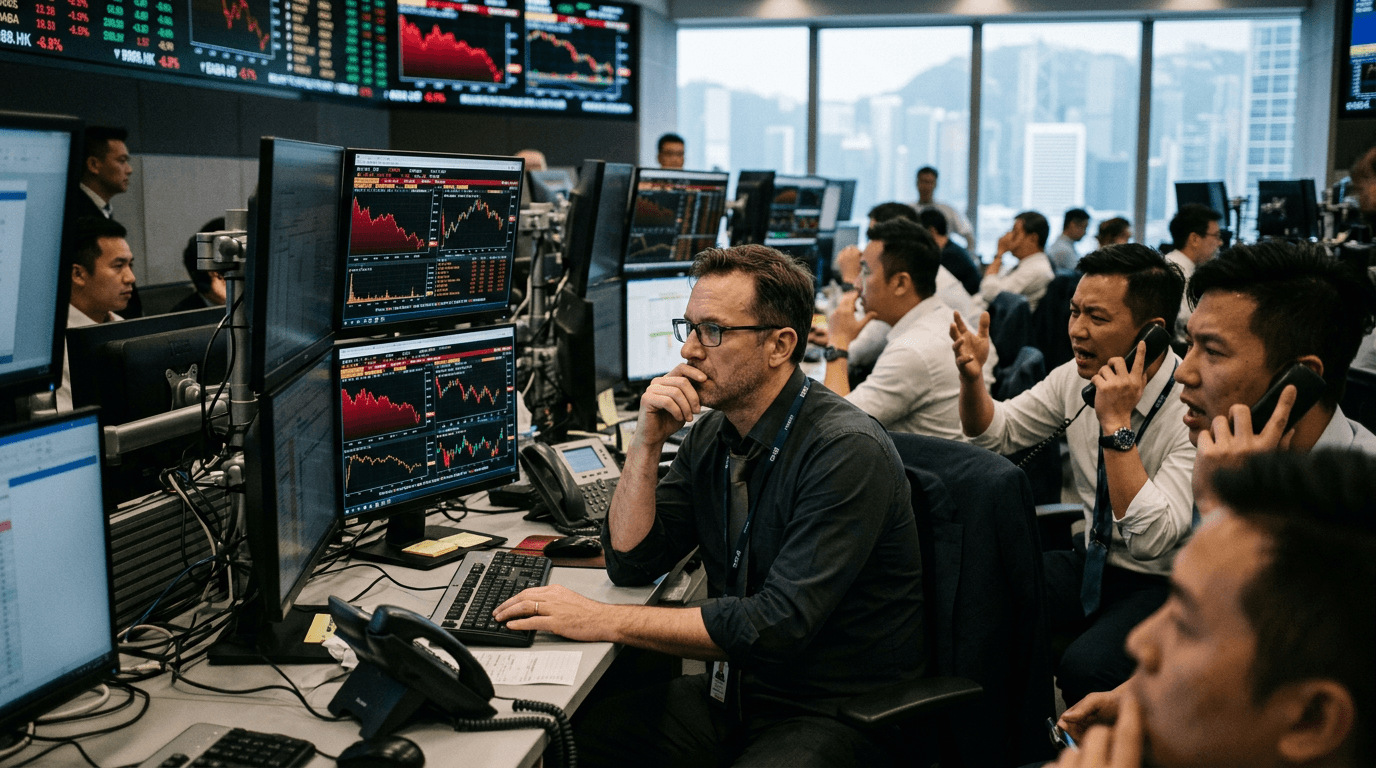
Alibaba’s latest move to raise more than $10 billion for artificial intelligence has triggered an immediate backlash in its share price, underscoring how sensitive markets have become to dilution and execution risk in big-tech AI spending. Hong Kong-listed shares of the Chinese e-commerce and cloud giant fell roughly 8–10% after it launched an HK$80 billion (about $10.2 billion) share placement, dragging broader Hong Kong and China indices into risk-off territory.[5][10][12][14]
What Happened In The Alibaba Share Sale
Alibaba is issuing 710 million new ordinary shares in Hong Kong, raising about HK$80 billion, or approximately $10.2 billion, in one of the largest follow-on offerings the market has seen.[2][3][4][15] The shares are being placed with investors outside the U.S. at HK$112.70 each.[2][3][5][11] That price represents a steep discount of around 8–8.4% to the previous close near HK$123, a gap that immediately set the tone for a weaker open.[5][11][12][14]
In early trading after the announcement and pricing, Alibaba’s Hong Kong shares dropped around 8% and, at points, were down close to 10–11% intraday before stabilising closer to the placement discount.[5][6][8][10][12] The deal is expected to close around August 26, with reports indicating the new shares are subject to a lock-up period of roughly 90 days, limiting immediate resale but not removing overhang concerns.[12][15]
Crucially, Alibaba has said that 100% of the net proceeds will be directed toward building out its “full-stack” AI capabilities.[1][2][3][8][11][15] That includes investment in custom chips, high-performance computing infrastructure, data centres, and the development and deployment of large AI models and related applications.[2][4][8][10][15] Management has framed the raise as necessary to extend Alibaba’s global AI leadership and to stay competitive amid an intensifying race across Chinese and global tech giants.[11][13][15]
Why The Market Reacted Negatively
Despite the long-term growth narrative around AI, equity markets tend to react quickly and mechanically to dilution, especially when new shares are issued at a noticeable discount. By issuing 710 million new shares, Alibaba is effectively spreading its future earnings across a larger share base, which, all else equal, lowers earnings per share in the near term.[2][3][15] The 8%+ discount to the prior close signalled that large institutional investors were not willing to buy into the deal at market prices, reinforcing the negative short-term sentiment.[5][11][14]
Investors are also focused on execution risk: raising $10 billion is the easy part, but converting that capital into profitable AI products and services is far harder.[5][13][14] Commentary around the deal has highlighted concerns about whether such heavy AI spending will generate adequate returns, particularly in an environment of intense competition from other Chinese platforms and global leaders in cloud and AI infrastructure.[13][14] The backdrop of ongoing Sino‑U.S. technology tensions adds another layer of uncertainty, given potential constraints on access to advanced chips and global cloud customers.[14][13]
The size and timing of the deal matter for market psychology. Coming after a period of renewed interest in Chinese tech stocks, a record-sized share placement can feel like management “selling into strength,” prompting traders to lock in profits and rotate into less volatile names.[4][13][14] The result has been a broader risk-off move across Hong Kong and China equities, with indices and related futures under pressure as investors reassess both tech valuations and regional macro risk.[4][14]
Strategic Logic Behind The Ai Push
From a strategic standpoint, Alibaba’s decision is consistent with a global pattern: major platforms are racing to secure AI compute, data, and talent, treating AI infrastructure as the new “digital energy grid” for the next decade. The company has explicitly positioned the offering as a way to fund full-stack AI investments, spanning chips, infrastructure, and models, rather than isolated software projects.[1][2][3][8][15] This suggests a commitment to controlling key layers of the AI value chain, from silicon to services.
Alibaba already operates a major cloud computing business and has been rolling out its own large language models and AI services for enterprise and consumer clients.[2][4][10][13] Scaling those efforts requires significant capital to build and upgrade data centres, GPUs and accelerators, networking, and storage—areas where global leaders have been spending tens of billions of dollars annually.[4][8][13] By ring‑fencing all proceeds for AI, Alibaba is signalling to the market that AI will sit at the core of its growth strategy, not at the periphery.[1][11][15]
However, unlike pure software investments, AI infrastructure is intensely capital‑heavy, with payoffs often arriving with a lag and subject to fast-moving regulatory and competitive dynamics. Analysts and investors are therefore trying to balance two narratives: AI as a long-term growth driver versus near-term pressure on margins and returns on invested capital.[5][13][14] The share price reaction indicates that, for now, markets are prioritising tangible dilution and execution risk over the more speculative upside.
What This Means For Traders And Investors
For traders, this episode is a textbook example of how large equity placements often create short-term volatility and downside pressure, even when the underlying strategic story is positive. A discounted placement price tends to act as a magnetic level in the near term: with the deal priced at HK$112.70, the stock has traded around that zone as markets digest the new supply.[5][8][11] Until the placement fully settles and the lock-up period runs its course, many participants will treat rallies as opportunities to de‑risk rather than to chase momentum.[12][15]
Event-driven and SimFi traders can use scenarios like this to practice trading around corporate actions: modelling dilution, identifying likely support and resistance zones, and testing strategies such as fade-the-rally, mean reversion to the placement price, or longer-term accumulation once the overhang clears. Because the deal is tied explicitly to AI, newsflow around Alibaba’s AI roadmap, partnerships, chip supply, and regulatory developments will likely act as catalysts for price swings over the next several quarters.[2][4][10][13][14]
Longer‑horizon investors face a different calculus. The key question is whether Alibaba’s incremental $10 billion in AI spend will generate returns above its cost of capital, given the competitive, regulatory, and geopolitical environment. That requires assessing not just the scale of its AI infrastructure, but also the monetisation pathways across e‑commerce, cloud, advertising, logistics, and enterprise software. The scale of the raise shows management’s conviction that AI is central to that multi‑vertical strategy.[1][2][11][15]
Practical Takeaways
1) Large discounted placements often mean near-term weakness, even when the strategic rationale is compelling, as dilution and new supply weigh on sentiment.[5][11][14] 2) When a company earmarks all proceeds for a single theme—here, full-stack AI infrastructure and models—the stock becomes more tightly linked to that theme’s narrative, both upside and downside.[1][2][8][15] 3) Macro and geopolitical context matters: China tech’s AI push is unfolding under U.S.–China tech tensions, increasing uncertainty around chips, export restrictions, and cross-border demand.[13][14] 4) For SimFi participants, Alibaba’s move is a useful case study in trading around corporate finance events, managing gap risk on open, and integrating thematic views (AI) with technical levels (placement price, prior support).
Conclusion: Short-term Pain, Long-term Question
Alibaba’s multibillion‑dollar share placement highlights the new reality of the AI race: leadership in the next phase of digital commerce and cloud computing will likely belong to firms willing and able to invest aggressively in infrastructure and models. By raising about $10.2 billion and dedicating all of it to AI, Alibaba has placed a very clear long-term bet on where its future growth will come from.[2][4][11][15] The market’s immediate reaction—a sharp share price slump driven by dilution fears, valuation questions, and broader risk-off sentiment—shows how costly that bet appears in the short run.[5][10][12][14]
For active traders, the episode offers opportunities around volatility, technical levels, and shifting sentiment. For longer-term investors, it poses a tougher question: is this a temporary dislocation that creates entry points into a scaled AI and cloud leader, or an early warning that the returns on megascale AI capex may disappoint? The answer will depend less on this week’s sell-off and more on whether Alibaba can translate its new AI war chest into defensible products, sticky cloud customers, and durable cash flows over the next investment cycle.[2][3][4][13][15]