
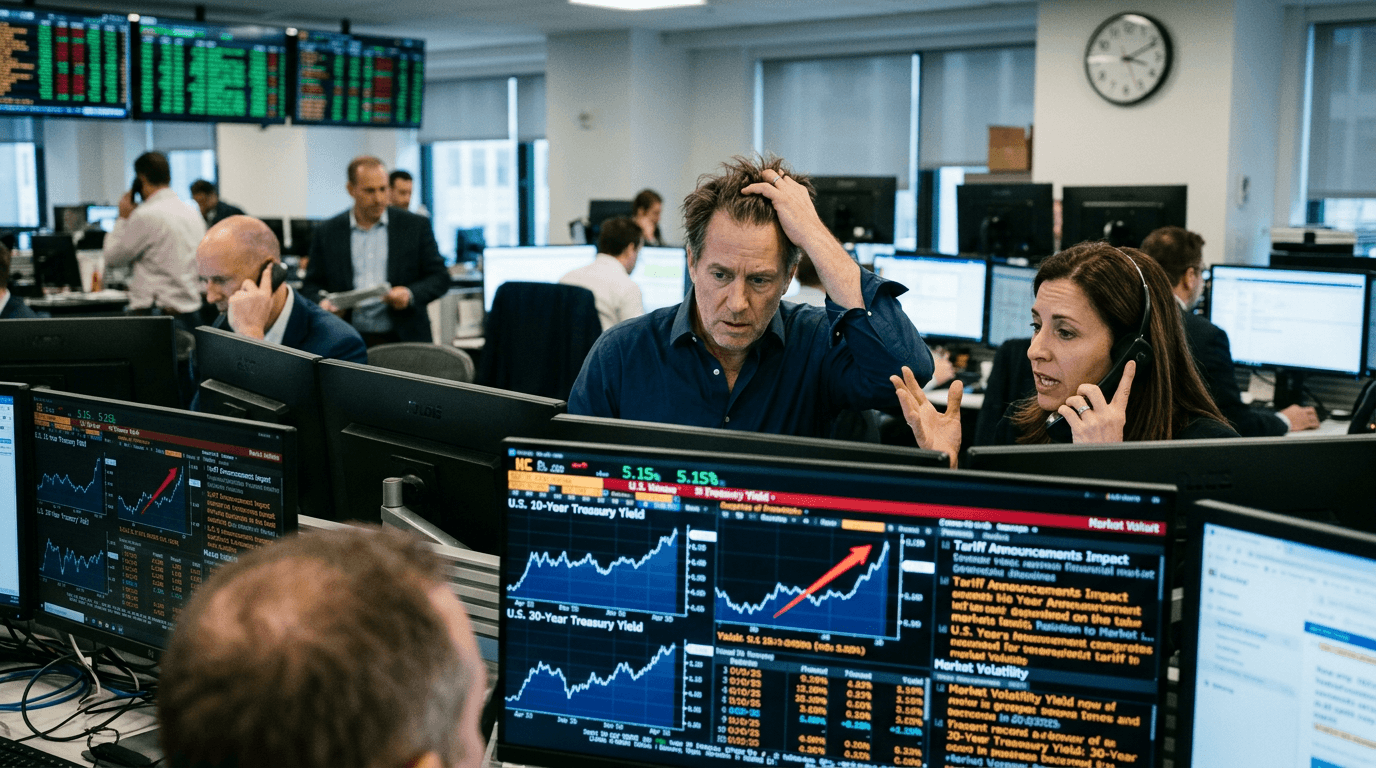
The Unforeseen Tariff Shock
April 2, 2025—deemed "Liberation Day" by investors—marked the unveiling of sweeping tariffs by the U.S. government, the most significant in a century. The repercussions were swift and severe, with the S&P 500 plummeting over 11 percent in the month’s first week. While equities seized headlines with their volatility, the real story lay in the Treasury market's unraveling, which signaled a deeper systemic stress.
Treasury securities, long celebrated for their depth and liquidity, suddenly became volatile, with large trades causing significant price shifts. Bid-ask spreads widened post-announcement, and order book depth fell to levels last seen in March 2023. Metrics that measure trade impact on market prices spiked, leaving institutional investors, accustomed to trading large volumes effortlessly, facing a new reality.
Liquidity Under Siege
The liquidity crisis in the Treasury market followed a familiar pattern: as uncertainty surged, risk-averse market makers retreated. They expanded bid-ask spreads and reduced order book depth, attempting to manage their risk exposure. Individually logical, these actions collectively strained the market, transforming it from a fluid environment into a challenging terrain.
The quantity of securities available at optimal bid and offer prices dwindled to its lowest in over two years, creating scarcity. The price impact per $100 million in net order flow—a critical measure of trade-induced price movement—rose sharply on April 2. This wasn't a minor hiccup; it represented a significant breakdown in the world's most vital financial market.
Volatility, as reflected in Treasury yields, soared. The 10-year Treasury yield, stable at March’s end, oscillated wildly in April, between 3.99 percent and 4.49 percent. Long-term rates spiked higher, with 30-year yields hitting 5.2 percent in late May—their highest since the 2008 financial crisis. These fluctuations were more than figures; they had tangible effects on borrowing costs, pension valuations, and the pricing of myriad financial products tied to Treasury yields.
A Hedge No More
Remarkably, during this turmoil, long-term Treasury securities faltered as a hedge against stock market volatility. On key dates in April—coinciding with tariff announcements—Treasury returns moved in tandem with stocks, exhibiting positive covariance. This rare occurrence, ranking in the top 0.25 percent of trading days since 2005, highlighted a critical breakdown. The resultant $47 billion outflow from long-term Treasuries in April 2025 marked a significant deviation from the usual monthly inflow, underscoring a shift in investor behavior under economic uncertainty.
Recovery and Lessons Learned
Once the White House announced a tariff delay, market conditions gradually stabilized. By late summer 2025, liquidity metrics, including bid-ask spreads and order book depth, had rebounded to pre-2022 levels or better. The Bloomberg U.S. Aggregate Bond index, reflecting this recovery, posted a 0.4 percent gain in April and was up 3.2 percent year-to-date by month’s end.
For traders and investors, the events of April 2025 underscored the need for vigilance and adaptability in even the most liquid markets. Treasury liquidity, robust under typical conditions, can swiftly erode amid policy uncertainties, challenging the presumed safety of these assets. The month demonstrated that diversification benefits can falter when most needed and that yields can deviate significantly from historical norms under systemic stress.
The Treasury market's rebound offered a reprieve, but the lessons of April 2025 persist: in a landscape marked by shifting trade policies and geopolitical tensions, comprehending the fragilities of supposedly risk-free markets is crucial for navigating ongoing volatility.