
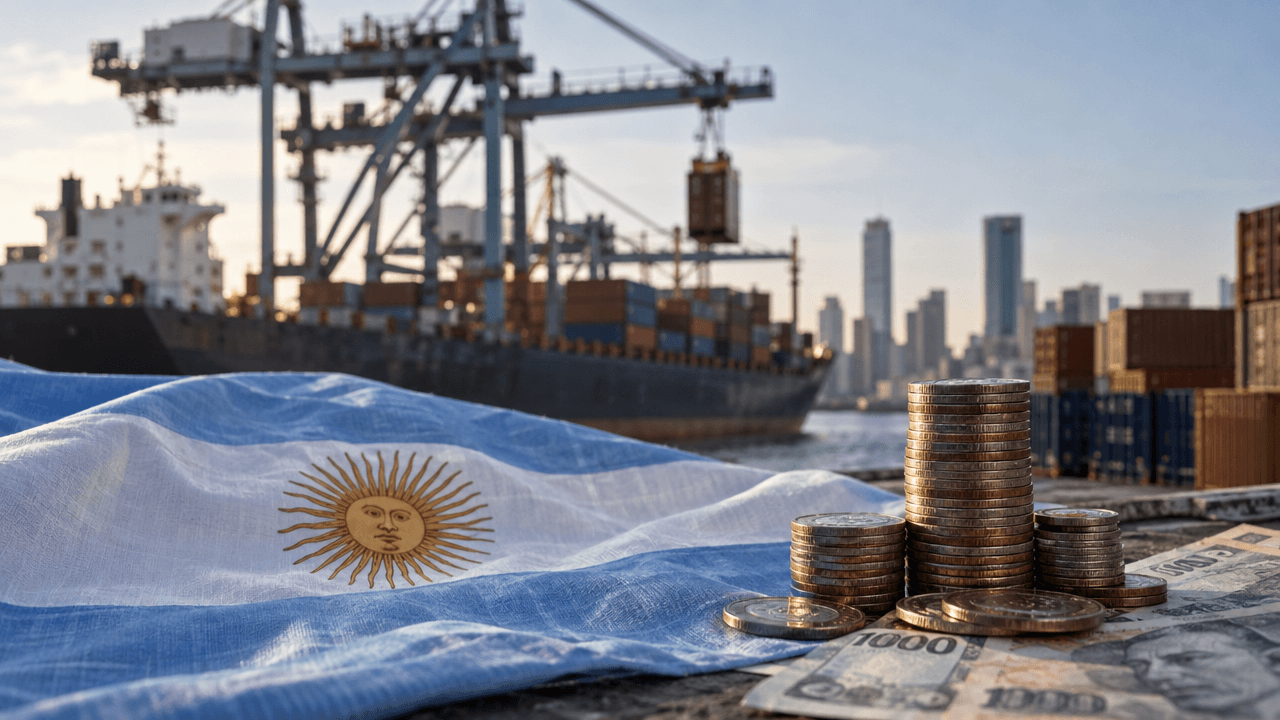
Argentina’s August trade data delivered a quietly powerful macro signal: a wider surplus of about US$2.19 billion, roughly US$746 million larger than a year earlier, strengthening the country’s external position and giving the peso some fundamental backing.[1][2] For emerging-market traders, this is the kind of headline that can nudge sentiment, repricing risk and opportunities at the margin.[2]
Trade Surplus: Why This Headline Matters
A trade surplus means Argentina exported more goods and services than it imported in August, generating net foreign currency inflows.[1] In this case, exports totaled around US$8.88 billion, up more than 12% year on year, while imports remained relatively subdued.[1][2] That combination—rising exports and contained imports—is what allowed the surplus to widen versus August 2025.[1][2]
Over a longer horizon, Argentina has been steadily rebuilding its external balance. In the first seven months of 2026, exports reached roughly US$58.4 billion, with imports near US$42.3 billion, creating a cumulative trade surplus of about US$16.1 billion, far above the US$3.7 billion level a year earlier.[3][4][13] Earlier data also showed that the January–May surplus of US$11.7 billion had already exceeded the full-year surplus for 2025, underlining the scale of the turnaround.[6] This context makes the August reading more than just a one-off; it is part of a broader improvement in Argentina’s external accounts.[3][4][6][13]
For traders and portfolio managers, a widening surplus can signal reduced external vulnerability, improving the country’s capacity to accumulate reserves and meet foreign-currency obligations.[1][3] That, in turn, feeds directly into sovereign risk pricing and cross-asset valuations.
WHAT IS DRIVING ARGENTINA’S SURPLUS?
Several structural and cyclical forces sit behind the strong trade numbers. On the export side, Argentina has benefited from a mix of record agricultural shipments and rapidly growing energy exports, particularly from the Vaca Muerta shale basin.[4][5][6] Vaca Muerta oil and gas have increasingly turned into an “export machine,” helping push the trade surplus to US$11.7 billion in the first five months of 2026 and US$16.08 billion by July.[4][6][13]
At the same time, import growth has been restrained by domestic demand dynamics and past currency weakness, which often make foreign goods relatively expensive.[3][5] Policy efforts to reduce central-bank financing of the treasury and to rebuild reserves have also encouraged a more cautious stance on imports, reinforcing the surplus.[5]
From a macro perspective, this composition matters. Surpluses driven by sustainable export growth—rather than deep import compression—are seen as more positive and durable. Argentina’s recent pattern leans more toward export-led improvement, especially in energy and agriculture, which markets tend to reward with narrower spreads and more constructive FX expectations.[4][5][6]
Implications For The Peso And Emerging-market Sentiment
A stronger trade balance typically supports the domestic currency by improving the supply of dollars and easing pressure on FX markets.[1][3] For Argentina, an August surplus of US$2.19 billion means the central bank and private sector have more foreign currency to work with, potentially reducing volatility in the peso over time.[1][2] While the peso’s path still depends on policy credibility and capital flows, better trade data is a positive anchor.
The impact extends beyond Argentina. Emerging-market investors constantly reassess relative macro strength: a large, improving surplus in one EM name can make it look more resilient compared with peers exposed to external deficits.[1][3] In a risk-on environment, that resilience may translate into inflows to local bonds, equities, and FX; in risk-off episodes, it can help cushion the downside.
For SimFi participants, this is a textbook example of how a single data point can shift FX and EM credit narratives. A trader running a simulated Argentine peso strategy might see the August surplus as a reason to reduce short-ARS exposure or to explore carry trades under the assumption of more stable FX dynamics—while still hedging for policy and political risk.
Macro Backdrop: Inflation, Tax Revenue And Growth Signals
To understand the full macro impact, traders need to place the trade surplus alongside other August indicators. Inflation slowed to about 1.7% month on month in August, the lowest reading in roughly 14 months, with annual inflation near 33.5% and year-to-date price increases around 21.3%.[7][8][9][11][12][14][15] Core inflation tracked slightly above the headline at 1.8%, signaling underlying price pressures remain but are easing.[9][14][15] Forecasts now see 2026 inflation around 29%, with modest disinflation expected to continue.[14]
Tax revenue also rose 33.5% year on year in August, reaching roughly 20.5 trillion pesos, but was essentially flat in real terms once inflation is taken into account.[10] In dollar terms, that revenue was about US$13.56 billion at the prevailing wholesale FX rate.[10] Real stability in tax intake suggests fiscal capacity is not deteriorating, even if it is not yet a strong driver of growth.[10]
Taken together, falling inflation, stable real revenues, and a widening trade surplus sketch a macro environment that is slowly improving but still fragile.[1][3][7][9][10][12][15] For markets, that mix can justify a gradual compression in risk premiums rather than a sharp re-rating, keeping sensitivity to global conditions high.
Practical Takeaways For Simulated Traders
For traders using a SimFi platform like E8 Markets, Argentina’s August trade surplus offers several practical lessons:
1. Watch the balance of trade as a leading indicator for FX and sovereign spreads. A sustained surplus often precedes currency stabilization and tighter credit spreads.[1][3][6]
2. Combine data points. The trade surplus has more signal when viewed alongside inflation, tax revenues, and growth indicators, not in isolation.[7][9][10][12][15]
3. Build scenarios. In simulations, test how Argentine assets perform under different external accounts trajectories—one with continued surpluses driven by Vaca Muerta exports, and another where exports falter and the surplus shrinks.[4][5][6][13]
4. Consider cross-market implications. Stronger external balances may benefit local bonds and FX first, but equity sectors linked to exports (energy, agriculture) can also see improved sentiment.[4][5][6]
5. Focus on risk management. Even with better macro data, Argentina remains a high-beta EM name. Simulated strategies should incorporate volatility controls, stop-loss rules, and position sizing that reflect both upside potential and downside risks.
Conclusion
Argentina’s wider August trade surplus is more than a line item in a data release; it is a tangible sign of an ongoing external rebalancing, supported by robust exports and cautious imports.[1][3][4][6][13] In combination with moderating inflation and stable real tax revenues, it paints a picture of a macro environment that is gradually becoming more investor-friendly, though not yet free of vulnerabilities.[7][9][10][12][15] For real and simulated traders alike, the key is to treat this headline as a signal to revisit assumptions about Argentina’s risk profile, FX dynamics, and relative attractiveness within the emerging-market universe—and to incorporate those insights into disciplined, data-driven trading strategies.