
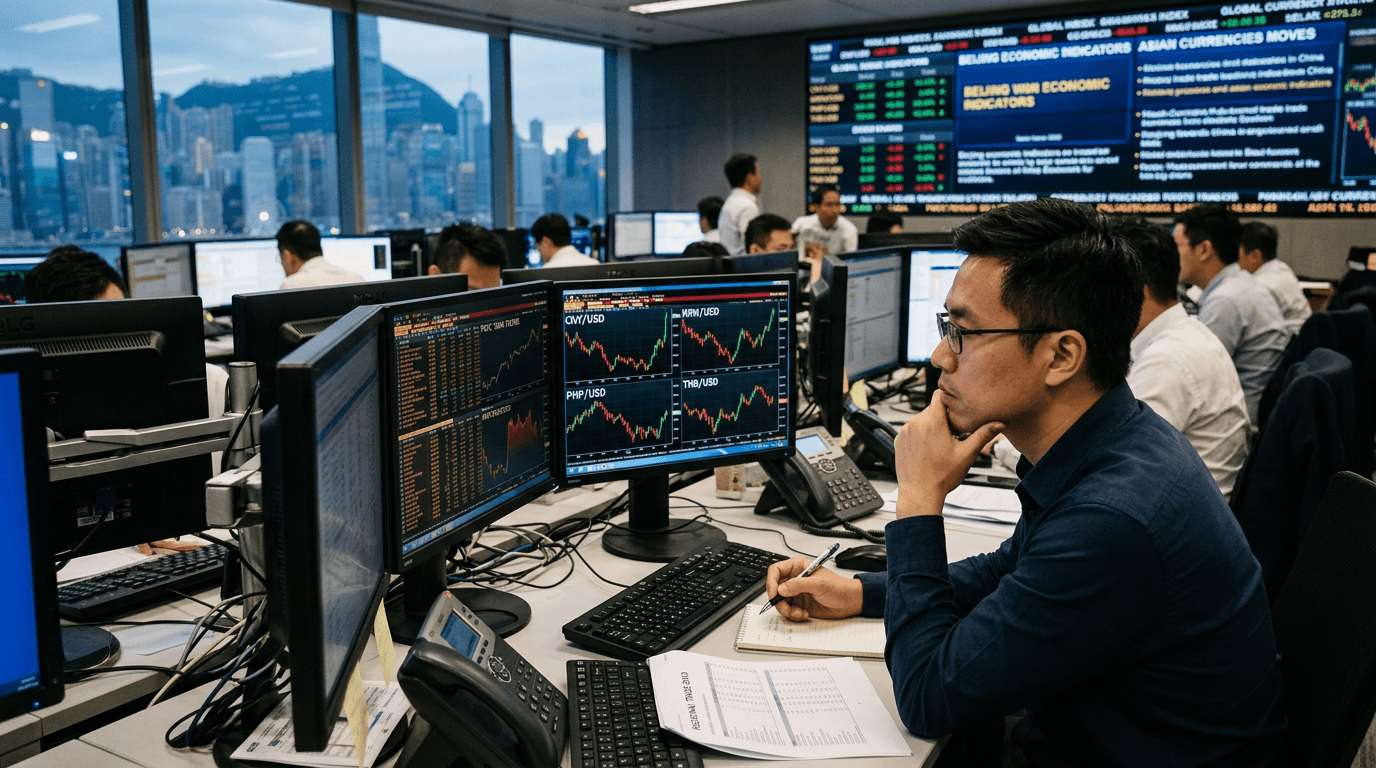
Asia’s currency market is back in the spotlight as traders parse every signal out of Beijing and every data point on regional trade to gauge where the next wave of FX volatility will emerge. For anyone trading simulated or real markets, understanding how China’s policy stance feeds into moves in the yuan, won, peso, and baht is increasingly essential, not optional.
Why China Policy Matters For Asia Fx
China is the largest trading partner for most economies in Asia, which means changes in its growth outlook, policy stance, or currency management quickly spill over into regional FX. When Chinese demand for imports is strong, export-focused economies in North and Southeast Asia often see stronger growth and, in turn, firmer currencies as trade and capital inflows improve.
China’s central bank has repeatedly signaled a commitment to keeping the yuan “basically stable” while maintaining a moderately loose monetary policy and using incremental tools to support domestic demand.[2][9][15] That combination tends to anchor expectations: traders assume China will tolerate some FX flexibility but will resist disorderly moves. A stable or firm yuan often acts as a north star for regional FX, especially in North Asia, where currencies like the Korean won tend to track broader shifts in China-sensitive risk sentiment.[14]
For traders, the key takeaway is that China policy is not just “China risk” anymore. It has become a macro factor that shapes global dollar demand, EM FX performance, and even broader risk-on versus risk-off positioning across asset classes.
Key Signals In The Yuan To Watch
The first and most widely watched signal is the People’s Bank of China (PBOC) daily USD/CNY midpoint fix. This reference rate, set each morning, tells the market whether authorities are comfortable with current levels or trying to lean against the grain of market pricing.[4] A fix that is consistently stronger than market estimates suggests the PBOC wants to curb depreciation; a weaker-than-expected series of fixes can hint at tolerance for a softer currency or discomfort with rapid gains.[1][11]
Recent communication from the PBOC and policy documents reinforce this balancing act. In its latest multi-year plan and recent meetings, the central bank has pledged to keep the exchange rate basically stable, expand the yuan’s international use, and maintain appropriately loose policy while fine-tuning tools as needed.[2][9][15] That blend of stability and flexibility is central to how traders frame their yuan scenarios.
Spot levels provide additional context. USD/CNY hovered around the mid-6.7s in mid-August 2026, with only modest day-to-day moves, reflecting a managed but not rigid regime.[8] Meanwhile, political and policy milestones like Politburo meetings and the Central Economic Work Conference (CEWC) are crucial macro signposts. Dovish signals around stronger stimulus and support for growth have already nudged the yuan stronger at times as markets priced in better domestic momentum and improved regional spillovers.[3][12]
For SimFi traders, that translates into a simple playbook: track the fix versus expectations, monitor key policy meetings and their language on growth and FX, and combine them with price action in USD/CNY and USD/CNH to infer whether authorities are leaning toward stability, controlled strength, or limited weakness.
How Regional Currencies React: Won, Peso, And Baht
Beyond the yuan, Asia FX is a web of correlations and common drivers. The Korean won is highly cyclical, tied closely to global tech, semiconductors, and China-linked exports. When China’s PMIs and regional trade data hint at stronger external demand, research often points to improved prospects for North Asian currencies as export volumes and corporate earnings outlooks brighten.[3] In a SimFi environment, that can be modeled as higher beta to positive China data surprises.
The Philippine peso and Thai baht tend to respond not just to trade but also to tourism flows, remittances, and local rate expectations. However, they still react to shifts in China policy and global risk appetite. Periods of cautious sentiment around US–China trade talks or tariff headlines have historically left Asia FX subdued, as investors pare back risk exposure until there is clarity.[7][10] When uncertainty around trade is high, high-beta EM Asia FX often underperforms, especially where current account positions are weaker or domestic political risks are elevated.
Regional data also matters. Trade numbers from Korea, Taiwan, and ASEAN exporters, alongside surveys on external demand, frequently feature in Asia FX commentary as forward-looking clues to whether the regional cycle is improving or stalling.[3][13] Stronger trade prints can support the won and baht, while softer numbers may weigh on them, especially if they reinforce concerns about China’s growth trajectory.
In practice, traders often view the yuan as the anchor and currencies like the won, peso, and baht as satellites, each with its own domestic story but all orbiting around China-linked growth, policy, and trade dynamics.
Dollar Demand, Risk Sentiment, And The Broader Fx Picture
Because Asia sits at the crossroads of global trade and supply chains, Asia FX moves often act as a real-time barometer for global risk sentiment. A firm, stable yuan and improving regional trade data tend to reduce demand for the US dollar as a safe haven and support carry and risk trades across emerging-market FX.[1][3][14] Conversely, signs of growth stress or policy missteps in China can trigger a flight to safety, boosting the dollar and putting pressure on Asia FX.
This dynamic matters beyond the region. Large macro and systematic strategies often use baskets of Asia FX as part of their broader EM exposure. When models detect synchronous weakness in currencies like the yuan, won, peso, and baht, they frequently respond by cutting EM risk, which amplifies moves in the dollar index and risk assets globally.
For SimFi traders, this is an opportunity to practice multi-layered macro thinking: trade a specific currency view, but also consider how that view fits into the broader EM dollar cycle and cross-asset risk sentiment.
Building A Practical Playbook In Simulated Markets
Turning these themes into a trading framework starts with preparation. First, build a calendar of key China events: PBOC decision windows, important data like PMIs and trade, and major political gatherings such as Politburo meetings and the CEWC.[3][12] Around these dates, expect higher volatility in the yuan and spillovers into Asia FX.
Second, track the daily USD/CNY fix and compare it to consensus estimates or model-based expectations. In a SimFi setup, you can create hypothetical scenarios where the fix comes in consistently stronger or weaker than expected and simulate how that path affects USD/CNY, USD/KRW, USD/THB, and USD/PHP over a multi-week horizon.[1][4][11]
Third, integrate trade and growth signals. Use scenarios where China’s trade data and regional export numbers either surprise to the upside or disappoint. For each scenario, outline how that would impact the relative performance of the won (export and tech lever), baht (tourism and regional flows), and peso (remittances, domestic demand, and external balances).[3][13]
Finally, layer in risk management. Simulated trading allows for testing position sizing, stop-loss placement, and correlation risk when holding multiple Asia FX exposures at once. For example, you might run a basket trade long Asia FX versus the dollar in a “strong China stimulus, stable yuan” scenario, and then stress-test what happens if policy communication turns more cautious or trade tensions re-escalate.
Conclusion
As Asia FX watches China policy and regional trade signals, the yuan remains the anchor that shapes how the won, peso, and baht trade around shifting growth and risk narratives. Policy commitments to a basically stable yuan, incremental easing, and expanded international use underscore the currency’s central role in the region’s FX ecosystem.[2][9][15] For traders, especially in a SimFi environment, the edge lies in connecting the dots: reading PBOC fixes, decoding policy language, tracking trade and growth data, and translating those signals into structured, risk-aware trading scenarios. Mastering that process turns headline noise into a disciplined macro strategy.