
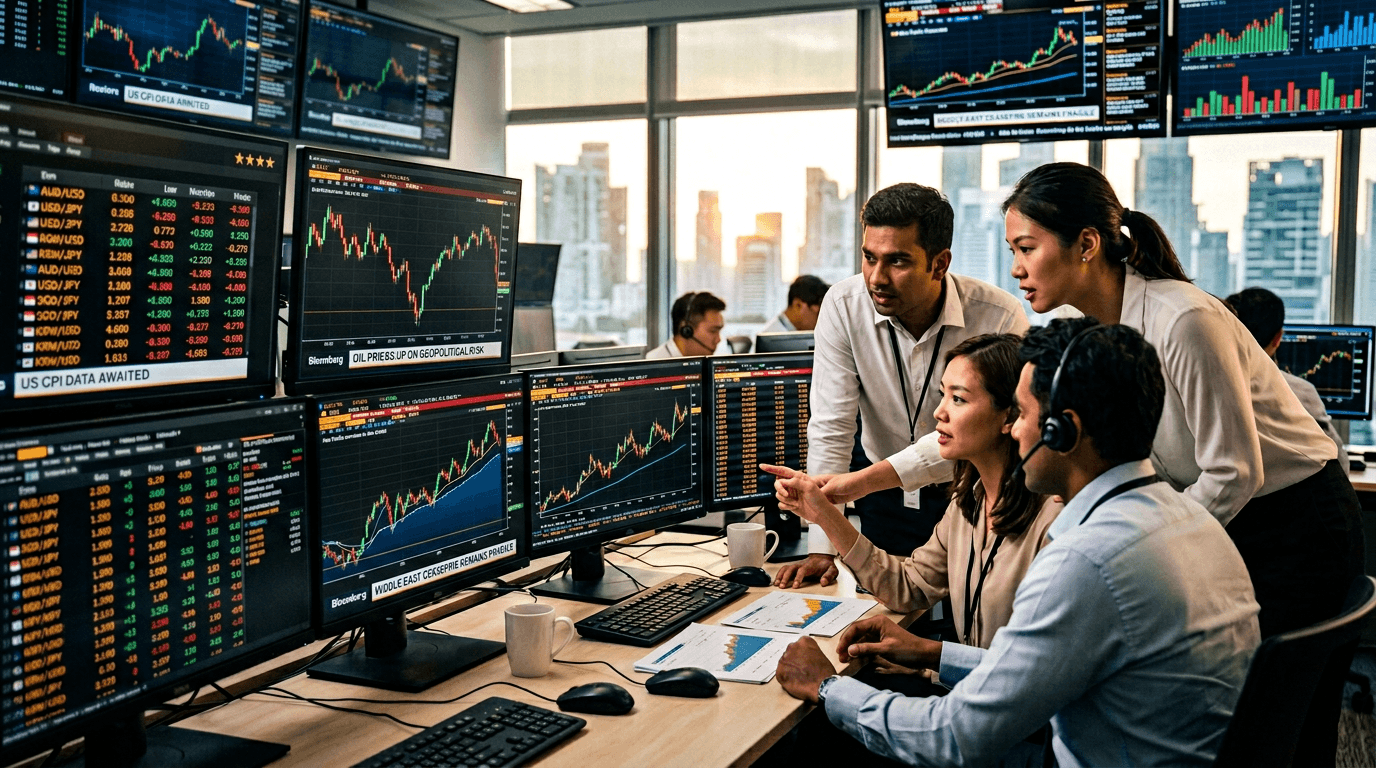
Asia’s currency markets are starting the week in a surprisingly calm mood, even as traders quietly position for what could be a volatile stretch of data and geopolitics. Major Asia‑Pacific currencies are holding in relatively tight ranges, reflecting a classic “wait‑and‑see” stance as participants weigh a softer U.S. dollar, firmer oil prices, and a fragile ceasefire in Iran. Similar periods of muted price action ahead of big events have been a recurring feature of the region’s FX landscape in recent years.[2][3][4][6]
Market Snapshot: Asia Fx In A Holding Pattern
When traders talk about Asia FX being “steady,” they generally mean that key pairs like USD/JPY, USD/CNY, USD/KRW, and USD/INR are moving within narrow intraday ranges, with limited directional conviction.[2][3] Liquidity is decent, but volume and volatility are subdued as many traders prefer to reduce risk rather than chase small moves.
This kind of backdrop often emerges when the U.S. dollar pauses after a run, while markets wait for clarity on interest rates and growth.[2][4][6] A modestly softer dollar can give Asia‑Pacific currencies some breathing room, but not enough to spark a full‑blown rally if investors are still wary of upcoming events. The result is a “holding pattern” where spot levels drift, but positioning and options pricing quietly adjust under the surface.
For regional equity and futures markets, steady FX can be supportive, especially for import‑dependent economies that benefit from reduced currency volatility.[3] However, it can also mask latent risk: if everyone is waiting for the same data or headline, any surprise can trigger a sharp, synchronized reaction across currencies, stocks, and rates.
Why The Data Calendar Matters For Currencies
A packed global data calendar is one of the main reasons Asia FX traders are sitting on their hands. In practice, this usually means a cluster of releases such as U.S. jobs reports, inflation prints, PMIs, and central bank minutes, plus key data from China, Japan, India, and ASEAN economies.[1][2][7] Each of these can shift expectations for growth, interest rates, and risk appetite.
Currencies trade on relative value. If U.S. data surprises on the upside while Asia’s numbers disappoint, the dollar tends to strengthen against regional FX, and vice versa. That’s why traders focus not just on the data itself, but on how it compares with consensus forecasts. A “beat” or “miss” relative to expectations often matters more than the headline number.
Ahead of heavy data weeks, many discretionary and systematic traders adapt by:
- Trimming leverage in directional FX positions
- Reducing exposure in carry trades that are sensitive to volatility
- Using options to hedge tail risk around specific data releases
Implied volatility in major Asia pairs often rises into big events, even when spot prices look calm.[2] For traders on simulated platforms, this provides a realistic backdrop to practice event‑driven strategies: planning trades around release times, testing reaction scenarios, and learning how quickly sentiment can flip when numbers deviate from expectations.
IRAN CEASEFIRE, OIL AND EMERGING‑MARKET FX
Layered on top of the data risk is a fragile ceasefire involving Iran and a tentative cooling in U.S.–Iran tensions. Geopolitical developments in the Middle East matter for Asian currencies primarily through two channels: energy prices and global risk sentiment.[4][6]
Oil is a key input here. A sustained rise in crude prices can hurt energy‑importing Asian economies by widening trade deficits, pressuring inflation, and squeezing corporate margins. Conversely, it can support energy exporters and related sectors. Recent episodes have shown that even modest moves in oil, when combined with geopolitical uncertainty, can nudge emerging‑market FX risk premia higher.[5]
In a fragile ceasefire scenario, markets may price in some relief but remain wary of re‑escalation. That keeps risk assets, including EM currencies and regional futures, on a short leash. Traders often respond by:
- Staying nimble in high‑beta FX (e.g., some ASEAN and South Asian currencies)
- Using indexes and futures to hedge broader regional exposure
- Watching correlations between oil, safe‑haven currencies like JPY, and EM FX
For Asia FX, a key question is whether the ceasefire leads to sustained de‑escalation or proves temporary. If headlines deteriorate, risk‑off flows can quickly strengthen USD and JPY while pressuring higher‑yielding and less liquid currencies across the region.[2][3][7]
Trading Strategies In A Steady But Risky Market
Markets that look quiet on the surface but are rich in event risk demand a different playbook from outright trending environments. Many experienced traders focus less on predicting direction and more on managing scenarios and volatility.
Several practical approaches stand out
- Range trading: With spot held in tight bands, short‑term traders may buy near support and sell near resistance, always with tight stops given the potential for event‑driven breakouts.[2][3]
- Event‑driven setups: Macro traders map out key data and geopolitical milestones, planning conditional trades that only trigger if specific thresholds are hit (for example, a large upside surprise in inflation or a significant breakdown in ceasefire talks).
- Options hedging: Buying FX options around known risk dates can cap downside while preserving upside. Implied volatility often rises around these windows, but that is the cost of protection in an uncertain environment.
For institutions, portfolio hedging via regional FX and equity futures can dampen the impact of a sudden risk‑off move linked to Iran or a data shock. For individuals, simulated finance platforms offer a way to rehearse these strategies under live market conditions without real capital at stake, refining execution and risk management before applying them in live trading.
Practical Takeaways For Simulated And Live Traders
Whether you trade live or in a simulated environment, a steady Asia FX tape with looming event risk is an ideal training ground. It reinforces several core lessons:
First, low spot volatility does not mean low risk. Tight ranges can quickly morph into sharp moves once the data hits or geopolitical headlines turn. Recognizing this gap between realized and potential volatility is critical for position sizing and leverage decisions.[2][3]
Second, preparation beats prediction. Mapping out the data calendar, identifying which releases matter most for each currency pair, and defining your response to upside and downside surprises puts you in control, even if the market outcome is uncertain. This applies equally to simulated portfolios and real ones.
Third, geopolitical risk is multi‑channel. In the case of Iran, the impact on Asia FX will likely flow through oil prices, global risk appetite, and safe‑haven demand, rather than direct trade links alone.[4][5][6] Understanding these transmission mechanisms helps traders move beyond headline reactions and focus on the underlying drivers.
Finally, calm markets are opportunities to build discipline. Practicing range trading, event‑driven strategies, and hedging in a simulation can make you more resilient when volatility eventually arrives. By the time the data prints or the ceasefire is tested, you want a well‑rehearsed plan rather than an improvised reaction.