
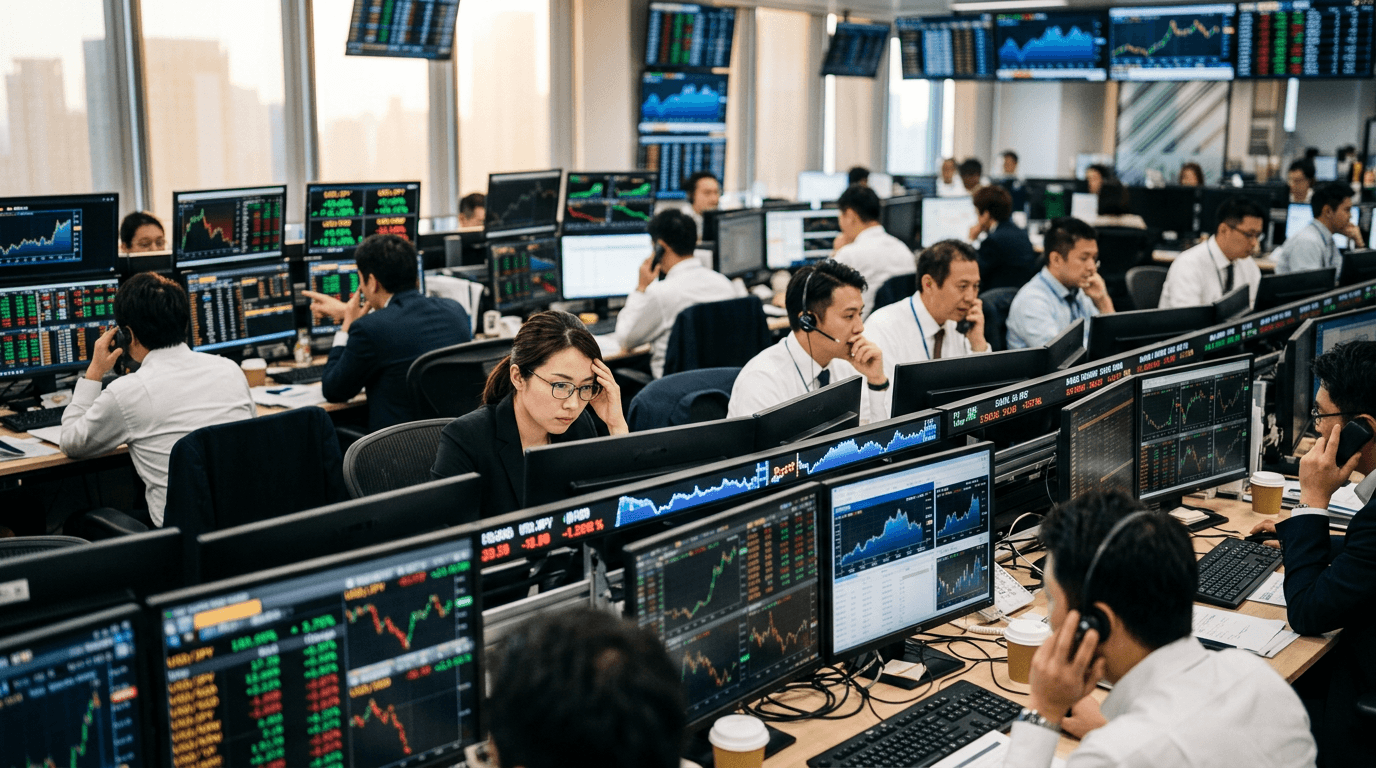
Asian foreign exchange markets opened the week in a cautious mood, with major regional currencies trading mixed against a softer U.S. dollar as traders recalibrated expectations for Federal Reserve rate cuts and weighed ongoing trade-policy uncertainty.[1] For Asia, where export competitiveness, external funding costs and carry trades are central to FX dynamics, this combination of a fragile dollar and fluid policy signals is creating both opportunities and new pockets of risk.
Global Backdrop: A Fragile Dollar And Changing Fed Expectations
The U.S. dollar has struggled to gain traction, hovering near multi-year lows after a modest rebound, as markets increasingly price in the prospect of Federal Reserve rate cuts later this year.[1] Futures-based tools show investors assigning a high probability to at least one 25-basis-point cut by September, reflecting a view that U.S. policy is likely too restrictive for an economy that is losing some momentum.[1]
This shift in expectations has been reinforced by high-profile commentary: major banks have floated scenarios involving multiple cuts starting as early as September, while some policymakers and officials have acknowledged that policy is moving closer to neutral rather than firmly restrictive.[1][2] Combined with softer U.S. data in areas like consumer activity and manufacturing, the narrative has pivoted from “how long will rates stay high” to “how quickly can they move lower without reigniting inflation.”
At the same time, uncertainty around U.S. fiscal and trade policy is capping any upside for the dollar.[1] Questions over the long-term implications of large tax and spending packages, alongside the possibility of renewed or adjusted tariffs, have injected an additional risk premium into dollar assets. That backdrop keeps investors cautious about holding large unhedged USD positions, especially when safer yields can be earned elsewhere.
Asia Fx Reaction: Winners, Losers And The Role Of Trade
Against this backdrop, Asian currencies have not moved in a straight line. Instead, price action has been distinctly mixed as local fundamentals, trade exposure and policy stances drive differentiation.
Export-heavy economies with strong external balances, such as some North Asian markets, tend to benefit from a softer dollar through improved terms of trade and more supportive risk sentiment. Where trade links to the U.S. and Europe remain robust, a weaker dollar can amplify competitiveness without forcing aggressive domestic policy moves.
By contrast, currencies in economies that are more sensitive to China’s growth cycle or to shifting global supply chains may lag if investors remain cautious about regional demand. Even with a softer USD, FX markets still reward countries with clearer growth trajectories and credible policy frameworks.
The classic “defensive” Asia currency, the Japanese yen, often fails to rally as much as models would suggest when global yields are still relatively high, because rate differentials remain deeply negative. Nonetheless, yen and other funding currencies can stabilize or strengthen on days when U.S. yields move lower on Fed-cut speculation.
For traders, this means Asia FX is no longer just a one-way play on the dollar. Instead, it is a relative-value landscape where the spread between, for example, a high-yielding Southeast Asian currency and a lower-yielding North Asian unit can move just as much as the broad dollar index.
Carry, Funding Costs And Why A Softer Dollar Matters
One of the most important implications of a fragile dollar for Asia is its impact on carry trades and external funding costs. Many Asian sovereigns, corporates and financial institutions borrow in dollars, even when their revenues are in local currencies. When the dollar is strong and U.S. rates are high, servicing that debt becomes more expensive, pressuring balance sheets and sometimes forcing abrupt FX adjustments.
A weaker or more stable dollar, especially when combined with expectations of lower U.S. rates, tends to:
1) Ease the burden of USD-denominated debt, improving credit conditions for emerging Asia. 2) Lower hedging costs for investors funding strategies in dollars and deploying capital into local-currency assets. 3) Support “carry trades,” where investors borrow in low-yield currencies and invest in higher-yielding Asian currencies to capture the interest-rate differential.
However, carry is never free money. If trade tensions flare or a policy surprise rattles markets, high-yielding currencies can sell off sharply, wiping out months of accumulated carry in days. The current environment of still-elevated global rates, uncertain inflation paths and fluid trade policy means carry strategies need tighter risk management than in past cycles.
Risks On The Horizon: Policy Surprises And Event Risk
Despite the near-term softness in the dollar, several risk factors could quickly alter the Asia FX landscape.
First, event risk remains elevated. Key U.S. data releases, such as inflation and labor-market reports, can rapidly reshape the Fed narrative, causing abrupt repricing in rates and FX markets. A series of stronger-than-expected prints could push back the expected timing of cuts, fueling a dollar rebound and challenging Asia FX.
Second, trade and industrial policy remain powerful swing factors. Any escalation in tariff rhetoric, new sector-specific restrictions or tensions around technology supply chains could disproportionately affect export-oriented Asian economies. Even if the dollar stays soft, risk-off flows in such scenarios can still drive regional currencies weaker.
Third, domestic politics and central-bank decisions within Asia matter. Some central banks may resist currency strength to support exports, while others may welcome appreciation to mitigate imported inflation. This policy divergence is one reason why Asia FX performance has been mixed rather than uniformly strong, even with a fragile dollar.[5]
For investors and traders, the practical takeaway is that Asia FX is increasingly an event-driven space. Monitoring central-bank communication, policy headlines and key data is no longer optional – it is central to managing directional and relative FX risk.
How Traders Can Navigate A Mixed Asia Fx Landscape
In this environment, a structured approach is essential.
First, anchor your FX views in rate differentials and expectations. Track how many cuts markets are pricing for the Fed versus major Asian central banks, and watch how those expectations shift with each data release. Changes in expected rate paths often drive FX moves more than actual decisions.
Second, focus on balance-sheet and external vulnerabilities. Economies with high levels of short-term external debt or large current-account deficits are more exposed if global funding conditions unexpectedly tighten. A softer dollar helps for now, but those vulnerabilities can resurface quickly.
Third, think in relative terms. Instead of only asking “Will Asia FX rise against the dollar?”, consider “Which Asian currencies are best positioned relative to their regional peers?” This mindset opens opportunities in cross-pairs, such as one Asian currency versus another, where idiosyncratic stories are often more important than the global dollar trend.
Finally, practice and stress-test your ideas. Simulated trading environments allow traders to explore how Asia FX might react under different Fed paths or trade scenarios without risking capital. Running scenario analysis around “faster cuts,” “no cuts,” or “new tariffs” can highlight where portfolios are most exposed and where hedges may be needed.
By combining macro awareness, country-level analysis and disciplined risk management, traders can turn today’s mixed Asia FX picture from a source of confusion into a map of opportunities – all against the backdrop of a dollar that, for now, remains fragile and highly sensitive to every shift in the policy conversation.