
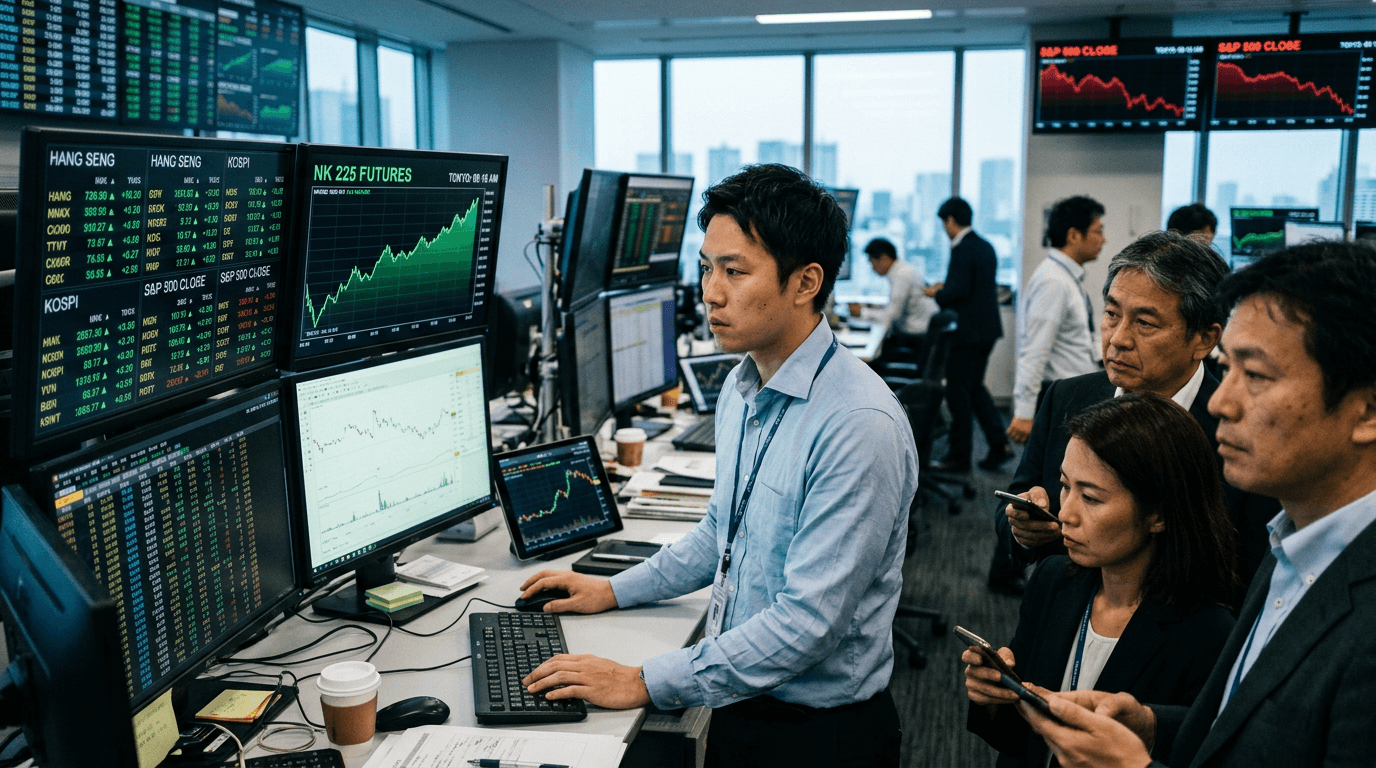
Asian equity markets have once again demonstrated their ability to decouple from Wall Street, opening higher even after a softer U.S. close and mixed risk signals from New York[6][14]. Local buyers are stepping in to support benchmarks and index futures, suggesting regional investors are increasingly comfortable taking their own view on growth, rates, and earnings rather than simply shadowing U.S. sentiment[6][14]. For traders, both live and simulated, this shift is an important reminder that global indices do not always move in lockstep.
ASIA’S RESILIENCE AGAINST WEAK U.S. LEADS
Recent sessions have seen Asian markets trade mixed-to-higher despite weaker U.S. leads, with indices in China and Japan holding gains even as Wall Street digested soft retail data and sector-specific pressure[6][14]. China’s benchmarks have rebounded following earlier growth concerns, helped by expectations of incremental support measures and selective policy easing[6]. Japan, meanwhile, has managed to preserve much of its recent rally despite a weaker-than-expected GDP print, underscoring faith in corporate earnings and ongoing monetary support[6]. Regional indices such as the Nikkei 225 and Hang Seng have continued to trade in positive territory, highlighting the region’s growing ability to absorb external shocks[14].
For traders, the takeaway is clear: Asia’s risk dynamics are increasingly driven by local fundamentals, from earnings cycles to domestic policy expectations, rather than simply following overnight moves in the S&P 500 or Nasdaq[6][14]. This opens opportunities in equity and index futures when U.S. sentiment is fragile but regional drivers remain supportive.
Local Buyers Step Into The Dip
A key feature of the recent price action has been the role of local investors in stabilising the market when global sentiment wobbles[6][11]. In several Asia-Pacific markets, domestic asset managers and retail traders have been active buyers on weakness, particularly in sectors tied to structural themes such as technology, infrastructure, and consumption[6][11]. This has softened the impact of foreign outflows that typically follow a risk-off lead from the U.S.
Episodes of weaker U.S. macro data, such as disappointing jobs or retail figures, have actually encouraged local buyers to step in, as softer data can reduce pressure on the Federal Reserve to push rates higher[5][11]. That, in turn, eases concerns about global funding costs and supports higher-risk assets across Asia[5][11]. For index futures traders, this pattern matters: it means that a negative U.S. close does not automatically translate into a sustained downside move in Asian contracts if domestic demand is waiting on the bid.
Practical takeaway: when simulating strategies, consider adding rules that distinguish between U.S.-driven risk-off events and Asia-specific flows. A purely reactive “follow Wall Street” strategy might miss the support provided by local buyers during Asian hours.
Index Futures As A Window Into Regional Sentiment
Index futures across major Asian markets have been signalling this resilience, with contracts on benchmarks such as the Nikkei, Hang Seng, and broader Asia-Pacific indices holding firm or retracing losses even when cash markets see early pressure[14]. These futures often price in both overnight news and expectations for the upcoming session, making them a useful tool for gauging intraday sentiment and positioning.
When weak U.S. leads meet strong domestic narratives—such as earnings beats, sector-specific policy support, or a favourable currency backdrop—index futures can turn higher before cash markets catch up[6][14]. That dynamic has been visible in recent trade, with futures stabilising early as local investors anticipated buying interest into the cash open[6][14]. For intraday traders, this reinforces the importance of watching futures curves, basis movements, and volume patterns, rather than relying solely on headlines.
In a simulated environment, traders can test how different signals—Wall Street closes, local macro data, and futures price action—interact. Strategies that integrate futures behaviour as a leading indicator of regional sentiment tend to capture turning points more effectively than those that rely on spot prices alone.
Cross-asset Drivers: Crypto, Energy, And Macro Data
The current bout of resilience is not happening in isolation. Improved crypto prices and firm energy markets are contributing to a broader risk-on tone, supporting appetite for equities and equity-linked derivatives across Asia. Higher crypto valuations often spill over into tech and fintech names, reinforcing flows into growth indices and related futures. At the same time, stable-to-firmer energy prices boost sentiment in commodity-linked markets and resource-heavy indices, particularly in Australia and parts of emerging Asia.
However, recent sessions also show that cross-asset support remains conditional on macro signals. Weak U.S. jobs data and softer economic surprises have helped temper rate-hike expectations, which in turn has supported Asia-Pacific equities and risk-sensitive assets[5][11]. Where inflation and growth data have come in line or slightly weaker than expected, equity markets have responded positively, anticipating a less aggressive global policy path[5][11]. Traders are therefore watching upcoming inflation prints, jobs reports, and central-bank communication closely, knowing that these can quickly shift the tone in both spot indices and futures.
What Traders Should Watch Next
For both live and SimFi traders, several practical focus points emerge from this environment. First, monitor divergences between U.S. and Asian indices: when Wall Street softens but Asia holds up, it often reflects local buying and sector-specific strength that can drive short-term opportunities[6][14]. Second, pay attention to how index futures behave in the pre-open and early session; sustained futures resilience in the face of negative overnight news can be an early signal of domestic demand.
Third, integrate macro catalysts into your scenarios. Recent price action shows that weaker U.S. data can be bullish for Asian risk assets if it reduces rate-hike fears and supports a more benign global liquidity backdrop[5][11]. Finally, incorporate cross-asset signals—crypto, energy, and FX—into your analysis, as these often shape sector flows and relative performance across regional indices.
In a simulated trading environment, this translates into building playbooks for “Asia shrugs off Wall Street” days: scenarios where local factors, supportive policy expectations, or sector fundamentals outweigh negative global leads. Testing how different strategies perform under these conditions can improve decision-making when similar setups appear in live markets.
Conclusion
Asia’s ability to shrug off weak Wall Street sessions underscores how regional markets are evolving from followers to independent price setters, driven by local buyers, domestic fundamentals, and nuanced macro interpretations[6][14]. Equity and index futures are at the centre of this story, offering traders a real-time lens into shifting sentiment and the interplay between global and regional forces[6][14]. With crypto and energy providing additional support and macro data steering expectations on rates and growth, the current environment is rich in both opportunity and complexity[5][11].
For traders—especially those honing their skills in simulated environments—the key is to move beyond simple headline reactions. Understanding when and why Asia can decouple from U.S. weakness, and how that shows up in index futures, is a valuable edge. The more rigorously these dynamics are studied and tested today, the better prepared traders will be when the next divergence between Wall Street and Asia appears on the screens.