
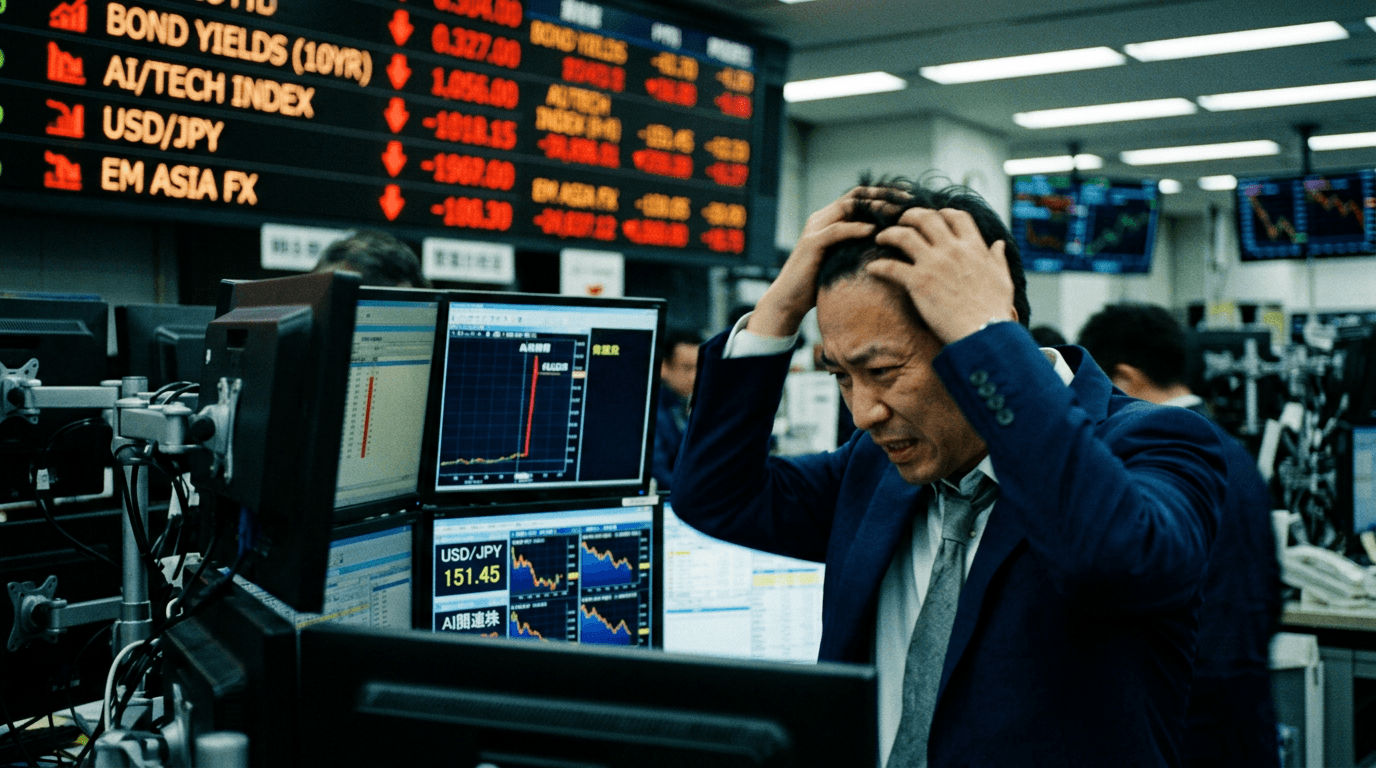
Asian equity markets have spent much of the past year riding an AI-fueled wave, but the latest surge in global bond yields is forcing traders to rethink how much rate risk they are really willing to own in growth-heavy portfolios.[1][2][14][15] Long-dated US Treasuries now trade around levels last seen in the mid-2000s, while Japanese government bond yields have pushed to multi-decade highs, dramatically raising the cost of capital for technology and AI infrastructure plays worldwide.[9][10][15] This tension between powerful earnings narratives and an unforgiving rates backdrop is increasingly defining day-to-day price action across Asia.
Global Yields Are Repricing Growth
The core of the story sits in fixed income, not equities.[8][9][10][14] Inflation-adjusted borrowing costs across major economies have jumped to their highest levels in more than a decade, as governments and AI “hyperscaler” companies flood bond markets to finance investment and fiscal commitments.[8] Higher real yields mean investors can earn more from relatively low-risk government bonds, so the hurdle rate for owning long-duration growth stocks has risen sharply.[1][8][14]
History suggests that this matters for Asia.[1][2] Over recent years, the MSCI Asia Pacific Index has tended to struggle in weeks when the US 10-year Treasury yield jumps by 20 basis points or more, with average losses reflecting the sensitivity of the region’s valuation-heavy sectors to rate shocks.[1] Episodes of rapid yield repricing amplify volatility because models for discounted cash flows, risk premia, and equity risk factors all have to be adjusted at once.[1][14] For traders, that means more frequent and more violent rotations between defensives, cyclicals, and high-beta tech.
Ai Rally Under Pressure
AI-linked names have been the clear leaders of Asia’s equity performance in 2026, from Taiwanese semiconductor giants to Korean memory-chip producers and specialist cloud infrastructure providers.[2][5][7][15] Korea’s KOSPI, for example, has rebounded sharply from mid-year weakness, powered by heavyweight tech stocks such as Samsung Electronics and SK Hynix as investors bet that AI earnings can outpace rising funding costs.[15] Taiwan’s benchmark has similarly benefited from enthusiasm around AI-driven demand for advanced chips and foundry capacity.[5]
Yet when global yields spike, these same AI beneficiaries quickly become the focal point for profit-taking and de-risking.[1][10][14][15] Higher discount rates compress the present value of long-dated cash flows, a particular problem for companies whose valuation rests on growth far into the future rather than near-term dividends.[1][8][14] Recent sessions have shown how quickly sentiment can swing: a few basis points of upside surprise in US or European yields has been enough to knock back Asia’s tech-heavy indices and remind traders that duration risk still matters, even when the AI story remains fundamentally strong.[10][14][15] The result is a market where AI optimism is intact but increasingly challenged by rate reality.
Asia Fx And Carry Trades In The Crosshairs
Equity volatility never stays isolated for long; the current shift in risk appetite is rippling through Asia FX and popular carry trades.[11][12][13] For years, investors have borrowed cheaply in low-yielding currencies and invested in higher-yielding ones, banking the interest rate differential and sometimes additional capital gains from appreciation in target currencies.[4][12] This strategy works best when volatility is low and funding costs are predictable.
Rising global yields complicate that calculus.[8][9][10][13] As US and other developed-market yields climb, dollar funding becomes more expensive and risk premia on higher-yield currencies must adjust upward to compensate for heightened macro uncertainty.[9][13] Research already shows that conviction carry positions in high-yielders like MXN and BRL have remained resilient, but that low-yielding Asia-Pacific currencies are increasingly being used as funding legs—creating vulnerability if policy expectations shift or if volatility spikes.[11] A rotation out of Asia carry trades would be a clear negative for regional FX, particularly those currencies tied closely to global growth and tech cycles.[12][13]
How Traders Can Position
For traders, the key is not to choose between “AI” and “rates” as narratives, but to understand how they interact across time horizons and instruments. In the short term, sharp jumps in yields can trigger outsized moves in high-duration equities and growth currencies, offering tactical opportunities for mean reversion trades and volatility harvesting. Over longer horizons, the level of real yields effectively sets the valuation anchor for risk assets, defining how far multiples can expand before they look stretched.
Several practical takeaways stand out.
1. Treat long-term yields as a primary risk driver, not background noise. When US 10-year or 30-year yields move toward multi-decade highs, reassess exposure to duration-heavy sectors like AI, software, and long-horizon infrastructure.[8][9][15]
2. Watch the relationship between real yields and equity volatility. Elevated real yields tend to compress valuation multiples and increase the frequency of drawdowns in growth-heavy indices, especially in Asia where tech weights are high.[1][2][14]
3. Stress-test carry and FX exposure for funding shocks. Consider how trades funded in low-yielding currencies would perform if policy expectations change or if bond supply dynamics force yields higher still.[11][12][13]
4. Diversify across time horizons. Intraday traders can focus on yield-driven volatility in futures and FX, while swing and position traders may look to balance AI exposure with sectors that benefit from higher rates, such as financials or select cyclicals.[1][2][14]
Simulated Finance: Practice The New Rate Regime
Simulated finance platforms give traders a practical way to rehearse these scenarios before capital is at risk. In a controlled environment, it is possible to model a sudden 50–75 basis point jump in US long-term yields and observe how Asian equity indices, AI-linked single names, and regional FX pairs respond over different horizons. Traders can test how tightening stop-loss logic, shifting position sizing, or rebalancing between growth and value alters portfolio outcomes in a high-yield shock.
These simulations are particularly useful for understanding nonlinear effects, such as how simultaneous moves in yields, credit spreads, and volatility indices can accelerate forced deleveraging in crowded AI trades. By building and replaying scenarios where carry trades unwind, funding currencies strengthen, and tech benchmarks gap lower, traders develop playbooks that are robust to the kind of regime shifts currently unfolding in global markets. The aim is not to predict every move, but to be structurally prepared for environments where rates and AI narratives collide.
Conclusion
Asian markets are discovering that an AI-powered earnings story, while compelling, does not fully insulate growth assets from the realities of a world with higher and more volatile bond yields.[1][8][14][15] As long-term borrowing costs rise and real yields reset higher, duration risk, FX carry positioning, and valuation discipline will sit at the center of cross-asset decision-making.[8][9][12][13] Traders who integrate yield dynamics into their equity and FX frameworks, and who actively rehearse rate-shock scenarios in simulated environments, will be better equipped to navigate this new regime where AI optimism coexists with an unforgiving cost of capital.