
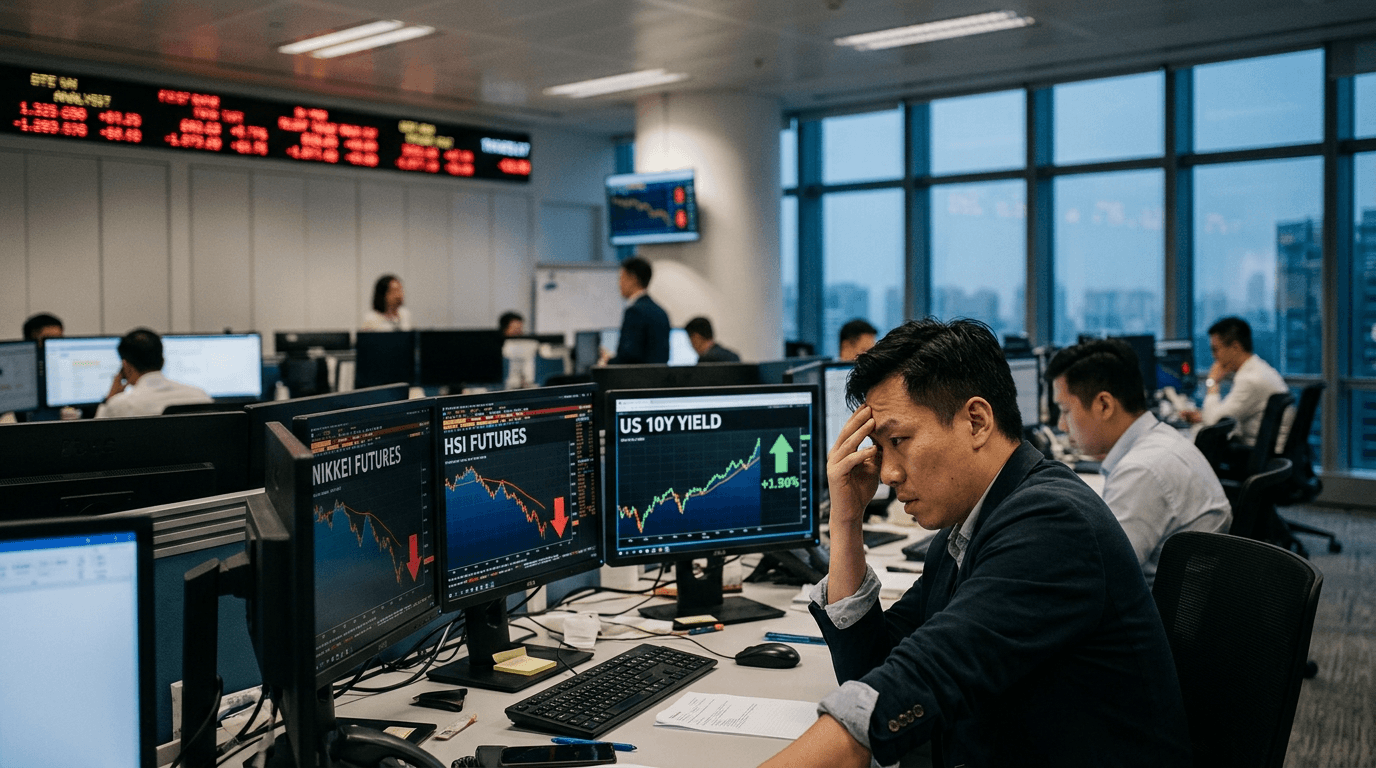
Asian equity index futures softened in overnight trading as U.S. long-dated Treasury yields pushed higher and Wall Street lost momentum, setting a cautious tone for the next Asia session.[1][3][11] For traders, this is a textbook example of how a move in global rates can translate almost immediately into risk sentiment and price action across regions.[3][11] Understanding this linkage is critical in both live markets and simulated environments, where index futures serve as a real-time barometer of investor expectations.
Market Snapshot
U.S. Treasury yields have been grinding higher, with the 10-year note hovering around 4.71% and the 30-year bond near 5.25%, levels close to multi-year highs.[1][11][15] These are structurally important yield levels because they effectively reset the discount rate applied to future corporate earnings and cash flows.[3][11] When the “risk-free” rate reprices sharply upward, equity valuations—especially for growth and high-duration assets—come under pressure.[3][12]
Wall Street has struggled to digest this renewed rate shock, with major U.S. indices posting repeated declines as investors reassess earnings multiples and the sustainability of recent rallies.[3][12] Episodes earlier this year showed that when long-term yields spike, sectors such as technology and rate-sensitive cyclicals tend to lead the equity sell-off.[2][3] Asian futures trading is now echoing that pattern, with contracts linked to benchmarks like the Nikkei and regional indices slipping as traders mark down opening levels in anticipation of weaker cash sessions.[2][9][14]
For market participants, the key point is that overnight futures are not just noise; they are the bridge between one region’s close and another’s open, translating U.S. rate and equity adjustments directly into Asia’s starting point.[9][14]
WHY U.S. YIELDS MATTER FOR ASIA
Higher U.S. yields affect Asian equity index futures through several channels: valuation, funding costs, currency dynamics, and risk appetite. On the valuation side, a 10-year yield near 4.7% and a 30-year above 5% materially increases the discount rate used in equity models, especially for export-oriented and tech-heavy markets that depend on global growth and capital flows.[1][11][12] That tends to compress price-to-earnings multiples, which futures markets quickly price in.
Funding and currency dynamics add a second layer. Rising U.S. yields often strengthen the dollar relative to Asian currencies, tightening financial conditions for economies reliant on external capital and dollar funding.[6][11] In turn, higher hedging and borrowing costs reduce the appeal of equity risk, particularly in markets where foreign investors are large marginal buyers.[9][13] Futures respond by pricing lower expected demand for regional equities.
Third, risk appetite is increasingly global. Recent episodes have shown that when Wall Street sells off on valuation or rate fears, Asia often follows with both cash markets and futures under pressure.[2][9][10] Futures tied to the Nikkei, Kospi, and other benchmarks have seen outsized moves during these periods, amplifying the transmission of U.S. sentiment into Asian open levels.[2][9][14] The latest softening of Asian index futures as yields rise fits neatly into this established pattern.
Implications For Traders And Simfi Participants
For traders on platforms like E8 Markets, where simulated finance environments mirror real market dynamics, this setup offers a practical lesson in global macro linkages. When long-dated yields spike, equity index futures typically become the first line of adjustment in equity risk.[3][11] Simulated Nikkei, Hang Seng, or broader Asia index futures will often gap lower or trend down in overnight trading as participants reprice earnings and risk premia.
This environment also illustrates why cross-asset awareness is essential. A purely equity-focused trader who ignores the U.S. Treasury curve is likely to be surprised by index futures moves that seem “out of nowhere.” In reality, these moves are often rational responses to higher discount rates and changing expectations for central bank policy.[1][8][11] SimFi participants can use these episodes to practice reading rate charts, understanding yield curves, and linking them to equity futures strategies.
Risk management is another core takeaway. Rising yields can increase intraday volatility and widen the distribution of potential outcomes for equity indices.[3][12] In a simulated environment, this is an ideal moment to test position sizing frameworks, stop-loss disciplines, and scenario analysis—without the emotional pressure of real capital at risk. Practicing how to respond to a rate-driven gap down in index futures builds resilience and a repeatable playbook for similar live-market conditions.
Strategies To Navigate Rate-driven Volatility
There are several practical approaches traders can explore when U.S. yields rise and Asian equity futures soften.
One strategy is to trade the opening gap dynamics. When futures signal a weaker open, cash markets often see follow-through in the first hour as overnight news is digested.[9][14] Simulated trades can focus on short-term momentum around the open, testing whether gaps tend to extend, fade, or mean-revert under different macro backdrops.
Another approach is sector and style rotation. Higher yields typically weigh more heavily on high-duration growth names than on value or defensive sectors such as utilities, staples, and certain financials.[2][3][12] While index futures are broad instruments, traders can use them as proxies for overall risk while simultaneously simulating relative value trades that assume growth-heavy indices underperform in high-yield regimes.
Hedging is a third angle. Traders can experiment with using equity index futures as macro hedges against rate exposure, simulating scenarios in which they hold a synthetic “portfolio” of growth assets and short index futures to offset rate risk. This mirrors institutional approaches where futures hedges are deployed to manage beta when yield shocks threaten portfolio performance.
Finally, macro narrative tracking is vital. Moves in long-dated yields often reflect evolving expectations for inflation, fiscal policy, and central bank actions.[1][6][15] In SimFi, traders can build routines around monitoring economic releases, central bank commentary, and yield curve shifts, then translating those signals into index futures positioning. That process, not just the trade outcome, is what builds durable skill.
Conclusion
The softening of Asian equity index futures in response to rising U.S. long-dated Treasury yields is a clear reminder that global markets are tightly interconnected and that rate shocks rarely stay contained to one asset class or region.[1][3][11] For both live traders and participants in simulated environments, these episodes highlight the importance of watching the yield curve, understanding how discount rates feed into equity valuations, and anticipating cross-region sentiment transmission.[3][9][11]
Rather than viewing this as a one-off move, traders can treat the current backdrop as a case study in global macro mechanics. By linking U.S. yield shifts to Wall Street performance and then to Asian futures, it becomes easier to build structured trading plans that account for these relationships and manage risk proactively.[2][3][9] Practicing those plans in a SimFi setting allows traders to refine strategies, test assumptions, and gain confidence—so when the next rate shock hits, they are ready to respond with discipline instead of reacting with emotion.