
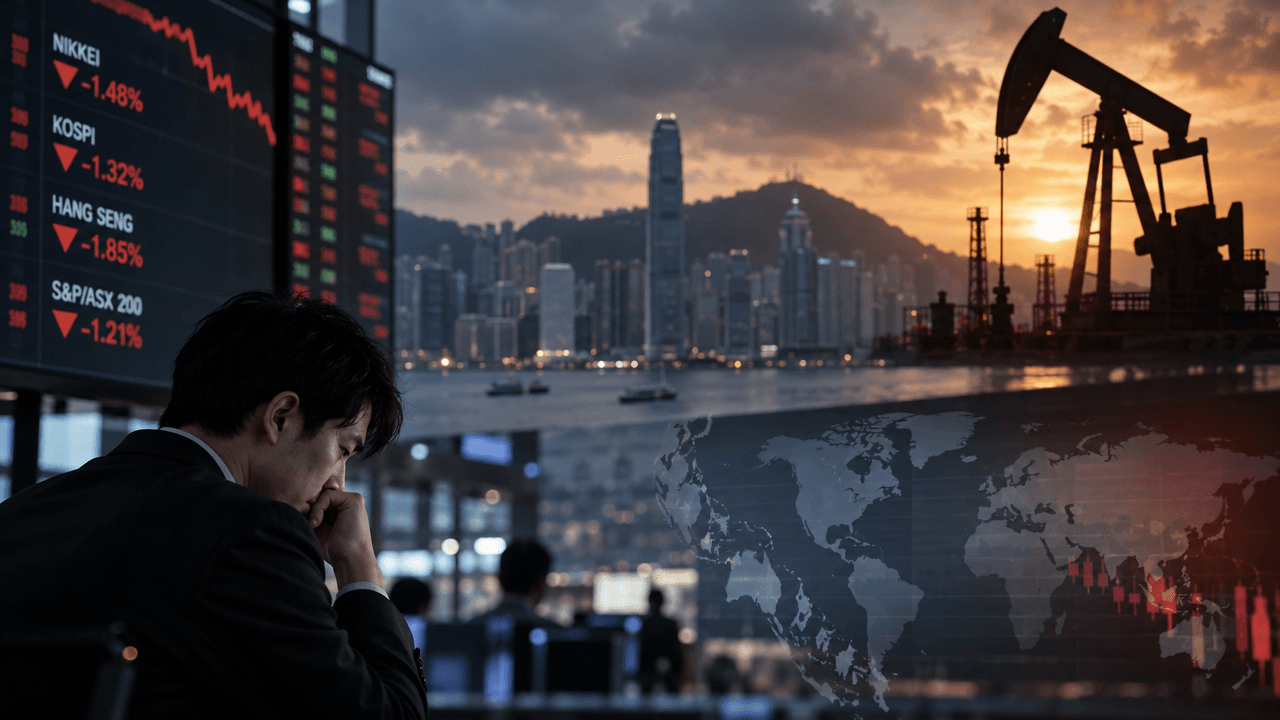
Asian equity futures are pointing lower as investors reassess two powerful forces shaping global markets: the enormous cost of the artificial-intelligence boom and rising geopolitical risk in the Middle East. Nasdaq 100 futures fell approximately 0.9%, while S&P 500 futures declined around 0.5%, signaling a weaker opening for U.S. technology and broader equity markets. In Asia, South Korean shares fell more than 1%, Japan’s Nikkei slipped 0.4%, and MSCI’s broadest Asia-Pacific index excluding Japan dropped 0.2%. [2]
The move reflects more than a routine pullback. Recent earnings from Tesla and Meta delivered encouraging headline numbers, but investors remain unconvinced that strong revenue growth will immediately justify the extraordinary spending required to build AI infrastructure. At the same time, renewed attacks and shipping threats in the Gulf region have pushed crude oil above $110 per barrel, reviving concerns about inflation, interest rates, and global growth. [1]
Ai Earnings Face A Higher Standard
The AI trade has benefited from years of enthusiasm surrounding data centers, advanced chips, cloud computing, and software automation. However, investors are now asking a more demanding question: when will the spending generate enough cash flow to support current valuations?
Meta reported third-quarter revenue of $64.60 billion, a 26% increase from a year earlier and above the $63.35 billion expected by analysts. Tesla also exceeded forecasts, reporting adjusted earnings of 48 cents per share on revenue of $28.05 billion. [7][8]
Those results would normally provide strong support for technology shares. Instead, market participants focused on the cost of future growth. Tesla continues to invest heavily in artificial intelligence, autonomous driving, and robotaxis, while Meta is expanding its AI infrastructure and product development programs. The market reaction shows that beating estimates is no longer enough. Companies must also demonstrate that capital spending is producing measurable and sustainable returns.
This creates a more selective environment. Businesses supplying the AI ecosystem may continue to attract interest, but highly valued companies with uncertain earnings payoffs could face sharper price swings. For traders, earnings quality, free cash flow, margins, and forward guidance may matter more than headline revenue growth.
Why Asian Markets Are Vulnerable
Asian equities are particularly sensitive to changes in technology sentiment. South Korea and Taiwan are major parts of the global semiconductor supply chain, while Japan has significant exposure to electronics, industrial automation, and advanced manufacturing. When investors reduce exposure to expensive technology shares, those markets can experience amplified declines.
The latest weakness also reflects a broader loss of momentum. Asia-Pacific equities outside Japan were on track for a fourth consecutive weekly decline, suggesting that investors are not treating the current move as an isolated reaction to one night of U.S. earnings. [2]
Higher U.S. bond yields, uncertainty over Federal Reserve policy, and concerns about whether AI investment can maintain its pace all contribute to the pressure. If investors begin to expect slower technology spending, semiconductor manufacturers and equipment suppliers could face lower earnings expectations.
Still, a decline in futures does not automatically mean the long-term AI investment theme has ended. It may indicate that markets are moving from broad enthusiasm toward greater discrimination. Companies with strong balance sheets, dependable cash generation, and clear commercial applications for AI may prove more resilient than businesses relying mainly on ambitious projections.
Oil And The Geopolitical Risk Premium
The second major source of pressure is energy. Brent crude rose above $110 per barrel, while West Texas Intermediate traded near or above $98 as traders assessed attacks in Saudi Arabia and continuing threats to vessels around the Strait of Hormuz. [1][5]
The Strait of Hormuz is one of the world’s most important energy corridors. Any sustained disruption could reduce the flow of crude and other petroleum products, forcing prices higher. Even before a major supply shortage develops, markets can add a geopolitical risk premium to oil prices as traders prepare for the possibility of further attacks or shipping delays.
Higher oil prices affect equities through several channels. They increase transportation and production costs, reduce household purchasing power, and make it more difficult for central banks to bring inflation under control. If inflation remains elevated, interest rates may stay higher for longer, which generally puts pressure on growth stocks whose valuations depend on future earnings.
Energy producers may benefit from higher crude prices, but that advantage can be offset if escalating tensions damage global confidence. Investors often respond by favoring defensive assets and reducing positions in cyclical or highly valued sectors.
What Traders Should Watch Next
The immediate focus will be on additional technology earnings, corporate guidance, and evidence of real returns from AI investment. A company can report strong sales while still disappointing investors if operating expenses and capital expenditures rise too quickly.
Traders should also monitor crude oil’s ability to remain above $110, developments involving shipping routes, and any signs that the conflict is spreading to critical energy infrastructure. A rapid retreat in oil prices could relieve some pressure on inflation-sensitive assets. Conversely, another supply shock could intensify volatility across equities, bonds, and currencies.
Risk management is especially important in this environment. Traders may want to reduce excessive leverage, define exit levels before entering positions, and avoid assuming that a strong earnings headline guarantees a positive stock reaction. Correlations can also change quickly: technology shares may fall while energy stocks rise, but a broader geopolitical escalation could eventually pressure nearly every risk asset.
The Bigger Market Lesson
The decline in Asian equity futures highlights how quickly market priorities can shift. Investors are balancing strong corporate results against expensive AI spending, while geopolitical tensions are creating a new inflation threat through energy prices.
For SimFi traders, the key lesson is to separate information from market interpretation. Tesla and Meta produced notable results, yet the market focused on spending and future returns. Oil moved higher not only because of current disruptions, but because traders were pricing the risk of worse conditions ahead.
This is a market that rewards preparation rather than prediction. Watch earnings guidance, capital allocation, oil-market developments, and central-bank expectations together. The most important opportunity may not come from guessing the next direction, but from understanding which risks are already priced in and which could still surprise the market.