
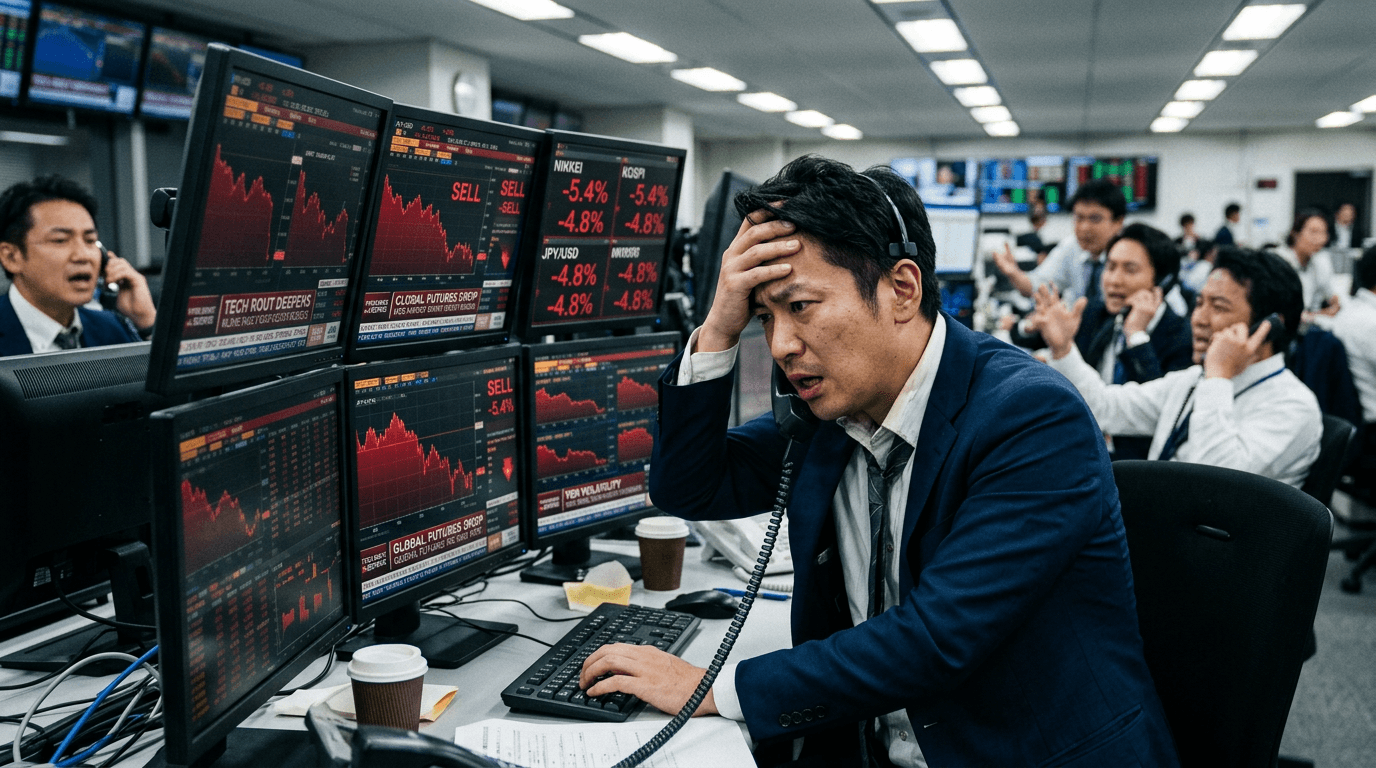
Asian equity markets have been hit by a brutal tech-led selloff, with major benchmarks in Japan, Taiwan and South Korea tumbling as global risk sentiment turns sharply defensive.[1][6][11] What started as a valuation-driven correction in US technology and AI names has spilled over into Asia, triggering losses of up to 6–10% in some of the region’s most tech‑heavy indices and sparking a broader “risk‑off” move across asset classes.[1][2][6][12]
GLOBAL TECH ROUT DRIVES ASIAN ‘BLOODBATH’
The term “bloodbath” is not hyperbole in this context: Japan’s Nikkei 225, Taiwan’s Taiex and South Korea’s Kospi have all seen single‑day drops in the mid‑single to high‑single digits, with the Kospi at one stage plunging around 8% and briefly triggering a circuit breaker.[2][6][12] In Japan, the Nikkei has fallen more than 10% from its recent all‑time high, confirming correction territory and underscoring how quickly sentiment has flipped.[1][9]
The pain is particularly acute in markets heavily concentrated in semiconductor, chip‑equipment and AI‑linked stocks.[5][11][13] Major Korean names such as Samsung Electronics and SK Hynix, key components of global AI and memory supply chains, have dropped between roughly 6–9%, while Japanese chip‑related firms and AI bellwethers like SoftBank have seen double‑digit declines on the day.[5][8][12] Taiwan’s tech‑rich index has also registered some of its steepest falls in months.[5][6]
WHAT’S REALLY BEHIND THE TECH SELLOFF?
At the core of this rout are concerns that AI and broader tech valuations have run too far, too fast.[2][5][9][11] Investors who chased the AI trade earlier in the year are now questioning whether earnings can grow quickly enough to justify the premium multiples many of these companies command.[7][9] When expectations are sky‑high, even small disappointments—like weaker‑than‑hoped revenue or cautious guidance from a major chipmaker—can trigger outsized price reactions.[8][11]
Several catalysts have combined to break the momentum. First, profit‑taking at quarter‑end after a strong run in AI and semiconductor stocks has removed an important source of marginal buying.[2] Second, negative surprises from high‑profile US chip names have cast doubt on the near‑term revenue trajectory for the sector globally, prompting investors to reassess risk in related Asian names.[8][11] Third, broader macro uncertainty—around Federal Reserve policy, potential rate hikes, and the risk of slower growth or even stagflation—has made investors less willing to hold volatile, long‑duration growth assets.[9][11]
Geopolitical tension and higher oil prices, including concerns around conflict in the Middle East and Iran, are adding a further risk premium to the market backdrop.[3][8][11] When investors face simultaneous valuation concerns, macro uncertainty and geopolitical risk, the natural response is to de‑risk portfolios, often starting with their most crowded trades—right now, that means AI and tech.
Ripple Effects: Fx, Futures And Volatility
The equity selloff has quickly spilled into index futures, FX and commodities, turning what began as a sector‑specific correction into a broad risk‑off episode. Futures on major Asian indices are showing elevated volatility and wider bid‑ask spreads as market participants hedge downside or speculate on further declines.[6][8] The volatility term structure across equity index futures has steepened, with near‑dated contracts pricing in more risk relative to longer maturities, reflecting immediate uncertainty.
In FX, demand for traditional safe‑haven currencies such as the US dollar and Japanese yen has picked up as investors seek shelter from equity turbulence.[6][10] This is a classic pattern: in periods of stress, global portfolios are often rebalanced towards cash and highly liquid government bonds, frequently funded by selling equities and higher‑beta currencies. The yen can be particularly sensitive, as Japanese equities fall while yen strengthens, creating complex feedback loops for local investors and global funds hedged into JPY.
Commodity futures are not immune either. Higher oil prices linked to geopolitical tensions can simultaneously squeeze corporate margins and fuel inflation worries, reinforcing fears that central banks may need to stay restrictive for longer.[3][8][11] For traders, this means correlation structures across assets can change rapidly: tech stocks, FX pairs, equity indices and energy contracts may move together more tightly during risk‑off episodes than in calmer regimes.
What This Means For Active And Simulated Traders
For active traders—and for those using simulated finance platforms to build skills—episodes like this “tech bloodbath” are crucial real‑time case studies in market dynamics and risk management. First, they highlight the importance of understanding concentration risk: when indices are heavily tilted toward a single theme like AI or semiconductors, thematic corrections can morph into index‑level drawdowns.[5][11][13]
Second, they show how shocks propagate through the market ecosystem. A disappointing earnings print or guidance from a single chipmaker in the US can trigger repricing in sector ETFs, spill over into Asian suppliers via expectations of slower demand, move index futures as traders hedge, and ultimately impact FX as global investors rebalance.[8][11] Simulated trading environments allow you to replay such sequences, test different hedging strategies, and analyze how cross‑asset correlations behave under stress.
Third, they reinforce the value of scenario planning and position sizing. In a SimFi context, traders can practice stress‑testing portfolios against sudden 5–10% index moves, sharp volatility spikes in equity and FX futures, and rapid rotations from growth to value or from tech into more cyclical sectors.[6][13] This helps develop rules around maximum risk per trade, use of stop‑losses, and diversification across themes and regions—skills that are critical when real markets turn turbulent.
KEY TAKEAWAYS FOR NAVIGATING RISK‑OFF MARKETS
Several practical lessons emerge from the current Asian tech selloff:
- Treat “hot” themes with respect. Strong momentum and compelling narratives—like AI—can drive powerful rallies, but they also set the stage for brutal reversals when expectations reset.[2][5][7][9]
- Watch leading indicators, not just local markets. Moves in US megacap tech, FX funding currencies, and global chip indices often provide early signals for what may hit Asian equities next.[3][8][11]
- Understand futures and volatility as risk tools, not just speculation vehicles. Index and FX futures, along with options, are central to how institutional investors hedge during risk‑off phases, and they shape price discovery when cash markets are stressed.[6][8]
- Use simulated environments to rehearse decisions before capital is at risk. Practicing how you would respond to sudden corrections—whether by cutting exposure, rotating sectors, or adding hedges—builds discipline that is hard to improvise in live market stress.
The current “bloodbath” in Asian tech equities is a vivid reminder that high‑growth stories come with high‑octane risk. For traders and investors, the challenge is not to avoid volatility altogether, but to understand it, prepare for it, and learn to navigate it with a robust framework—whether in live markets or through sophisticated simulation.