
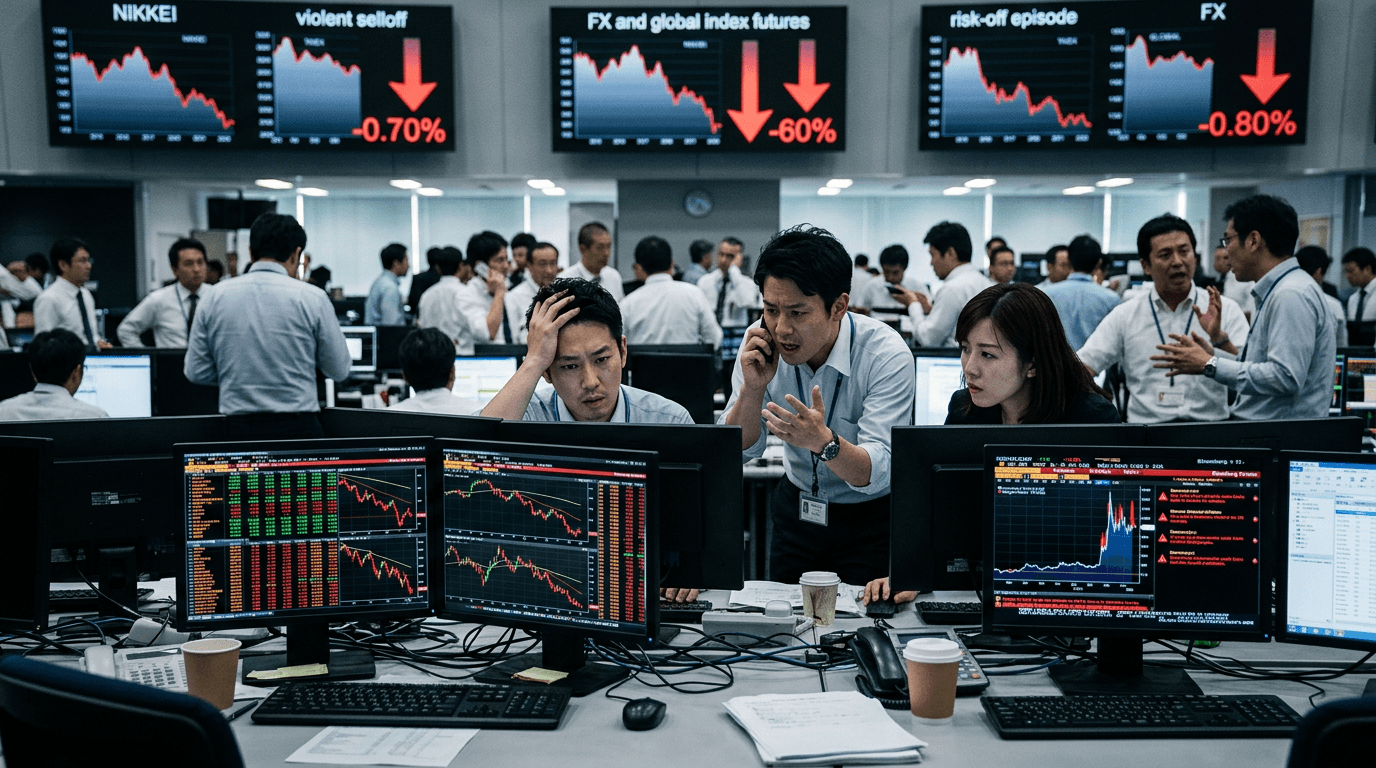
Asian equity markets have just endured a tech-led bloodbath, with Japanese and Taiwanese benchmarks dropping as much as 6% in a single session, and the shockwaves quickly spilling into foreign exchange and global index futures.[1][4][7] What began as a rapid reassessment of high‑growth technology valuations has morphed into a broader risk‑off episode, where investors are cutting exposure to equities, rotating into safer currencies, and hedging aggressively via derivatives.
Market Bloodbath: Tech Rout Goes Global
The epicenter of the sell‑off is in Asia’s most tech‑heavy markets. Japan’s Nikkei 225 and Taiwan’s Taiex have both seen steep declines as investors rush to unwind crowded positions in semiconductor, AI, and high‑beta growth stocks.[1][6][7] Many of these names had enjoyed a powerful rally driven by enthusiasm for artificial intelligence and advanced chips; now, the same segment is bearing the brunt of the correction.
This isn’t an isolated Asian story. The move follows sharp declines in U.S. technology shares, where concerns about stretched valuations, disappointing guidance from major chipmakers, and rising macro uncertainty triggered a broader risk reset.[4][6][8] When Wall Street’s tech leaders stumble, global investors reassess positions across the entire supply chain—from Korean and Taiwanese chipmakers to Japanese equipment manufacturers—creating synchronized stress across regions.
The severity of the intraday moves has added to the sense of shock. Single‑day falls of 4–6% in benchmark indices are rare outside of crisis periods, and they tend to force investors to reduce leverage, meet margin calls, and rebalance portfolios quickly. That mechanical selling can amplify price moves well beyond what fundamentals alone would suggest.
The Drivers Behind The Sell-off
Under the surface, several themes are driving this rout:
First, valuation fatigue. After months of relentless gains in AI‑linked and semiconductor stocks, investors have become more sensitive to any hint that future earnings may not justify current prices.[2][6] A few cautious outlooks from leading chipmakers and hardware firms have been enough to puncture the narrative of guaranteed, exponential AI growth, triggering profit‑taking and, in some cases, outright panic.
Second, macro headwinds. A robust U.S. jobs report has revived expectations that the Federal Reserve could keep rates higher for longer or even deliver additional tightening if inflation re‑accelerates.[2][4] Higher global interest rates compress the present value of long‑dated cash flows, disproportionately hurting high‑growth tech firms whose valuations depend on earnings far into the future.
Third, positioning and leverage. Tech and AI had become consensus trades, with large inflows and significant derivative activity built on the assumption of continued upside.[6][7] When sentiment turns, those crowded trades unwind quickly. Stop‑loss orders, risk‑parity strategies, and volatility‑targeting funds can all accelerate selling once key thresholds are breached.
For traders—both in live markets and on simulated platforms—this episode illustrates how fundamental narratives (AI growth, chip demand) can be abruptly overwhelmed by valuation and macro concerns. It’s a reminder that price risk is often about positioning and sentiment as much as it is about earnings.
Fx Reaction: Safe Havens Vs Risk Currencies
As equities plunge, currency markets have delivered a classic risk‑off response. Demand has risen for traditional safe‑haven currencies such as the Japanese yen and Swiss franc, while higher‑yielding or more cyclical currencies have come under pressure.[8] This behavior reflects a familiar pattern: when risk assets sell off, investors seek liquidity, stability, and lower volatility in FX.
In Asia, the feedback loop is particularly complex. Japan’s tech rout weighs on local equities, yet the yen can strengthen as global investors unwind carry trades and hedge exposure.[8] That can further pressure Japanese exporters, whose earnings are hurt by a stronger currency, compounding the equity stress. Meanwhile, regional currencies linked to global trade and manufacturing—like the Korean won or Taiwanese dollar—face selling as investors mark down growth expectations tied to the tech cycle.
For FX traders, the key lesson is correlation. In risk‑off episodes:
- Safe havens and low‑yielding currencies tend to outperform.
- EM and cyclical currencies often weaken.
- Cross‑currency moves can be driven as much by position unwinds as by local economic data.
On simulated finance platforms, monitoring these correlations in real time—equity indices versus FX pairs—helps build intuition about how macro shocks propagate through different asset classes.
Index Futures: How Contagion Spreads
Index futures have been another critical channel for the spillover. As Asian cash markets sold off, futures linked to major global equity benchmarks—such as U.S. and European indices—saw increased volatility and heavier selling as investors moved to hedge or adjust exposure quickly. Futures allow large players to recalibrate risk almost instantaneously, and sudden changes in sentiment in one region often show up in overnight moves in another.
When a tech‑led rout hits Asia:
- Global investors may sell S&P 500, Nasdaq, or Euro Stoxx futures to hedge portfolios heavy in technology and growth.
- Systematic strategies that trade index futures based on volatility, momentum, or risk budgets can flip from net long to net short, amplifying directional moves.
- Futures prices can temporarily diverge from fair value as hedging demand spikes, creating basis moves that arbitrageurs attempt to exploit.
For both real and simulated traders, index futures are an essential lens on how local shocks become global ones. Watching futures alongside cash markets gives a richer picture of how sentiment is evolving and where liquidity is deepest during stress.
Practical Takeaways For Traders And Simulated Investors
Episodes like this Asian equity bloodbath offer valuable lessons:
1. Risk is cross‑asset, not siloed Tech valuations in one region can drive moves in FX, futures, and commodities elsewhere. Building strategies that consider correlations across equities, currencies, and derivatives is crucial.
2. Crowded trades magnify reversals When everyone is on the same side of a theme—AI, chips, high‑growth tech—small disappointments can trigger outsized price moves. Monitoring positioning and market sentiment matters as much as following earnings reports.
3. Volatility is opportunity and danger Elevated volatility can create attractive entry points for long‑term investors and rich options premiums for traders. It also raises the probability of sharp intraday swings and forced liquidations. Scenario analysis and stress testing are vital.
4. Simulated trading is a safe laboratory On SimFi platforms, traders can rehearse how they would respond to such shocks: rebalancing tech exposure, rotating into defensive sectors, hedging via FX and index futures, or managing margin calls—all without real capital at risk. That practice helps build discipline for when similar volatility appears in live markets.
Ultimately, the Asian tech rout and its spillover into FX and index futures underscore a central truth of modern markets: narratives travel fast, and capital travels faster. Whether trading live or in simulation, the winners are usually those who understand how valuation, macro policy, positioning, and cross‑asset correlations fit together—and who are prepared for the moment when a hot theme turns cold.