
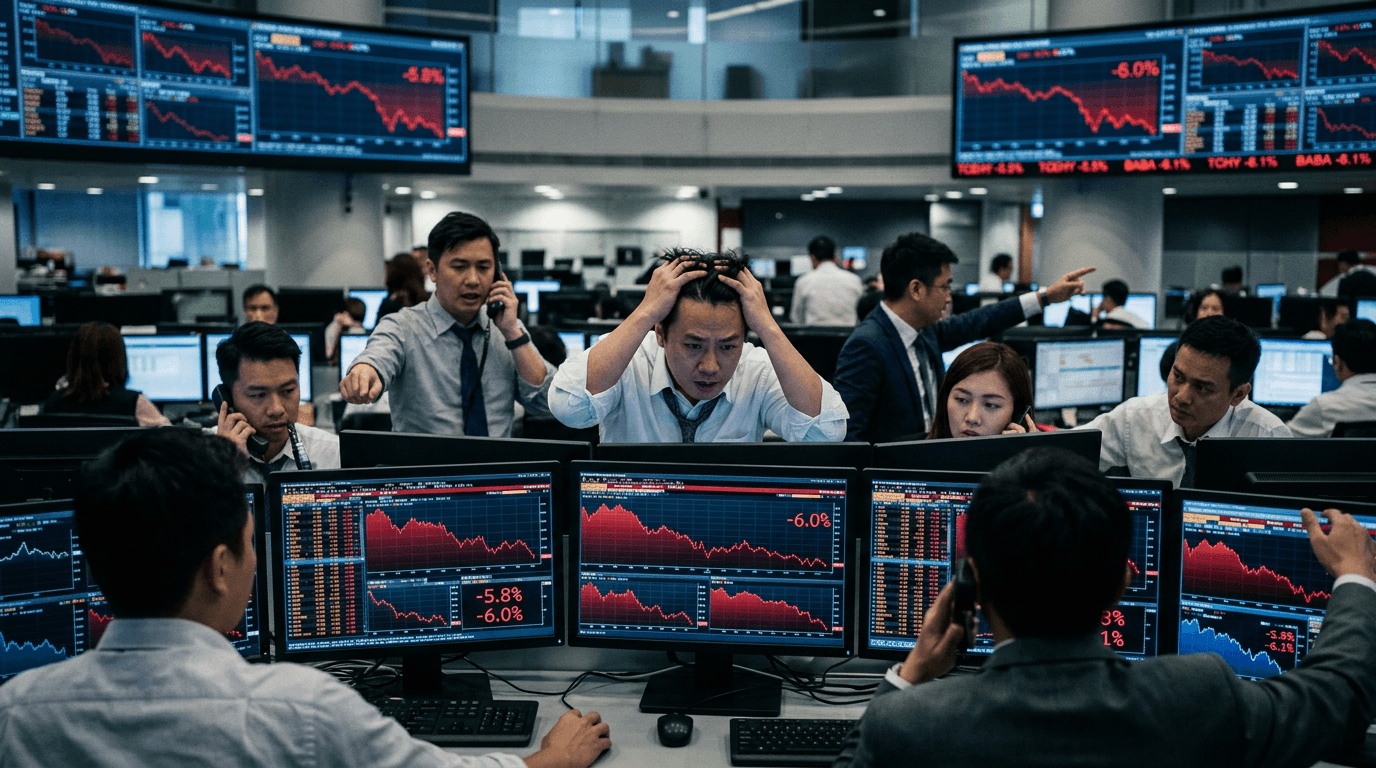
Asian markets woke up to a harsh reality check as equity benchmarks across the region slumped, with Japan and Taiwan falling as much as 6% amid an aggressive global selloff in technology stocks.[1] The move has spilled over into foreign exchange and derivatives, pressuring risk-sensitive currencies and injecting fresh volatility into major index futures tied to the S&P 500 and Nasdaq.[7] For traders, this episode is a live case study in how a sector-specific shock can morph into a broad risk-off event.
Tech Rout Sparks Broad Asian Sell-off
The sharpest pain has been felt in markets most heavily exposed to technology and semiconductor names, such as Japan, Taiwan, and South Korea.[1][8] In Japan, the Nikkei 225 dropped over 4%, dragged down by double-digit declines in heavyweight tech and investment firms.[2][7] Taiwan’s tech-centric Taiex and South Korea’s Kospi have also posted outsized losses, at times triggering volatility control mechanisms as selling intensified.[2][5][15]
This is not an isolated Asian story; the region is essentially amplifying a global tech correction that began on Wall Street.[11][15] Disappointing guidance from major chipmakers and AI beneficiaries, such as Broadcom, has rattled confidence in the durability of the AI trade and prompted investors to rotate out of richly valued growth stocks.[3][8] When a dominant leadership group like mega-cap tech stumbles, it often causes broad-based de-risking, especially in markets where that sector has become a large share of the index.
Key takeaway: When leadership sectors with stretched valuations stumble, markets that are most leveraged to those narratives—like Asian tech hubs—tend to react disproportionately. Position sizing and concentration risk matter as much as directional views.
WHAT’S DRIVING THE TECH ROUT?
Several overlapping drivers are contributing to the intensity of this selloff:
First, valuation fatigue is front and center. After a blistering rally in AI-related and semiconductor stocks, investors are questioning whether earnings and cash flows can justify current price multiples.[3][9][13] Analysts note that the valuation premium for tech and AI names has not fully adjusted to more realistic expectations, leaving the sector vulnerable to negative surprises.[13]
Second, earnings disappointment has acted as a catalyst. Lower-than-expected outlooks from key chip and infrastructure firms have undermined the assumption that AI spending will translate smoothly into near-term profitability.[3][8][9] When leading companies underdeliver, it tends to reset expectations across the entire theme.
Third, macro uncertainty is amplifying the reaction. Strong U.S. jobs data have revived fears of additional Federal Reserve rate hikes, raising discount rates for growth stocks and compressing valuations.[3][10] At the same time, investors are cautious ahead of major U.S. earnings releases, including Alphabet and other tech bellwethers, which could either validate or further undermine the growth narrative.[1][8] Geopolitical tensions and unsettled global trade dynamics add another layer of risk, reinforcing the preference to reduce exposure.[11][12]
Key takeaway: Sector selloffs are rarely about a single headline. Valuation, earnings, rates, and geopolitics interact, and traders who map these linkages have a clearer framework for risk management.
Risk Currencies Feel The Stress
The equity slump has quickly transmitted into foreign exchange markets. When equities fall sharply on growth or valuation fears, investors tend to unwind positions in high-beta or “risk” currencies and seek shelter in safe havens.[7][14]
High-beta currencies—typically those tied to commodities, emerging markets, or cyclical growth—often weaken in such episodes. That can include the Australian and New Zealand dollars, as well as regional EM FX, which are sensitive to global growth expectations and capital flows. By contrast, safe-haven currencies like the U.S. dollar, Japanese yen, and Swiss franc usually benefit as investors prioritize capital preservation and liquidity.[7][14]
This pattern is visible in recent price action: the dollar has generally held firm, while yen moves have reflected both its safe-haven status and the complex impact of Japanese equity volatility.[7][14] For traders, the key is understanding that FX is not moving in a vacuum; it is reacting to shifts in global risk appetite emanating from equities and rates.
Practical angle for traders
- Monitor cross-asset correlations: rising equity volatility often precedes or coincides with FX repricing.
- Use FX as a hedge: short positions in risk currencies or long safe-haven FX can partially offset equity risk.
- Be mindful of carry trades: strategies that rely on borrowing low-yield currencies to buy higher-yielders are vulnerable when risk sentiment turns.
Index Futures Signal Global Risk-off
Index futures tied to the S&P 500, Nasdaq, and other major benchmarks have mirrored the nervous tone, swinging between sharp declines and tentative recoveries as news flow evolves.[7][11] Because futures trade nearly around the clock, they offer a real-time barometer of how investors are processing Asian developments before cash markets open in Europe and the U.S.
The tech-heavy Nasdaq futures are particularly sensitive, given their direct linkage to the same growth and AI narratives that are unraveling in Asia.[7][11] Rapid moves in these contracts can influence risk budgets for global funds, trigger algorithmic responses, and set the stage for gap openings in cash indices.
For traders on both live and simulated platforms, index futures provide several advantages in this environment:
- Tactical hedging: short futures positions on broad indices can hedge long equity exposure without requiring stock-by-stock adjustments.
- Expression of macro views: views on rates, earnings, and tech valuations can be expressed efficiently via futures rather than single-name trades.
- Volatility opportunities: heightened intraday swings create both opportunity and risk for short-term strategies; realistic sizing and robust risk controls are essential.
Key takeaway: Futures are the transmission belt of global sentiment. Even if you trade spot equities or FX, tracking futures can improve timing and context.
What Traders Can Learn From This Move
Episodes like this Asian tech-led slump are valuable learning environments, especially for traders refining their process in a simulated finance setting. Several practical lessons stand out:
- Respect concentration risk: when a market’s performance is heavily driven by a single sector or theme, drawdowns can be sudden and deep. Diversification across sectors and regions is not just theory—it is a drawdown control tool.
- Connect the macro dots: tech valuations, AI narratives, Fed policy, and earnings guidance are interlinked. Building a simple macro map helps anticipate where stress might appear next.
- Plan for risk-off transitions: have predefined rules for how your portfolio should respond if volatility spikes or leadership sectors crack—whether that means cutting exposure, rotating to defensives, or increasing hedges.
- Use simulated environments to test playbooks: reproduce similar risk-off conditions and see how your strategies behave. Evaluate slippage assumptions, stop-loss placement, and position size in volatile markets.
- Focus on process, not prediction: no one can perfectly time a tech rout, but traders can control how they size positions, diversify, and respond to new information.
Ultimately, the slump in Asian equities is a reminder that narrative-driven rallies—especially in cutting-edge themes like AI—can reverse quickly when valuations stretch and macro uncertainty rises.[3][9][13] Traders who treat these episodes as chances to refine risk frameworks, rather than simply as market shocks, will be better positioned for the next wave of volatility—whether it starts in Silicon Valley, Seoul, or Tokyo.