
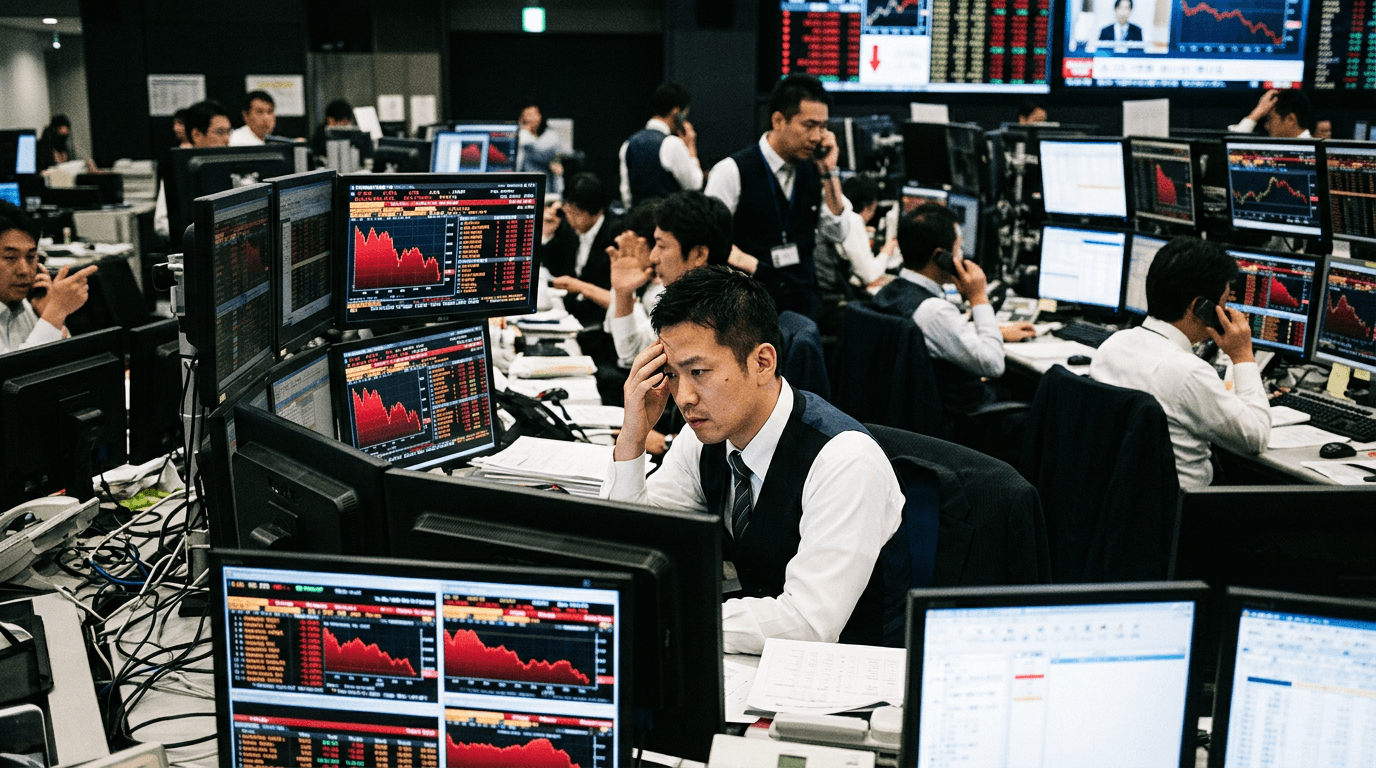
Asian equity markets are in full risk-off mode, with benchmark indices across the region posting some of their sharpest declines of the year as a deepening technology rout forces investors to reassess the AI-driven boom. From Seoul and Tokyo to Taipei and Hong Kong, traders are aggressively unwinding positions in high-growth chip and software names, pulling broader indices into correction territory and reigniting volatility across global assets[2][3][7][12]. This is more than a localized selloff: it is a sentiment shock with the potential to spill into equity futures, FX safe havens, and even crypto markets as investors scramble for protection[6][9][12].
Markets In Risk-off Mode
The current move has all the hallmarks of a classic risk-off episode: sharp declines in previously high-flying sectors, elevated intraday volatility, and a rapid shift from growth to defensiveness. South Korea’s Kospi has slumped close to 10% from recent record highs, triggering a temporary trading halt as circuit breakers were hit[3][7][17]. Japan’s Nikkei, packed with technology and chip-related names, has swung from record levels into correction territory, falling more than 10% from its recent peak and dropping over 5% in a single session during the worst of the rout[2][12]. Taiwan’s tech-heavy Taiex index has similarly seen declines in the mid-single digits in a day, its steepest pullback in months[2][9].
The selling pressure is not confined to a handful of markets. MSCI’s broad index of Asia-Pacific shares outside Japan has dropped around 2.7% in a single session as investors fled risk across the region[12]. Hong Kong’s Hang Seng and India’s Nifty have also been dragged lower, albeit more modestly, reflecting a generalized de-risking from equities rather than idiosyncratic country-specific stress[6][7]. Foreign investors have accelerated outflows, dumping nearly $10 billion in Asian equities in just one week as they reassess both valuations and the macro backdrop[10]. For traders, this matters because it signals a regime shift: capital that had been chasing AI-linked growth stories is now actively seeking safety or sitting on the sidelines.
WHAT’S DRIVING THE TECH ROUT?
At the heart of the selloff is a classic problem in markets: valuations that overshoot underlying fundamentals. The past year’s rally in AI and semiconductor names – from chipmakers to cloud infrastructure providers – pushed many Asian technology stocks to record highs, with South Korea’s Kospi and Japan’s Nikkei among the world’s best-performing major indices[3][6][7]. As long as the narrative of limitless AI-driven demand held, investors were willing to pay increasingly rich multiples for earnings that were often years in the future.
That narrative has been challenged on several fronts. Disappointing guidance from major chipmakers, including AI hardware leaders, has reminded markets that ramping up capacity requires enormous capital expenditure and that payoff timelines are uncertain[1][10]. At the same time, stronger-than-expected U.S. jobs data has rekindled fears that central banks – especially the Federal Reserve – may need to keep policy tighter for longer, or even consider additional rate hikes down the line[1][4][11]. Higher discount rates mechanically reduce the present value of long-duration growth stories, and few sectors are more exposed to that dynamic than technology.
Layered on top of this are macro and geopolitical risks. Renewed tensions in the Middle East, including attacks involving Iran and Israel, have pushed oil prices higher and helped support the U.S. dollar, feeding into inflation and policy uncertainty[1][11]. Trade frictions and U.S.-China tensions over technology and security further complicate the outlook for Asian chipmakers and exporters[6]. The result is a fragile mood where any disappointment – whether in earnings, data, or geopolitical headlines – can quickly become the trigger for broad de-risking.
Spillover Into Futures, Fx And Crypto
A deep selloff in Asian cash equities rarely stays contained. Equity futures in the U.S. and Europe are already reflecting the risk-off tone, with contracts tied to major indices softening as the tech-led volatility in Asia ripples across time zones[6][11][12]. For traders, this is a reminder that Asian sessions often set the tone for the trading day: large overnight moves in Nikkei or Kospi futures can pre-position global portfolios for weaker openings in the S&P 500, Nasdaq, or Euro Stoxx.
In FX, the pattern is equally familiar. When growth-sensitive assets come under stress, flows tend to move toward perceived safe havens – most notably the U.S. dollar and, at times, the Japanese yen and Swiss franc[11][12]. Recent sessions have seen the dollar remain firm against regional currencies, while swings in yen crosses highlight how equity volatility can translate into FX turbulence[11]. For traders running leveraged positions in currency pairs, these knock-on effects can be as important as the equity moves themselves, since margin requirements and stop-loss levels may be hit by sudden spikes in volatility.
Crypto markets have not been immune. As investors reassess risk exposure, there has been a retreat from speculative assets, including cryptocurrencies, following the reversal of an earlier AI-related rebound in U.S. tech shares[9][12]. When high-beta assets such as AI stocks and crypto move together during risk-off episodes, correlations spike, and portfolios that appeared diversified can behave like a single trade. That correlation risk is one of the key lessons of this tech rout.
Lessons For Traders And Simulated Finance
For active traders and those using simulated finance platforms, episodes like this are invaluable live case studies in market dynamics under stress. The Asian tech rout compresses several key themes into a short time frame: valuation repricing, macro shocks, position unwinds, and cross-asset contagion. Trading these moves successfully requires more than directional guesses; it demands a framework for risk management and scenario planning.
In a simulated environment, traders can test how strategies perform when volatility spikes and liquidity thins. For example, one can model the impact of a sudden 8–10% drop in a major index, combined with widening bid–ask spreads in single-name tech stocks and a concurrent move higher in the dollar and oil[3][7][11][12]. How do different position-sizing rules fare? Do stop-losses trigger at sensible levels, or do they force exits at the worst possible moments? How does adding hedges via index futures or options change portfolio drawdowns? Answering these questions in a risk-free setting helps traders build robust playbooks before deploying capital in live markets.
Practical Takeaways For Risk Management
Several practical lessons emerge from the current selloff that traders can incorporate into both real and simulated strategies:
First, recognize concentration risk. When a portfolio is heavily tilted toward a single theme – such as AI or chips – a narrative shift can translate into outsized losses. Monitoring sector weights and the contribution of a handful of names to overall risk is essential.
Second, respect valuation and macro signals. Extended multiples, heavy capital expenditure plans, and data that point to tighter monetary policy are a warning sign that future returns may be more volatile. The combination of stretched valuations and rising rates has historically been challenging for growth stocks[1][4][11][16].
Third, plan for correlation spikes. In risk-off episodes, assets that normally offer diversification – equities in different regions, high-yield credit, and crypto – can move in tandem. Building scenarios where correlations jump toward one during stress helps assess how “diversified” a portfolio truly is.
Finally, think in terms of liquidity. In sharp selloffs, liquidity can evaporate in individual stocks, while index futures and major FX pairs remain tradeable. Having pre-defined rules for rotating into more liquid instruments when volatility surges can improve execution and reduce slippage.
Ultimately, the Asian tech rout is a reminder that markets are cyclical, narratives evolve, and risk can reprice quickly when conditions change. For traders and investors, the goal is not to avoid volatility altogether, but to understand it, prepare for it, and use disciplined risk frameworks—backed by both live experience and simulated practice—to navigate whatever the next regime brings.