
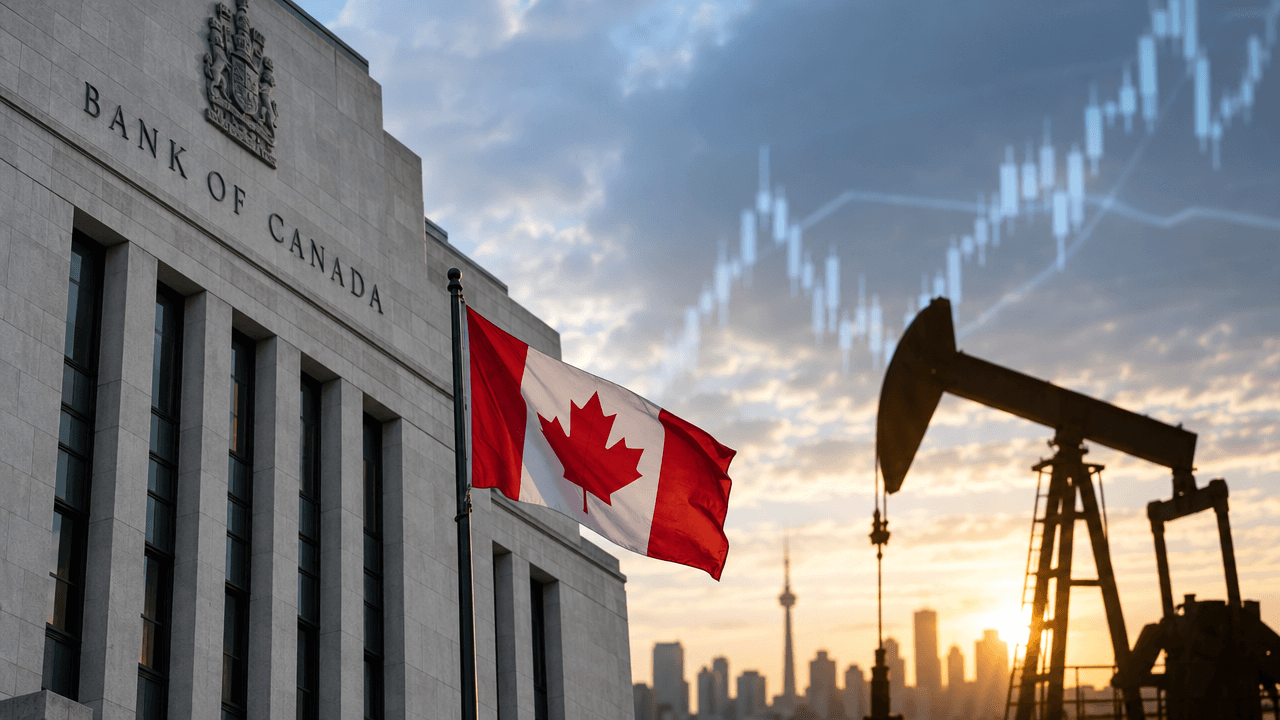
The Bank of Canada has raised its policy rate by 25 basis points to 2.50%, marking its first rate increase since July 2023. The decision reflects a growing concern that elevated energy prices could push inflation beyond a temporary shock and into a broader, more persistent increase in the cost of goods and services. For traders, the move creates a more complex market environment involving interest-rate expectations, oil prices, the Canadian dollar and global risk sentiment.
The central bank’s decision was widely anticipated, but its reasoning gives the announcement greater significance. Canadian headline inflation has remained around 3% since April, while the Bank expects inflation to rise to approximately 3.5% by the end of 2026. Policymakers also anticipate inflation staying above 3% through much of next year before gradually moving back toward the 2% target in 2028. [3][8]
Why Energy Prices Are Central To The Decision
Energy prices affect inflation through two distinct channels. The first is direct. Higher prices for gasoline, diesel and heating oil immediately increase household expenses, transportation costs and utility bills. These increases can lift the consumer price index even when other areas of the economy remain relatively stable.
The second channel is indirect and potentially more important for monetary policy. Energy is an input for almost every industry. When fuel and transportation costs rise, businesses face higher expenses for manufacturing, shipping, agriculture, construction and retail distribution. Companies may initially absorb some of these costs, but prolonged price increases can encourage them to pass more of the burden on to customers.
The Bank of Canada said fuel prices were considerably higher than in July and expected to remain elevated for longer. It also pointed to business survey evidence suggesting that a larger share of companies intends to pass higher input costs on to consumers over the next year. [3][5] This cost pass-through increases the risk that an energy shock spreads into services and other categories that are less directly connected to oil.
A rate hike cannot produce more gasoline or reduce global crude oil prices. Instead, it works by moderating demand and inflation expectations. Higher borrowing costs can discourage consumption, business expansion and investment, reducing the ability of companies to raise prices broadly.
What The Rate Hike Means For The Canadian Dollar
In conventional currency analysis, a higher policy rate can support the Canadian dollar. When Canadian interest rates rise relative to those in other major economies, Canadian assets may become more attractive to international investors. Higher expected returns can increase demand for the currency, particularly if traders believe additional rate increases may follow.
The Canadian dollar may also receive support from elevated oil prices because Canada is a major energy exporter. Stronger energy revenues can improve the country’s trade position and increase demand for Canadian dollars. However, this relationship is not automatic. A persistent energy shock can also raise concerns about inflation, weaken global growth and trigger broader risk aversion.
That creates competing forces for the Canadian dollar. The rate hike is currency-positive because it improves Canada’s interest-rate differential. High oil prices may also be supportive through the export channel. But if geopolitical uncertainty causes investors to reduce exposure to risk-sensitive currencies, the Canadian dollar could struggle despite the Bank’s move.
Traders should therefore monitor USD/CAD alongside crude oil, Canadian bond yields and broader measures of market volatility. A rising Canadian two-year yield combined with stable or falling USD/CAD would suggest markets are emphasizing the monetary-policy effect. If oil rises while USD/CAD also climbs, global risk aversion may be overwhelming domestic rate support.
The Policy Signal For Future Meetings
The October increase should not automatically be interpreted as the beginning of an aggressive tightening cycle. The Bank has emphasized that future decisions will depend on incoming data and the evolution of inflation. Nevertheless, the move signals that policymakers are willing to act pre-emptively when they believe temporary price pressures could become embedded in wage and business pricing decisions.
The key question is whether inflation expectations remain anchored. If households and businesses begin to assume that higher prices will continue, workers may seek larger wage increases and companies may adjust prices more frequently. That dynamic can make inflation harder to control and require more restrictive policy later.
For that reason, traders will pay close attention to upcoming inflation reports, wage data, household spending, business surveys and employment figures. A sequence of stronger-than-expected releases could increase expectations for further rate hikes. Conversely, evidence that core inflation is cooling and consumer demand is weakening could encourage the Bank to hold at 2.50% while it assesses the economic impact.
Practical Takeaways For Simfi Traders
First, avoid treating the rate decision as a one-directional Canadian dollar signal. The immediate reaction may favor the loonie, but oil prices, equity-market sentiment and geopolitical headlines can quickly change the balance.
Second, watch interest-rate expectations rather than focusing only on the announced rate. Currency markets often move more on the expected path of policy than on the current decision. A hike accompanied by cautious guidance may produce a smaller currency response than a hold with strongly hawkish language.
Third, consider scenario planning. In a persistent-inflation scenario, Canadian yields and the Canadian dollar could rise as markets price additional tightening. In a growth-scare scenario, oil may weaken, risk aversion may increase and USD/CAD could rise despite higher Canadian rates. A disinflation scenario would likely reduce expectations for further hikes and place renewed pressure on the loonie.
Finally, manage position size around data releases. Central-bank decisions can produce sharp moves, but the first reaction is not always the lasting trend. Using predefined risk levels, avoiding excessive leverage and waiting for confirmation can be more valuable than attempting to predict every headline-driven fluctuation.
Conclusion
The Bank of Canada’s move to 2.50% is a response to the growing persistence of energy-driven inflation, not simply a reaction to one month of higher fuel prices. Policymakers are trying to prevent elevated energy costs from spreading through the broader economy and becoming embedded in expectations.
For markets, the decision creates both support and uncertainty for the Canadian dollar. Higher rates and strong oil prices can help the currency, while global risk aversion and concerns about economic growth can work in the opposite direction. The most important developments from here will be the direction of core inflation, evidence of business cost pass-through and whether energy prices remain higher for longer.
For SimFi traders, the broader lesson is clear: central-bank decisions should be analyzed as part of an interconnected system. Interest rates, commodities, inflation expectations and risk sentiment must be considered together. That framework can help traders respond to market developments with discipline rather than relying on a single headline.