
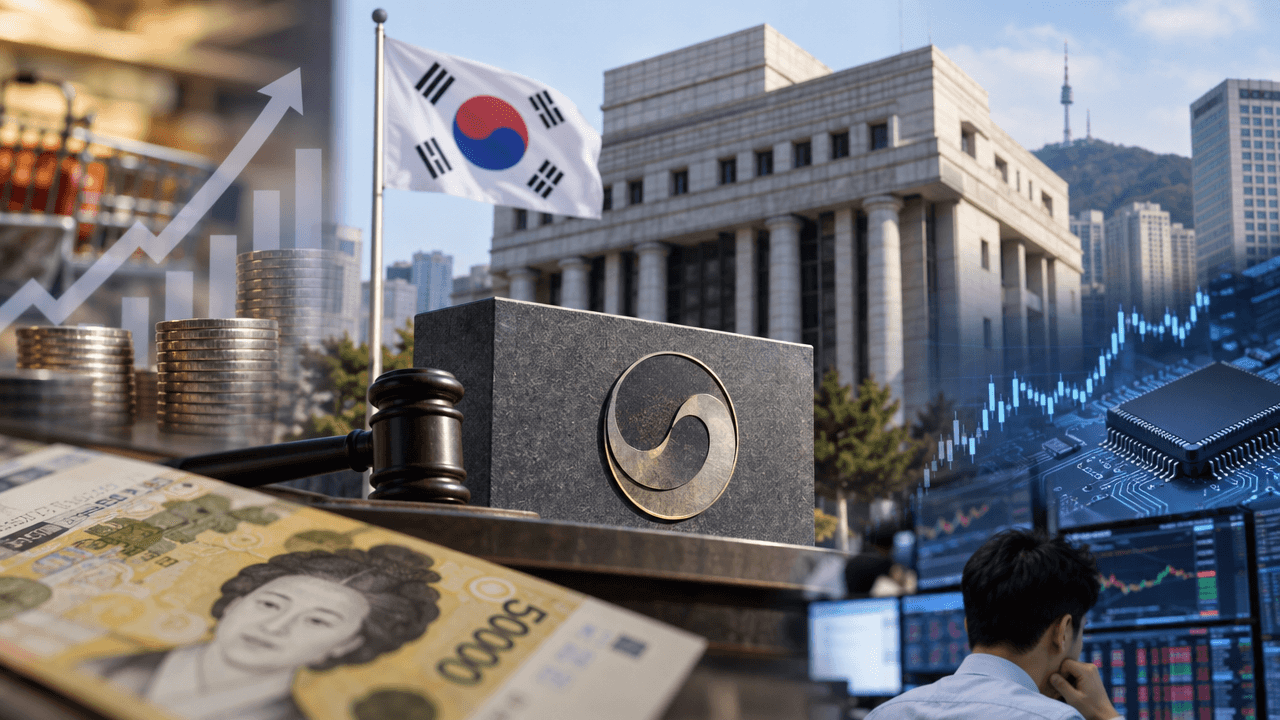
The Bank of Korea’s decision to hold its policy rate at 3% marks a pause, not necessarily a change in direction. After raising rates by 25 basis points in both July and August, the central bank chose to evaluate how those increases are affecting inflation, growth, household finances, and financial stability. The unanimous decision by all seven Monetary Policy Board members was widely anticipated, but its message remains important for traders: Korean monetary policy is still restrictive, and another hike remains possible. [1][13]
Why The Bank Of Korea Paused
The Bank of Korea said it needed more time to assess the impact of its two recent rate increases. The July and August moves lifted the benchmark rate from 2.5% to 3%, representing the first consecutive rate hikes since early 2023. Rather than immediately deliver a third increase, policymakers opted to observe incoming economic data and the delayed effects of tighter financial conditions. [5][9]
Interest-rate policy works with a lag. Higher borrowing costs can take months to influence household spending, corporate investment, housing demand, and employment. A pause allows policymakers to determine whether inflation is slowing without unnecessarily weakening economic activity.
The decision also reflects a complicated external environment. The Bank of Korea highlighted uncertainty surrounding the Middle East conflict, monetary policy in major economies, and fiscal developments abroad. These factors can influence energy prices, global trade, capital flows, and the South Korean won.
Inflation, Growth, And The Won
The rate hold should not be interpreted as a declaration that inflation risks have disappeared. The central bank indicated that inflation remained elevated at around 3%, above its 2% medium-term target. It also said domestic growth had remained solid, supported by exports and investment. [11]
This combination creates a difficult policy balance. Strong exports can support corporate earnings and economic growth, but they may also increase demand for labor, materials, and transport. Meanwhile, imported energy and commodity costs can rise if geopolitical tensions intensify or if the won weakens against the U.S. dollar.
Currency movements are especially important for South Korea because the country is deeply integrated into global manufacturing and trade. A weaker won can improve the competitiveness of exporters, but it also raises the local-currency cost of imported goods. That can add to inflation and make it more difficult for the central bank to ease policy.
For traders, the key lesson is that a rate hold does not automatically mean a bullish signal for Korean equities or a bearish signal for the won. The market reaction depends on how the decision compares with expectations and how investors interpret the central bank’s forward guidance.
Implications For Asian Markets
The decision came during a broader period of weakness across Asia-Pacific markets, with technology shares facing pressure. South Korea’s equity market is particularly sensitive to global technology sentiment because major listed companies are heavily exposed to semiconductors, electronics, artificial intelligence infrastructure, and international demand.
Higher interest rates can weigh on technology valuations by increasing the discount rate applied to future earnings. Growth-oriented companies, whose profits may be expected further in the future, are often more sensitive to changes in bond yields and central-bank expectations.
At the same time, a restrictive policy stance can support the currency by improving the relative attractiveness of domestic assets. That support may be limited if U.S. yields rise, global risk appetite deteriorates, or investors seek safer assets during periods of geopolitical uncertainty.
The Bank of Korea’s decision therefore matters beyond South Korea. It adds to the regional central-bank narrative and provides another example of policymakers trying to balance inflation control with the risks created by tighter financial conditions.
What Traders Should Watch Next
The next major focus will be the data released before the Bank of Korea’s next scheduled policy meeting on November 26. Policymakers specifically pointed to third-quarter gross domestic product and October inflation figures as important inputs for future decisions. [3][13]
A stronger-than-expected growth reading, persistent inflation, or renewed weakness in the won could increase expectations for another rate hike. By contrast, softer inflation, weaker domestic demand, or signs that higher borrowing costs are damaging household and business activity could support a longer pause.
Traders should monitor several connected markets rather than focusing only on the policy rate. The USD/KRW exchange rate can reveal changing expectations for capital flows and imported inflation. Korean government bond yields can show whether investors are pricing additional tightening. The KOSPI and technology shares can indicate how markets are assessing the impact on corporate financing and future earnings.
For SimFi traders, this is an opportunity to practice scenario-based decision-making. Before entering a position, define what would happen if inflation exceeds expectations, if growth slows, or if global technology stocks continue to decline. Consider position size, stop-loss levels, and the possibility of sharp volatility around economic data releases. A simulated environment allows traders to test whether their strategy can withstand multiple outcomes without risking real capital.
The Bigger Picture
The Bank of Korea’s 3% rate decision represents a pause in tightening rather than a clear pivot toward easier policy. The central bank remains concerned about inflation and financial stability, while robust exports give it room to maintain a restrictive stance. At the same time, geopolitical risks, regional market weakness, and pressure on technology shares make an immediate follow-up hike less straightforward.
The most important message for markets is that future policy will remain data-dependent. Traders should avoid assuming that a hold guarantees rate cuts or that another hike is certain. Instead, they should track inflation, growth, currency performance, bond yields, and global risk sentiment together.
For investors and SimFi participants alike, the decision reinforces a central principle of macro trading: the headline is only the starting point. The greater opportunity often comes from understanding what policymakers are watching, how markets interpret the guidance, and which economic scenario is already reflected in prices.