
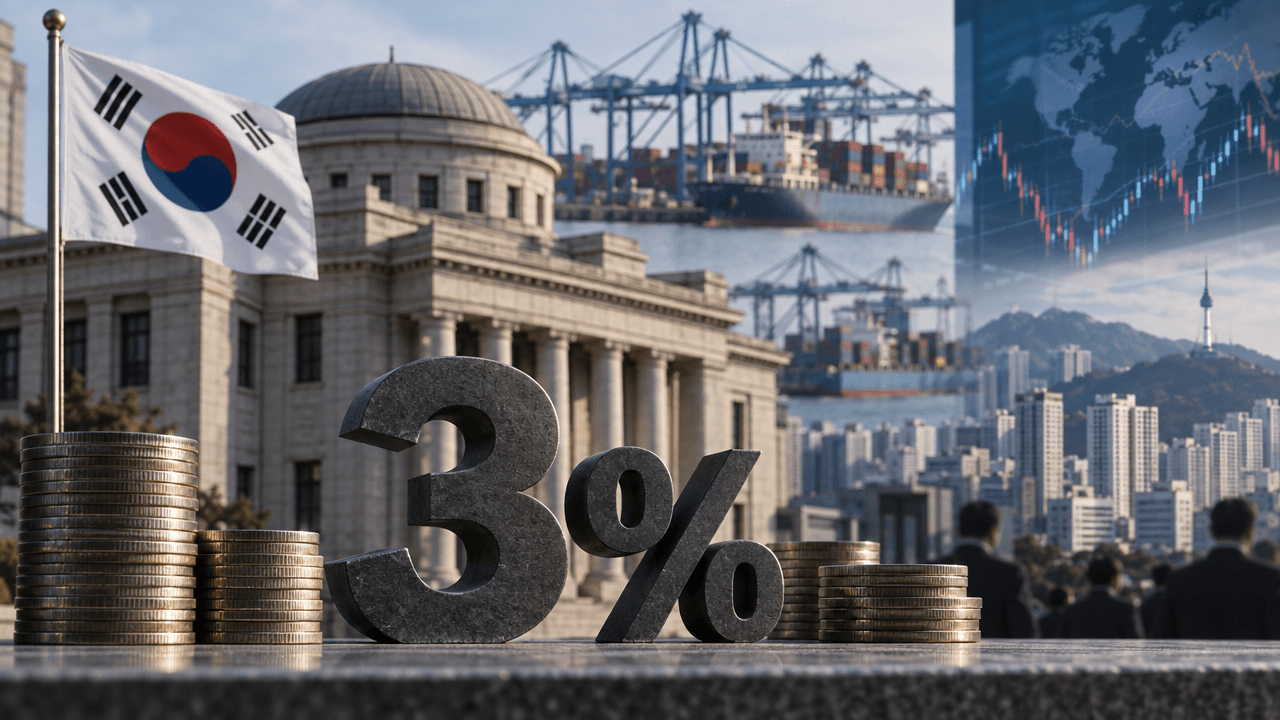
The Bank of Korea’s decision to hold its benchmark interest rate at 3.00% was widely expected, but the pause still carries important signals for traders. After raising rates by 25 basis points in both July and August, policymakers chose to assess the effects of their tightening campaign rather than deliver a third consecutive increase. The decision reflects a central bank attempting to balance persistent inflation, strong export growth, financial stability risks, and pressure from global markets. [1]
Why The Bank Of Korea Paused
The July and August increases lifted the policy rate from 2.50% to 2.75%, and then to 3.00%. These were the Bank of Korea’s first consecutive rate hikes in more than three years, described by policymakers as a preemptive response to mounting inflationary pressure. [4]
A pause after two rapid increases does not necessarily represent a shift toward easier monetary policy. Instead, it gives policymakers time to observe how higher borrowing costs affect household demand, business investment, housing activity, and consumer prices. Monetary policy works with a lag, meaning the full impact of July and August’s decisions may not yet be visible in economic data.
The central bank also kept the door open to additional tightening. Reports indicate that the BOK maintained a hawkish tone while highlighting the need to evaluate external risks and the delayed effects of its recent decisions. [6] This creates an important distinction for market participants: the Bank of Korea has paused, but it has not clearly ended its tightening cycle.
Growth, Inflation, And Export Momentum
South Korea’s economic outlook has been supported by strong exports, particularly in the semiconductor sector. Robust chip demand has helped offset some weakness in domestic activity and has contributed to a more optimistic view of economic growth. The BOK reportedly upgraded its growth forecasts for this year and next year compared with its August projections. [6]
Stronger growth can give a central bank more flexibility to maintain higher interest rates. If exports remain resilient, policymakers may be less concerned that restrictive policy will immediately push the economy into a sharp contraction.
At the same time, stronger demand can create additional inflationary pressure. Core inflation had already become a concern before the August hike, with readings reaching their highest level since December 2023, according to reporting at the time. [14] The BOK therefore faces a difficult policy equation: rates must be high enough to contain prices, but not so high that they unnecessarily damage domestic consumption and investment.
Housing and household debt add another layer of complexity. South Korea has historically faced elevated household leverage, making borrowers sensitive to higher interest rates. Additional hikes could help cool property prices and credit growth, but they would also increase debt-servicing costs for households and businesses.
The Global Market Backdrop
The decision arrives during a challenging period for Asian financial markets. Regional currencies and equities have faced pressure from weaker market conditions and elevated global yields. Higher yields in major bond markets can draw capital away from emerging and developed Asian markets alike, particularly when investors expect interest rates to remain higher for longer.
For the South Korean won, the BOK’s policy stance matters because interest-rate differentials influence international capital flows. A higher domestic rate can support the currency by improving the relative return on won-denominated assets. However, currency movements also depend on global risk appetite, energy prices, trade conditions, and the direction of the U.S. dollar.
A pause at 3.00% may therefore produce a mixed market reaction. It avoids the immediate economic pressure of another hike, but it may provide less support for the won than a further increase would have. If global yields continue climbing, South Korean assets could remain vulnerable even with the BOK maintaining a restrictive policy.
What Traders Should Watch Next
The most important question is whether this pause becomes a temporary assessment period or the beginning of a longer holding pattern. Traders should focus on several indicators.
First, inflation data will show whether the July and August hikes are beginning to cool price pressures. Persistent core inflation would increase the probability of another hike, while a sustained moderation could support an extended pause.
Second, market participants should monitor export and semiconductor data. Continued strength in chip demand would reinforce the BOK’s more optimistic growth outlook. A sudden slowdown, however, could make further tightening more difficult.
Third, watch the won, government bond yields, and housing indicators. A weakening currency or renewed property-market acceleration could encourage policymakers to act again. Conversely, tightening financial conditions and rising debt stress could persuade the central bank to remain on hold.
For SimFi traders, this event is a useful example of why central-bank decisions should not be interpreted solely as “hawkish” or “dovish.” The rate itself was unchanged, but the surrounding guidance, growth forecasts, currency reaction, and inflation outlook may create tradable volatility across foreign exchange, bonds, equity indices, and related Asian markets.
Practical Takeaways For Simfi Traders
Avoid assuming that an expected decision will produce no movement. Markets can react sharply to changes in forward guidance, forecasts, and press-conference language even when the policy rate matches expectations.
Separate the immediate headline from the broader trend. The BOK held rates at 3.00%, but its continued concern about inflation and confidence in export growth suggest that future hikes remain possible.
Manage exposure around volatility. Central-bank announcements can trigger rapid moves, wider spreads, and reversals as traders digest new information.
Finally, build scenarios rather than relying on a single forecast. A stronger won, higher Korean yields, and softer equities could indicate markets are pricing renewed tightening. A weaker won alongside falling yields might suggest investors are focusing more heavily on global risk or domestic growth concerns.
Conclusion
The Bank of Korea’s 3.00% rate decision is best understood as a strategic pause, not a definitive policy reversal. After two consecutive hikes, policymakers are giving the economy time to absorb tighter financial conditions while keeping attention on inflation, exports, household debt, and global yields.
For traders, the next major opportunity may come not from the rate decision itself, but from the data and guidance that determine whether another increase is needed. The balance between resilient semiconductor-led growth and persistent financial-market pressure will remain central to South Korea’s monetary-policy outlook.