
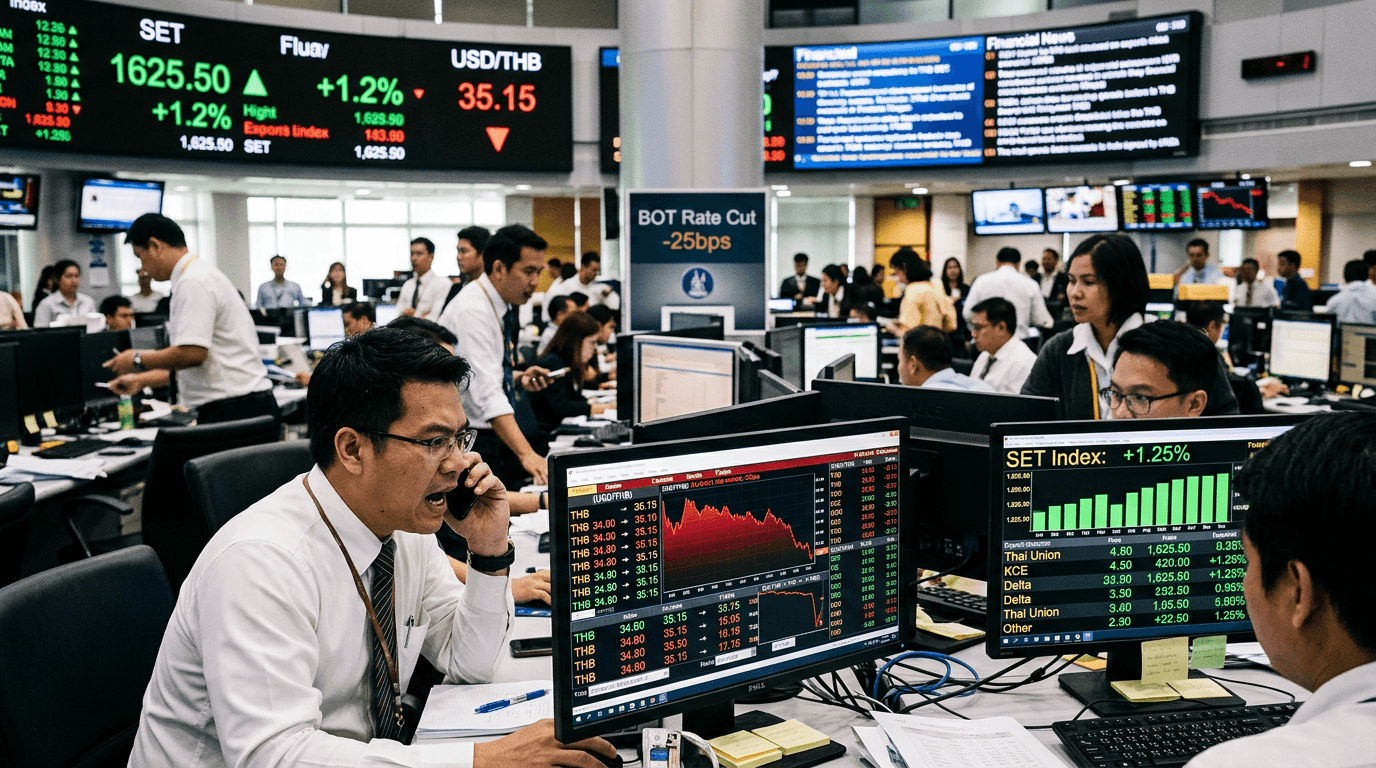
Thailand’s latest interest rate cut is doing exactly what policymakers signaled: easing financial conditions to support exporters and growth – and putting the baht under pressure in the process.[1] The move has reinforced expectations of a looser policy stance, helped export-linked equities, and left the Thai currency underperforming regional peers as investors reassess carry trades and capital flows.[1]
Policy Move In Focus
The Bank of Thailand (BoT) has been in easing mode as economic momentum softens and inflation remains subdued.[1][2] In December, the Monetary Policy Committee cut the policy rate by 25 basis points from 1.50% to 1.25%, citing an “apparent economic slowdown.”[2][3]
More recently, the central bank surprised parts of the market by cutting again by 25 basis points to 1.00%, despite expectations for a pause.[1] The finance minister openly framed the decision as a way to help exporters, signaling that growth and competitiveness in trade-sensitive sectors now sit at the top of the policy agenda.[1]
This clear alignment between fiscal authorities and the BoT sends a strong message: Thailand is willing to tolerate more currency weakness and policy divergence from the US Federal Reserve and other major central banks in order to support its domestic economy.[1]
Why The Baht Is Under Pressure
When a central bank cuts rates while others stay on hold or remain relatively tighter, yield differentials move against that currency.[1] With the policy rate now at 1.00%, Thailand’s yield gap versus the US has widened further, diminishing the appeal of baht-denominated assets for global investors seeking higher returns.[1]
Lower yields reduce the attractiveness of THB carry trades, prompting some unwinding of positions and encouraging portfolio flows toward higher-yielding markets.[1] This shift helps explain why the baht has underperformed regional peers following the latest cut, especially against currencies whose central banks are on a more hawkish or neutral path.[1]
At the same time, signaling that rate cuts are explicitly intended to help exporters reinforces expectations that policy will remain accommodative for longer.[1] Markets tend to price not just the move that has happened, but the path that may follow. That forward-looking repricing adds extra pressure to THB crosses and can increase short-term FX volatility as traders adjust positioning.
For Thailand, a weaker baht is a feature, not a bug, of this strategy. A softer currency makes Thai exports cheaper in foreign currency terms, improving price competitiveness in sectors such as electronics, autos, agriculture, and tourism services.[1]
Winners And Losers In Thai Markets
On the equity side, the policy mix of rate cuts plus a weaker baht is broadly supportive for growth-sensitive and export-oriented names.[1] Exporters benefit from both improved FX competitiveness and lower funding costs, which can help margins and investment capacity if global demand holds up. Tourism and hospitality names may also see a tailwind as Thailand becomes more affordable for foreign visitors.[1]
Domestic cyclicals – such as banks, consumer, and property – tend to welcome lower rates as well, since cheaper credit can support loan growth, investment, and household spending.[1] For banks, however, the trade-off is narrower net interest margins, so the net effect depends on how much volume growth offsets pressure on spreads.
In fixed income, rate cuts generally support local bond prices, particularly at the front end of the curve, where yields adjust most directly to policy shifts.[1] Shorter-dated government bonds can therefore see stronger demand, while the long end remains more sensitive to inflation expectations, fiscal policy, and global yield moves.[1]
The clear loser, at least near term, is the baht. As markets digest the policy shift and recalibrate expectations for further easing, the bias is toward a softer THB and higher FX volatility, especially versus the US dollar and other high-yield or commodity-linked currencies.[1]
What This Means For Traders And Investors
For FX traders, Thailand’s rate cut is a textbook example of how monetary policy divergence can reshape currency trends. A few practical angles to consider:
- THB crosses: Pairs like USD/THB and THB versus regional currencies may see continued volatility as positioning adjusts. The directional bias leans toward baht weakness while policy remains clearly dovish.[1]
- Carry dynamics: With Thailand moving down the yield spectrum, some investors may rotate away from THB carry trades toward higher-yield alternatives. This can reinforce downside pressure on the baht until valuations or positioning become stretched.
- Event risk: BoT meetings, inflation releases, and any fresh guidance from the finance ministry now take on heightened importance. Signals of additional cuts or tolerance for further FX weakness can trigger quick reactions across THB assets.
For equity investors, the key is to distinguish between segments that gain from a weaker currency and those that suffer:
- Beneficiaries: Exporters, tourism-related companies, and cyclical sectors linked to global trade stand out as potential winners if the baht remains on the softer side and global demand does not deteriorate sharply.[1]
- Potential laggards: Firms heavily dependent on imported inputs without pricing power may face margin pressure as a weaker baht makes imports more expensive. Investors need to monitor hedging practices and cost pass-through capabilities.
SimFi traders and portfolio builders can use the Thai case as a live learning tool: mapping how a single policy decision cascades through FX, rates, and equities, and testing strategies that respond to these correlations.
Outlook: Weaker Baht, Stronger Export Push
Looking ahead, much will depend on how growth, inflation, and global demand evolve. The BoT has already trimmed growth forecasts and highlighted downside risks, while inflation is expected to remain subdued before gradually returning to target.[1][2] That backdrop gives policymakers room to keep policy accommodative if needed.
As long as the priority remains reviving growth and export competitiveness, authorities are likely to tolerate a softer baht, particularly if currency weakness is orderly rather than disorderly.[1] For Thailand, the trade-off is clear: accept more FX volatility and weaker THB levels in exchange for support to exports, jobs, and domestic demand.
For traders and investors, this environment rewards a disciplined, cross-asset approach. Understanding how rate cuts affect currency valuations, bond yields, and sector performance is essential. Thailand’s latest move is a timely reminder that central bank decisions rarely stop at the policy rate – they ripple across markets, reshaping risks and opportunities for anyone exposed to the baht and Thai assets.