
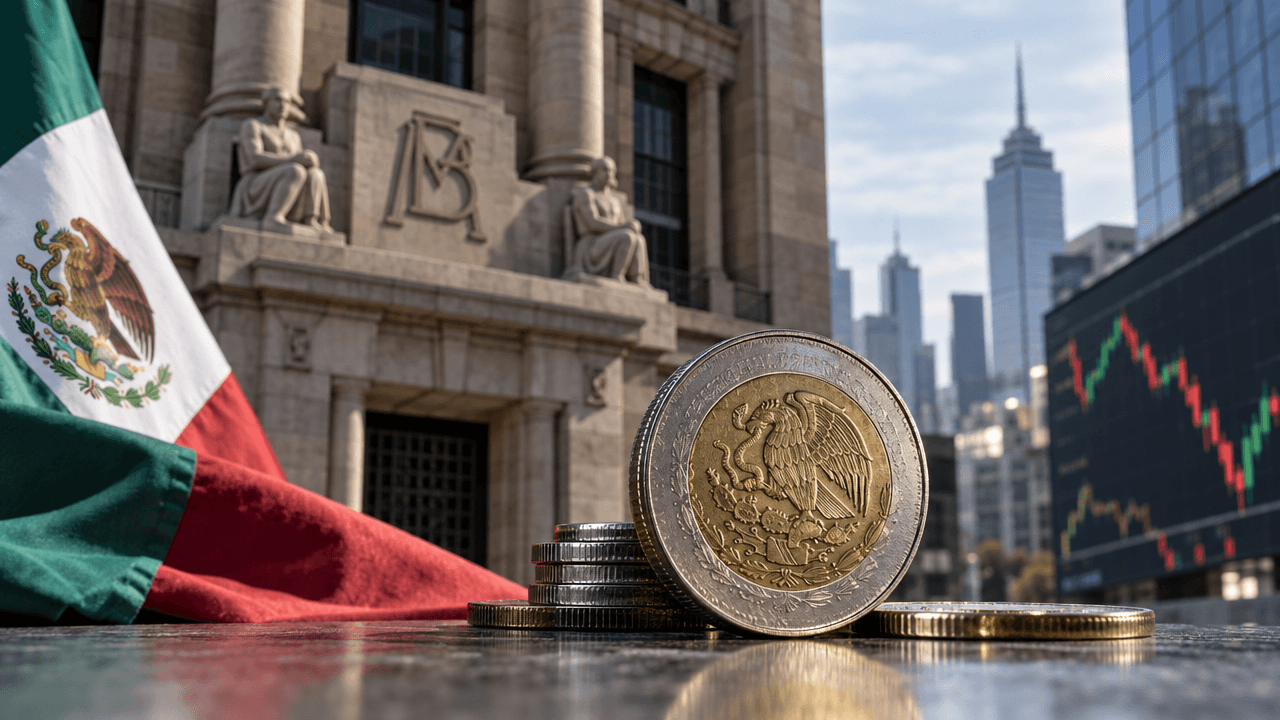
Mexico’s central bank, Banco de México (Banxico), has opted to keep its benchmark overnight rate unchanged at 6.50%, extending a pause that began earlier this year and reinforcing a stance of cautious stability in the face of persistent inflation pressures and global uncertainty.[9][12][14] For traders, this is not a “no-news” decision; it shapes the carry profile of the Mexican peso, the trajectory of local yields, and the way markets will react to upcoming data and U.S. policy moves.[7][13]
WHAT BANXICO’S HOLD SIGNALS
By holding the policy rate at 6.50%, Banxico has maintained the lowest level of interest rates seen in Mexico in more than four years, following a gradual easing cycle that cut the rate from a peak of 11.25% starting in March 2024.[1][2][13] That easing cycle culminated in a 25 basis point reduction in May 2026, after which the board signaled that policy was likely appropriately calibrated and that further cuts were unlikely.[1][2][8]
Since then, the central bank has kept the overnight interbank rate at 6.50% for several consecutive meetings, including the August and September decisions, with unanimous votes from its five-member governing board.[4][9][14] The latest statement keeps the rate unchanged for a third straight meeting and reiterates that future decisions will depend on how inflation and economic data evolve, rather than promising to hold at current levels indefinitely.[10][13][14]
For market participants, this shift in language matters. It suggests Banxico believes the current rate is broadly neutral for the economy, but wants flexibility to respond either way if inflation or growth surprise in coming months.[8][13] That opens the door to a more data-dependent, potentially more volatile reaction function, which traders need to incorporate into scenario planning and risk management.
Inflation, Growth And The Policy Trade-off
Banxico’s reluctance to cut further is rooted in inflation dynamics that remain uncomfortable, even if headline price growth has moderated from its prior highs.[1][7][13] Core inflation has proven sticky, and the bank continues to describe the balance of risks to inflation as tilted to the upside, pointing to global factors such as renewed conflict in the Middle East, higher energy prices, and uncertainty around U.S. economic policy.[13][15]
At the same time, Mexico’s economy has slowed from the post-pandemic rebound, creating pressure to support growth without undermining price stability.[2][3][12] Holding the rate at 6.50% reflects an attempt to strike a delicate balance: avoid reigniting inflation by easing prematurely, while not tightening conditions unnecessarily in an environment where real rates are still positive and financial stability is broadly intact.[1][3][8]
For traders, this trade-off translates into a central bank that is highly sensitive to inflation surprises. Hot CPI prints, stronger-than-expected wage data, or renewed commodity price spikes could quickly shift expectations toward a longer hold or even a mild re-tightening bias.[7][13] Conversely, a clear continuation of the disinflation process, coupled with weaker activity data, could revive speculation about future modest cuts—but Banxico will likely require sustained evidence before changing course.[1][8][14]
Peso, Global Yields And Market Sensitivity
A steady policy rate at 6.50% offers near-term support to the Mexican peso by preserving its carry appeal compared with lower-yielding developed markets.[7][12] Investors looking for yield in an environment of still-low rates in parts of the world often view MXN as a carry candidate, and an unchanged Banxico stance reduces immediate policy uncertainty.[8][15]
However, the peso’s outlook remains highly sensitive to external drivers. U.S. Treasury yields, the broader direction of the U.S. dollar, and global risk appetite all influence MXN performance, sometimes more than domestic rate decisions.[3][7] If U.S. yields rise or the dollar strengthens sharply, the relative attractiveness of Mexican carry can erode, even with Banxico on hold, leading to pressure on the currency and local bonds.[3][12]
Inflation risks also matter for FX. Any sign that Mexican inflation is reaccelerating while Banxico remains cautious about further cuts could preserve or increase real yields, potentially supporting the peso, but at the cost of higher macro volatility.[1][7][13] On the flip side, a benign inflation path would keep markets focused on when the bank might eventually ease again, which could reduce carry but support domestic growth-sensitive assets.
For traders, the takeaway is clear: the rate hold stabilizes one piece of the puzzle, but MXN remains a macro-sensitive currency that demands continuous monitoring of global yields, commodity prices, and geopolitical developments alongside Banxico’s communications.[3][7][13]
Implications For Traders And Simulated Finance Participants
For active traders and those using Simulated Finance platforms to build skills, Banxico’s decision offers an ideal case study in how monetary policy interacts with markets in real time. With the rate on hold, price action in MXN, local bonds, and equity indices will be driven less by surprise rate changes and more by shifts in expectations around inflation, growth, and global risk.[3][7][12]
Practically, there are several actionable angles to explore:
1) Scenario testing: Build and test scenarios around different inflation outcomes—strong disinflation, sticky inflation, or renewed price pressures—and map how each could affect Banxico’s reaction function and MXN performance.
2) Event trading: Track Mexican inflation releases, Banxico minutes, and major U.S. data (especially inflation and Fed decisions) as key catalysts. Practice structuring short-term trades around these events, focusing on position sizing and risk-reward.
3) Carry and volatility: Experiment with simulated carry trades in MXN pairs, but overlay volatility management rules, such as using options structures or dynamic hedging, to model how sharp moves in U.S. yields or global risk sentiment can affect positions.
4) Cross-market analysis: Use the current rate hold to study correlations between MXN, Mexican government bond yields, and regional EM FX, noting how shared drivers like commodity prices or geopolitical headlines ripple across assets.
For both new and experienced traders, the goal is to move beyond headline reactions and understand the underlying macro framework that drives Banxico’s choices and the market’s response. That deeper understanding improves decision-making when volatility spikes and helps avoid overreacting to routine, well-telegraphed policy decisions.[8][10][14]
Conclusion: Stable Rate, Active Market
Banxico’s decision to hold its policy rate at 6.50% underscores a phase of cautious stability in Mexican monetary policy, with the bank signaling that it views current settings as broadly appropriate but remains ready to adjust if inflation or growth deviate from its baseline.[1][8][14] While this reduces near-term policy uncertainty, it does not eliminate macro risk; inflation remains a central concern, and global factors—from U.S. yields to geopolitical tensions—continue to shape Mexico’s outlook.[3][7][13]
For markets, the rate hold is modestly supportive of the peso and Mexican assets, but the real story lies in how expectations evolve from here.[7][12] Traders who focus on the interplay between domestic data, Banxico’s forward guidance, and external conditions will be better positioned to navigate MXN moves than those who treat the decision as a static, one-off event.[3][15]
In a SimFi environment, this is precisely the kind of development that can be used to refine macro trading strategies: a non-surprise policy move with meaningful implications for inflation trajectories, carry dynamics, and cross-asset correlations. By treating Banxico’s 6.50% hold as a live laboratory for monetary policy and market behavior, traders can build robust, data-driven frameworks that serve them well across future decisions—both in Mexico and in other emerging markets facing similar trade-offs.[1][8][13]