
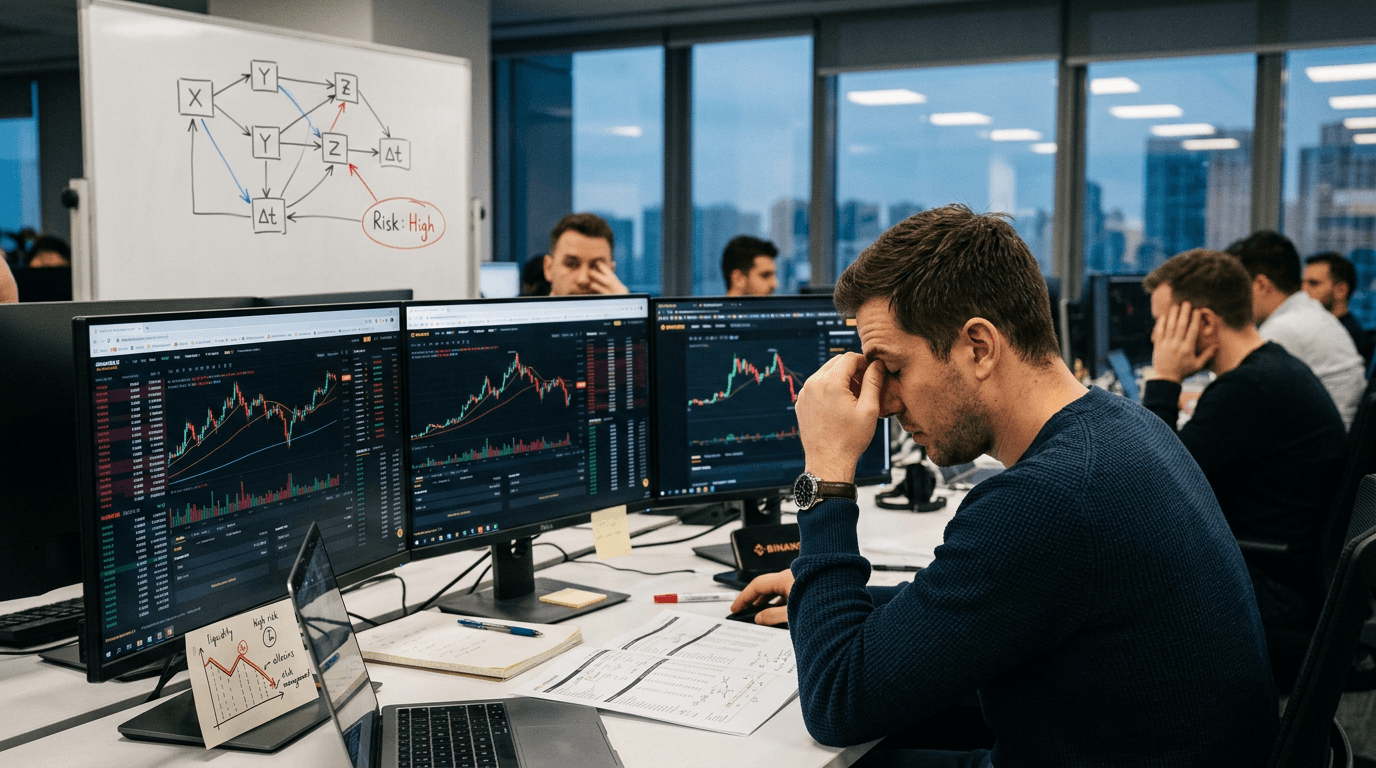
Binance’s latest delisting announcement is a reminder that exchange risk is just as real as market risk for crypto traders. On August 17, the exchange is removing six tokens—Across Protocol (ACX), Hashflow (HFT), PIVX, Vulcan Forged PYR (PYR), Vanar (VANRY), and Viction (VIC)—from spot trading and is phasing out associated futures, margin, lending, and other products over the following weeks.[1][3][11] For anyone active in speculative altcoins, this change tightens liquidity and limits derivatives opportunities in these names, with knock-on effects for volatility and risk management.[3][6][11]
What Exactly Binance Is Changing
Binance has scheduled the delisting of all spot trading pairs involving ACX, HFT, PIVX, PYR, VANRY, and VIC at 03:00 UTC on August 17, 2026, after a periodic listing review.[1][4][7] Once spot pairs are removed, any open spot orders in these markets are automatically canceled, and new trades can no longer be placed on the exchange.[1][11][14]
The impact goes beyond spot. Over the weeks following the delist date, Binance plans to wind down related futures contracts, margin trading pairs, crypto lending programs, convert functions, and other earn or structured products linked to these six tokens.[3][11][14] This staged phase-out is intended to give traders time to close positions and redeem or reallocate assets tied to those markets.[1][11][14]
For holders of these tokens on Binance, that means three concrete changes:
- You will no longer be able to buy or sell these tokens on Binance spot markets after trading stops.[1][3][11]
- You will gradually lose the ability to trade them with leverage or hedge via futures, options, or margin pairs on the platform.[3][6][11]
- You will need to decide whether to withdraw the tokens to self-custody or another venue, or to exit the position entirely before key deadlines hit.[1][6][11]
Why Exchanges Delist Tokens
Binance, like most major exchanges, runs periodic reviews of listed tokens based on criteria such as trading volume, liquidity, project development progress, network stability, and regulatory or compliance risk.[1][6][15] When a token no longer meets internal standards, or when risk-reward skews unfavorably for the venue, delisting becomes a real possibility.[1][6][15]
In this case, Binance’s review flagged concerns such as insufficient trading activity, weaker development traction, and other listing metrics that no longer justified full support for these six assets.[6][14][15] That does not necessarily mean the underlying projects are dead; rather, the cost and risk of maintaining markets for them on a top-tier exchange may exceed the benefits.
For traders, the key takeaway is that listing is not permanent. A token can be technically sound, have a dedicated community, and still lose its spot on a major exchange if:
- Volumes dry up and order books thin out.
- The project fails to ship updates or maintain transparent communication.
- Regulatory or compliance questions increase the venue’s risk exposure.
This is why exchange risk is a core dimension of altcoin investing. Price charts alone do not fully capture the probability that a token’s main liquidity venue may disappear with a few weeks’ notice.
How Delistings Affect Liquidity, Volatility, And Risk
The immediate market impact of a delisting often shows up in liquidity and spreads rather than just headline price. As the delist date approaches, some holders rush to exit, while others move tokens to alternative exchanges or on-chain liquidity pools.[3][5][6] Order books can thin out, spreads widen, and slippage increases, especially for larger tickets.
When futures and margin pairs are removed, speculative open interest in those markets must be unwound, which can amplify short-term volatility.[3][6][11] Traders who previously hedged spot holdings using derivatives lose a convenient tool, forcing them either to reduce exposure outright or to seek more fragmented liquidity elsewhere.
For the broader altcoin market, the removal of six smaller tokens from Binance slightly tightens conditions for speculative trading. The effect is incremental rather than systemic, but it still matters for:
- Market makers, who may withdraw capital from illiquid venues rather than chase displaced flow.
- Retail traders, who lose easy access and leverage on these specific names.
- Price discovery, which shifts more heavily to smaller exchanges or decentralized venues with different liquidity profiles.
From a risk perspective, the most important point is that liquidity can vanish faster than most models assume. If your strategy relies on being able to exit within a certain spread or depth, a delisting event can instantly invalidate those assumptions.
Practical Steps For Traders Holding The Affected Tokens
If you hold ACX, HFT, PIVX, PYR, VANRY, or VIC on Binance, treating this as a structured risk-management exercise is better than reacting emotionally at the last minute.[1][3][11]
Concrete steps to consider
- Review spot balances and any open orders in these tokens and decide whether you want to hold, exit, or migrate to another venue.
- Check for any active margin, lending, or derivatives positions tied to these assets and plan an orderly unwind before product-specific deadlines.
- Evaluate liquidity and counterparty risks on alternative centralized exchanges or decentralized pools if you intend to keep exposure.
- Adjust portfolio concentration limits so that any single token’s delisting would not materially disrupt your strategy in future.
This is also a good moment to update your playbook. For every token in your portfolio, ask: What happens if its primary exchange delists it with 2–3 weeks’ notice? Where is backup liquidity? How will you manage slippage, and what signals would prompt you to exit preemptively?
Lessons For Simulated Traders And Strategy Design
For traders practicing on SimFi platforms like E8 Markets, events like this are ideal case studies to incorporate into your simulated environments. While no real capital is at risk, you can test how your strategies behave when:
- A core market suddenly loses spot and derivatives liquidity.
- You can no longer hedge using familiar futures pairs.
- You must exit or rebalance under worsening spreads and thinner order books.
Simulated trading allows you to rehearse delisting scenarios in advance: modeling forced position unwinds, staggered exits, and reallocation into correlated assets or stablecoins. By building these stress-test conditions into your practice regime, you train yourself to respond with a plan rather than panic when similar events occur in live markets.
You can also use this event to refine your asset selection criteria. In a simulated portfolio, experiment with:
- Imposing minimum liquidity thresholds for any token you trade.
- Scoring projects based on development activity, communication, and exchange listing risk.
- Limiting exposure to tokens that rely heavily on a single venue for the majority of their trading volume.
These design choices can materially improve the resilience of your strategy, whether you trade altcoins, derivatives, or multi-asset portfolios.
Conclusion
Binance’s decision to delist ACX, HFT, PIVX, PYR, VANRY, and VIC and to phase out related futures, margin, and earn products is a targeted move, not a systemic shock—but it carries valuable lessons.[1][3][11] Exchange listings are conditional, liquidity is fragile, and leverage access can disappear faster than prices reflect.
For active traders, the priority is to manage the immediate operational steps: closing or migrating positions, reassessing liquidity, and tightening risk parameters around similar altcoin exposures. For simulated traders, this is an opportunity to build more realistic stress scenarios into your training and to bake exchange risk into your framework from day one.
In both cases, the edge goes to the trader who plans for delistings, rather than the one who is surprised by them. Crypto markets will continue to evolve, exchanges will keep pruning their listings, and those who incorporate these dynamics into their strategy design will be better positioned to navigate the next round of changes with discipline and confidence.