
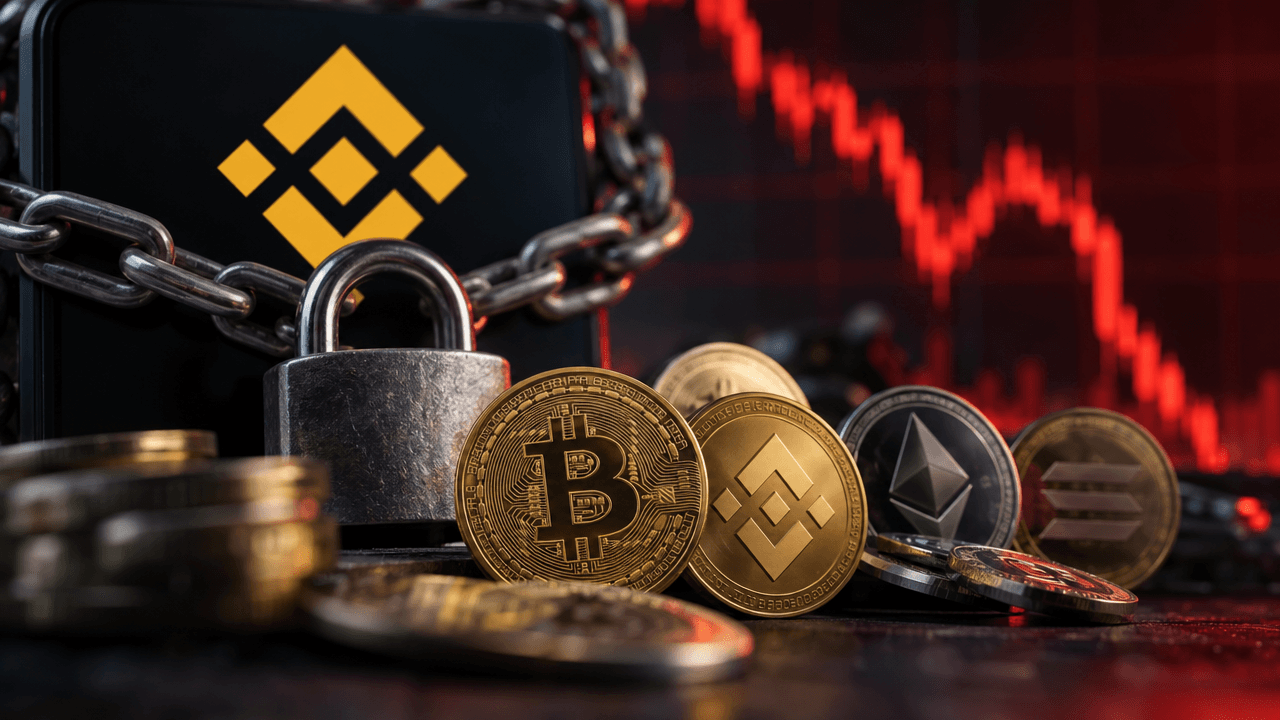
A security investigation at Binance has triggered a broad crypto sell-off, reminding traders that confidence can disappear faster than liquidity can be restored. The exchange temporarily suspended deposits and withdrawals while investigating a suspected hack, and reported that approximately $2.54 billion in digital assets had been frozen. Bitcoin fell below $78,000, while Ethereum, XRP, Solana and BNB suffered sharper declines. BNB dropped roughly 8.6% as traders reassessed both exchange-specific and market-wide risks. [1][2]
The immediate market reaction was driven by uncertainty. Binance said it was investigating a potential security incident and coordinating with law enforcement, blockchain intelligence firms and asset issuers. Stablecoin companies including Tether and Circle reportedly froze assets connected to the investigation, helping prevent some funds from moving further through the crypto ecosystem. [2][3]
For traders, the episode is more than another volatile session. It is a practical demonstration of how exchange risk, liquidity risk and sentiment risk can combine to create rapid price moves across otherwise unrelated assets.
What Happened At Binance
Binance temporarily suspended deposits and withdrawals as a precaution while its teams performed security checks, froze suspected assets and worked to trace transactions. The exchange stated that customer funds had not been confirmed as affected, but the investigation remained ongoing and the amount of frozen assets could increase. [4][8]
Reports circulating in the market referenced considerably larger figures for the value of assets potentially involved. However, Binance’s verified frozen-assets figure was approximately $2.54 billion at the time of reporting. That distinction matters. In the early stages of a security incident, on-chain movements, suspected exposure and confirmed losses are not necessarily the same thing.
The response also illustrates an important characteristic of blockchain markets: transactions can often be tracked publicly, but identifying the owner, intent and final destination of funds can take much longer. Exchanges, stablecoin issuers, investigators and law enforcement may attempt to freeze or block assets when they can identify addresses linked to suspected theft.
Why The Sell-off Spread
Bitcoin traded below $78,000 after falling roughly 3% to 5%, depending on the time and data source. Ethereum, XRP and Solana declined more sharply, while BNB experienced one of the largest losses among major cryptocurrencies, falling approximately 8.6% toward the $690 to $700 range. [1][5][7]
BNB’s larger decline was logical from a market-psychology perspective. The token is closely associated with Binance, so traders often price in additional uncertainty when the exchange faces operational or security concerns. Even if customer funds are ultimately protected, traders may worry about withdrawals, liquidity, regulatory scrutiny, or reduced activity on the platform.
The broader sell-off reflects crypto’s interconnected structure. Investors frequently trade multiple tokens through the same exchanges, stablecoins and liquidity providers. When a major venue pauses transfers, participants may reduce exposure across their portfolios rather than wait for complete clarity.
Leverage can intensify the move. If leveraged traders are forced to close positions as prices fall, those liquidations can create additional selling pressure. A security headline can therefore develop into a market-wide event even when the underlying incident is limited to specific wallets or systems.
What Traders Should Watch Next
The next phase will depend on verified information rather than early estimates. Traders should monitor Binance’s official updates, confirmation of whether customer assets were affected, the status of deposits and withdrawals, and any new figures from blockchain investigators.
Asset flows are another important signal. Large movements of funds from exchange wallets may attract attention, but wallet activity should not automatically be interpreted as proof of theft or insolvency. Exchanges routinely move assets between hot and cold wallets, custody accounts and operational addresses.
Price behavior can also provide clues. If Bitcoin stabilizes while BNB remains under pressure, the market may be treating the situation as primarily Binance-specific. If major cryptocurrencies continue falling together, it may indicate broader deleveraging and declining risk appetite.
Traders should also watch stablecoin activity. The freezing of related USDT or USDC addresses can limit the ability of suspected attackers to cash out, but it can also affect short-term liquidity in the market. Changes in stablecoin premiums, exchange balances and trading volumes may reveal whether participants are moving toward or away from risk.
Practical Lessons For Simfi Traders
A major exchange incident offers useful training opportunities for SimFi traders because it tests decision-making under uncertainty without requiring real capital.
First, define event risk before entering a position. A trader should know in advance how much volatility a position can tolerate and where the trade thesis becomes invalid. Waiting until a headline appears often leads to emotional decisions.
Second, reduce concentration risk. Holding several tokens that all depend on the same exchange or liquidity network may create the appearance of diversification without providing genuine protection. Portfolio exposure should be evaluated by infrastructure, not only by ticker symbol.
Third, avoid assuming that every sharp decline is a buying opportunity. A falling market can continue lower when withdrawals are restricted, leverage is being unwound or information remains incomplete. Patience is a position-management tool.
Finally, practice scenario planning. In a simulated account, traders can compare outcomes from holding, reducing exposure, using smaller position sizes or waiting for confirmation. The objective is not to predict every headline, but to build a repeatable response to fast-moving risk.
The Bigger Market Takeaway
The Binance investigation demonstrates that crypto markets remain highly sensitive to trust. Technology may make transactions transparent, but confidence in exchanges, custodians and liquidity providers still influences prices dramatically.
The most responsible response is to separate confirmed facts from speculation, manage leverage carefully and wait for evidence before forming a long-term conclusion. For SimFi traders, the event is a valuable reminder that risk management is not limited to chart patterns. Operational interruptions, security incidents and liquidity shocks can matter just as much as technical indicators.
As the investigation develops, volatility may remain elevated. Traders who focus on position sizing, verified information and predefined rules will be better prepared than those reacting to every rumor. In uncertain markets, disciplined execution is often the clearest advantage available.