
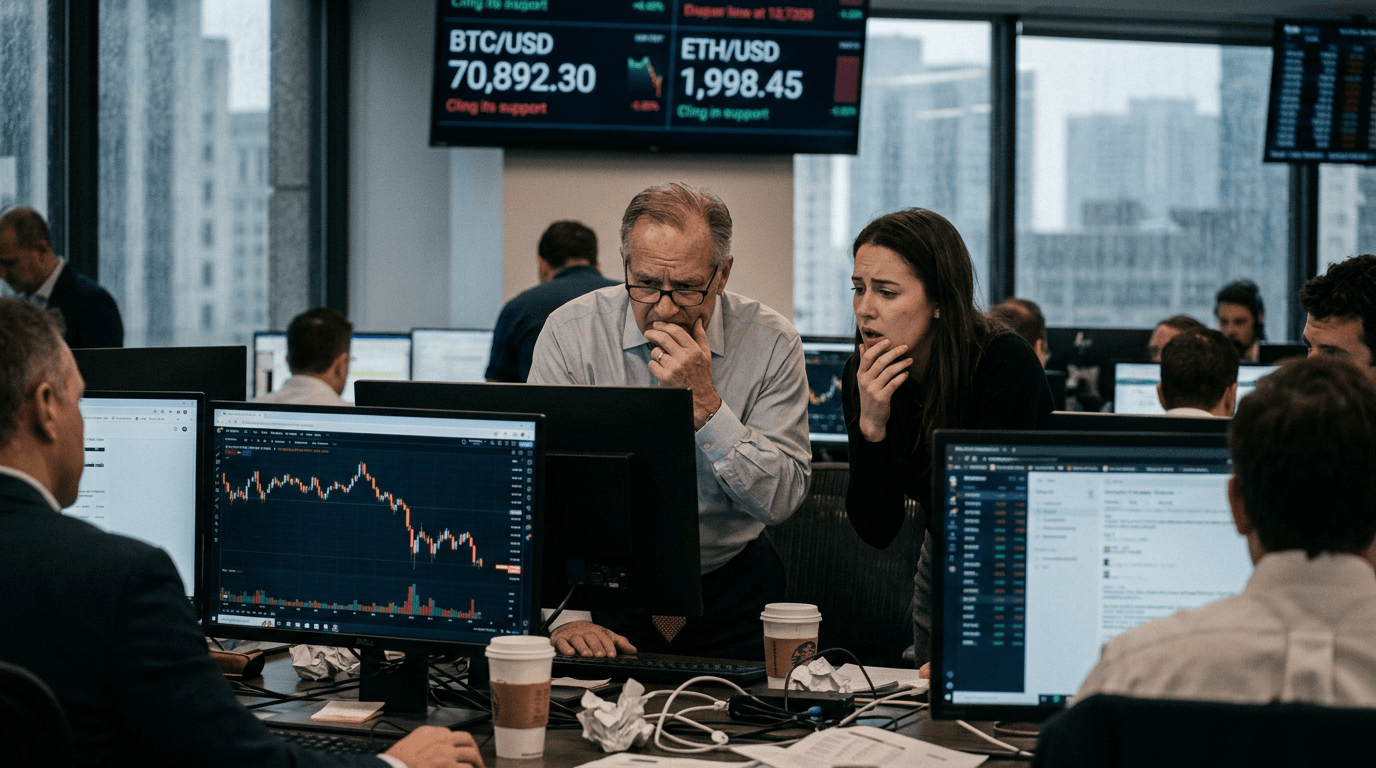
Bitcoin’s latest pullback has traders on edge for reasons that go far beyond the charts. After a roughly 2% slide, BTC is hovering just above the psychologically important $71,000 area, with Ethereum pinned near $2,000 and majors like XRP stuck in sideways ranges. Price action is choppy, futures volumes are picking up around key supports, and the backdrop of intensifying US–Iran tensions is forcing the market to reassess risk in real time.
Market Snapshot: Crypto Holds, But On Shaky Ground
The current move doesn’t look like a full-scale capitulation, but it clearly marks a shift in tone.
Bitcoin’s dip from recent highs has been met with buying interest near $70,000–$71,000, signaling that dip‑buyers are still active, just less aggressive than earlier in the uptrend. Ethereum shows a similar pattern: repeated tests of the $1,950–$2,050 zone, with buyers stepping in but failing to push price decisively higher.
Altcoins, especially high‑beta names, have softened more noticeably. XRP is grinding in a tight range without clear direction, while many L1 and DeFi tokens have pulled back to previous breakout zones.
Under the surface, crypto futures volumes are rising into these levels. That’s a sign of active positioning and de‑risking, not a frozen market. Leveraged longs are being trimmed, some late shorts are chasing downside, and options markets indicate traders are paying up for short‑term protection.
In other words, this is a classic “wobble at resistance-turned-support”: not euphoric, not broken—just fragile.
Why Geopolitics Hits Bitcoin, Ethereum And Altcoins
The catalyst for this shift is geopolitical, not crypto‑native.
Escalating US–Iran tensions have pushed global markets into a risk‑off stance multiple times this year. When headlines hint at possible escalation or regional spillover, traditional risk assets—equities, high‑yield credit, growth stocks—tend to sell off. Crypto is now tightly linked to that same risk cycle.
In earlier years, many investors hoped Bitcoin would behave like “digital gold,” rallying during crises. Reality has been more mixed:
- In the very short term, Bitcoin often trades like a high‑beta tech stock: risk‑on when confidence is high, risk‑off when fear spikes.
- Over longer horizons, structural drivers like supply halving, institutional adoption, and ETF flows can dominate, allowing BTC to recover faster than equities once panic subsides.
Right now, we’re in that short‑term window where war headlines drive intraday swings. Traders lighten up on leverage, rotate into cash or traditional havens like the US dollar and gold, and wait for clarity. Crypto’s response is less about its fundamentals and more about global liquidity and risk appetite.
For Ethereum and altcoins, the effect is amplified. When macro fear rises:
- Capital concentrates in BTC and sometimes ETH
- Altcoin liquidity thins out
- Price moves become more exaggerated relative to Bitcoin
That’s what we’re seeing: majors wobble, but smaller caps feel more pressure.
Key Levels To Watch: Bitcoin, Ethereum And Major Altcoins
Even in a macro‑driven market, technical levels still matter because that’s where positioning clusters and liquidity sits.
For Bitcoin: - Immediate support: The $70,000–$71,000 zone is the first line of defense. It’s acted as both resistance and support in recent weeks, making it a key battleground. - Deeper support: Below there, $68,000–$69,000 stands out as a high‑volume area from prior consolidations. A clean break and acceptance below that band would suggest a more meaningful correction toward the mid‑$60Ks. - Resistance: On the upside, $73,000 remains the ceiling. Bulls need a decisive break and hold above this area to signal that the war scare is a temporary shakeout, not the start of a broader top.
For Ethereum: - Critical zone: The $1,950–$2,050 band is both psychological and structural support. Repeated tests without a breakdown are constructive, but each test marginally weakens it. - Downside risk: A sustained move below $1,900 could trigger a sharper repricing in majors and altcoins, as ETH is often used as a proxy for broader risk sentiment in crypto. - Upside trigger: Reclaiming and holding above $2,200 would suggest that the recent jitters are fading and that the medium‑term uptrend is reasserting itself.
For XRP and other majors: - Range behavior: XRP remains locked in a sideways band, reflecting indecision rather than outright bearishness. Range highs and lows are key; a break either way is likely to attract momentum traders. - Beta effect: Solana, Cardano, and other high‑beta names typically move 1.5–3x Bitcoin’s percentage move in risk‑off or risk‑on pulses. That can cut both ways: sharp drawdowns on negative headlines, but equally fast relief rallies on de‑escalation signals.
What Futures Flows And Sentiment Are Signaling
Futures and sentiment indicators help explain what’s happening behind the candles.
Rising futures volume near support suggests that traders are actively managing risk, not passively absorbing losses. We’re seeing:
- Long liquidation spikes around intraday lows, showing that some overleveraged longs are being flushed out.
- A reduction in aggregate open interest, indicating that traders are closing positions and stepping back, not piling into fresh leverage.
- Relative stability in funding rates compared with a full‑blown panic, implying more of a controlled de‑risking than a cascading liquidation event.
Sentiment metrics tell a similar story. Fear and greed gauges have slid from “greed” toward “fear,” but not to extreme capitulation. Social and derivatives data point to:
- Growing caution: Less FOMO, more emphasis on capital preservation.
- Shorter time horizons: Traders reacting to intraday news rather than multi‑week narratives.
- Asymmetric mindset: Many participants are more worried about missing a downside break than missing the next leg higher.
In practice, this environment often sets the stage for sharp moves in either direction. With positioning lighter and leverage lower, a major escalation could spark a deeper, faster sell‑off—but a credible de‑escalation could just as easily ignite a relief rally, as sidelined capital re‑enters.
How Traders Can Navigate This Volatility
For both active traders and longer‑term participants, the current backdrop calls for a shift from aggression to precision.
Actionable considerations
1. Respect key levels, don’t predict them Treat $70K on BTC and $2K on ETH as decision zones, not lines to blindly defend or attack. Let the market show its hand—wait for confirmation (e.g., strong volume and follow‑through) before committing to breakout or breakdown trades.
2. Adjust position sizing to headline risk In a headline‑driven tape, your biggest risk isn’t being “wrong” on the trend, it’s oversized positions during sudden news shocks. Smaller positions with clearly defined invalidation levels can keep you in the game.
3. Use volatility to refine entries, not chase moves War‑related spikes often overshoot in both directions. Rather than chasing green or red candles, identify levels where your risk‑reward improves and set conditional orders or alerts.
4. Differentiate time frames Short‑term traders can lean into volatility with tight risk controls. Longer‑term investors should zoom out: if the structural thesis for Bitcoin or Ethereum hasn’t changed, tactical drawdowns may be opportunities rather than existential threats.
5. Practice and stress‑test your strategy Environments like this are ideal for testing playbooks in a simulated setting before deploying full risk. Running through “what if” scenarios—escalation, de‑escalation, range‑bound drift—helps you respond systematically instead of emotionally.
Conclusion: Fragile, Not Broken
Bitcoin, Ethereum, and major altcoins are wobbling, not collapsing. The market is caught between robust longer‑term fundamentals and a short‑term shock from the US–Iran conflict. Key supports are holding—for now—but the balance is delicate, and news flow can tip it quickly.
For traders, the message is clear: this is a time to sharpen risk management, not to abandon the market altogether. Understanding how macro shocks interact with crypto, tracking key technical levels, and reading futures and sentiment signals can turn a stressful environment into a structured one.
Volatility cuts both ways. The same forces shaking prices today can create tomorrow’s opportunities—for those prepared with a plan.