
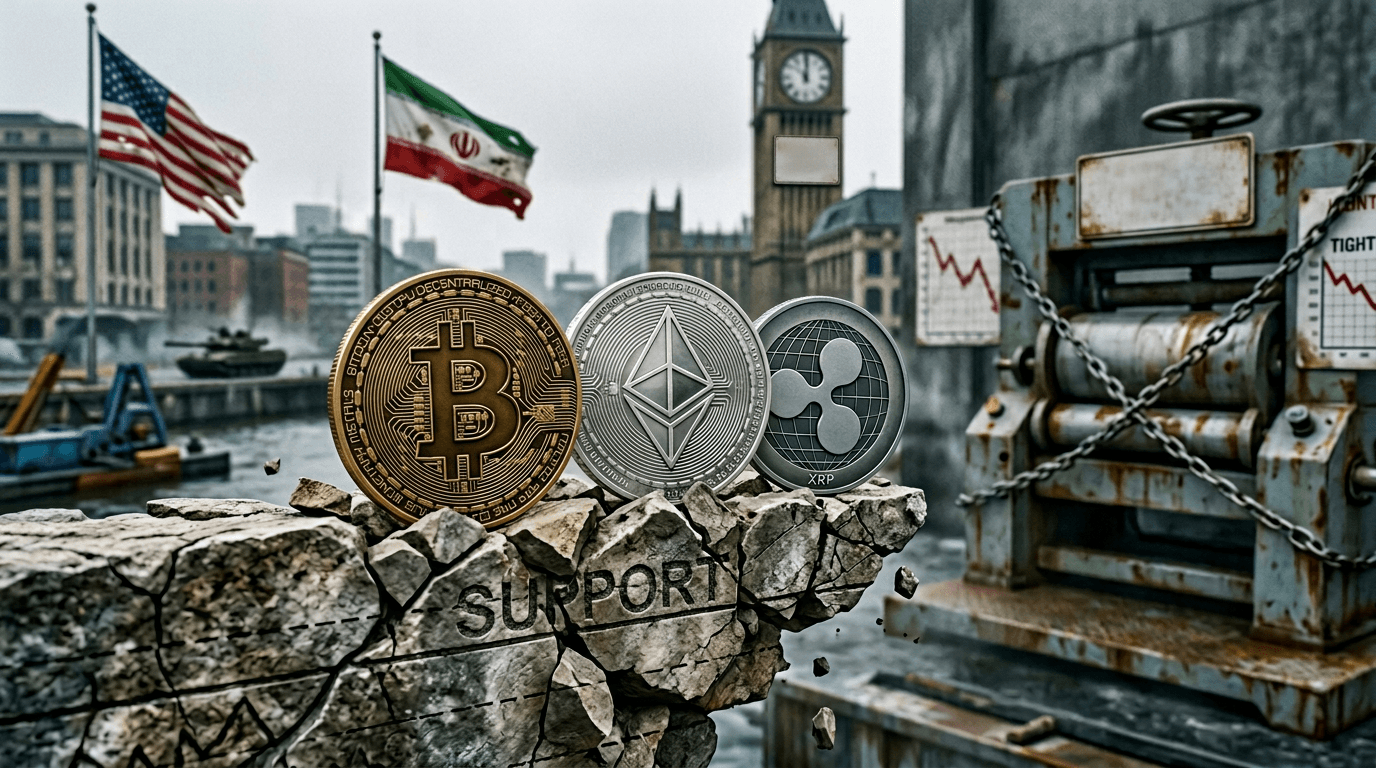
The ongoing US-Iran conflict continues to cast a long shadow over the crypto market, with Bitcoin, Ethereum, and Ripple all grappling to maintain crucial support levels amidst increasing geopolitical uncertainty. Bitcoin attempts to secure its footing above $71,000, Ethereum fights to defend the critical $2,000 threshold, and Ripple holds steady at $1.33, all under the strain of sustained market pressure. For investors navigating this turbulent environment, grasping the complex dynamics impacting cryptocurrency valuations during wartime is vital for safeguarding investments and identifying recovery opportunities as market conditions evolve.
Geopolitical Shocks Override Technical Analysis
The repercussions of the US-Iran conflict on cryptocurrency markets have been both rapid and intense. In the wake of heightened US-Israeli military actions on February 28, Bitcoin nosedived 6.4%, Ethereum tumbled 8%, and Ripple plunged 9%. These steep drops highlight a critical truth: geopolitical shocks can swiftly eclipse technical analysis and sentiment indicators that typically guide trading decisions. The market's response indicates that investors are reassessing risk exposure across all asset classes, with digital currencies particularly susceptible to this risk-averse climate.
A pattern has emerged throughout this conflict, revealing a concerning cycle: ceasefire announcements trigger momentary rallies, yet optimism is fleeting. When news of potential de-escalation breaks, Bitcoin and Ethereum witness temporary surges. However, traders remain cautious about committing significant capital to risk assets, aware that the next military development could spark another sell-off within hours. This oscillation between hope and renewed anxiety has left the market in a state of constant indecision, with positions intentionally light and defensive strategies dominating trading activity.
Inflation And Monetary Policy Squeeze
Beyond immediate military tensions, the conflict has spawned secondary economic pressures that are equally detrimental to crypto valuations. As tensions escalated in the Middle East, oil prices soared past $92 per barrel for West Texas Intermediate crude, with Brent crude lingering around $106. These elevated energy costs have fueled inflationary pressures that central banks are viewing with increasing caution. Instead of supporting risk assets through accommodative monetary policy, central banks have postponed rate cuts and restricted liquidity injections that have historically bolstered Bitcoin and Ethereum prices.
This shift marks a fundamental change in the environment that has previously supported digital assets. Cryptocurrencies have thrived under accommodative monetary policy, but when central banks react to inflation by maintaining higher rates and constraining capital flows, the foundational support for risk assets erodes. The combination of geopolitical risk and monetary tightening creates a particularly challenging backdrop for crypto traders seeking entry points.
Critical Support Levels Under Siege
Technically, all three major cryptocurrencies are hovering dangerously close to support levels that have historically attracted significant buying interest, yet they continue to face downward pressure. Bitcoin's immediate support is around $67,800, with a breach potentially leading to further declines toward the $65,800 to $65,000 range. If losses deepen, the mid-March base around $63,000 serves as the final major support before descending to levels last seen in early 2025.
For Ethereum, the outlook is similarly worrisome. Following a decline from its March peak, Ethereum has retreated toward the $2,000 to $2,100 support zone. A sustained break below $2,000 would clear the path toward the $1,930 to $1,980 range, where previous congestion and buying activity were evident.
Ripple faces comparable challenges at lower levels, having dropped to $1.33, with each major cryptocurrency experiencing double-digit percentage declines in recent weeks. These technical levels represent critical battlegrounds where traders must decide whether to accumulate for potential recovery or continue reducing exposure amidst ongoing uncertainty.
Paths To Recovery Require Policy Shifts
The market's direction ultimately hinges on developments that could unfold within days. If tensions ease and ceasefire agreements hold, market analysts suggest that safe-haven flows could rotate back into traditional risk assets, eventually benefiting cryptocurrencies. Lower oil prices would alleviate inflation pressures, potentially increasing the likelihood of more accommodative monetary policy that would support risk assets.
Conversely, any escalation would likely extend the risk-off environment and further test lower support levels. The interplay between military developments and central bank policy responses will determine whether crypto markets can mount a sustained recovery or face additional declines.
Navigating The Uncertainty
For traders in the current environment, adopting a defensive stance is prudent until clearer signals emerge regarding both geopolitical resolution and monetary policy direction. Position sizing should reflect the heightened volatility and limited visibility on timing for recovery catalysts. However, traders should remain vigilant for potential entry opportunities at critical support levels, particularly if ceasefire announcements result in rotations back into risk assets. Understanding that technical analysis operates within a broader geopolitical and macroeconomic context is essential for success in these challenging conditions.