
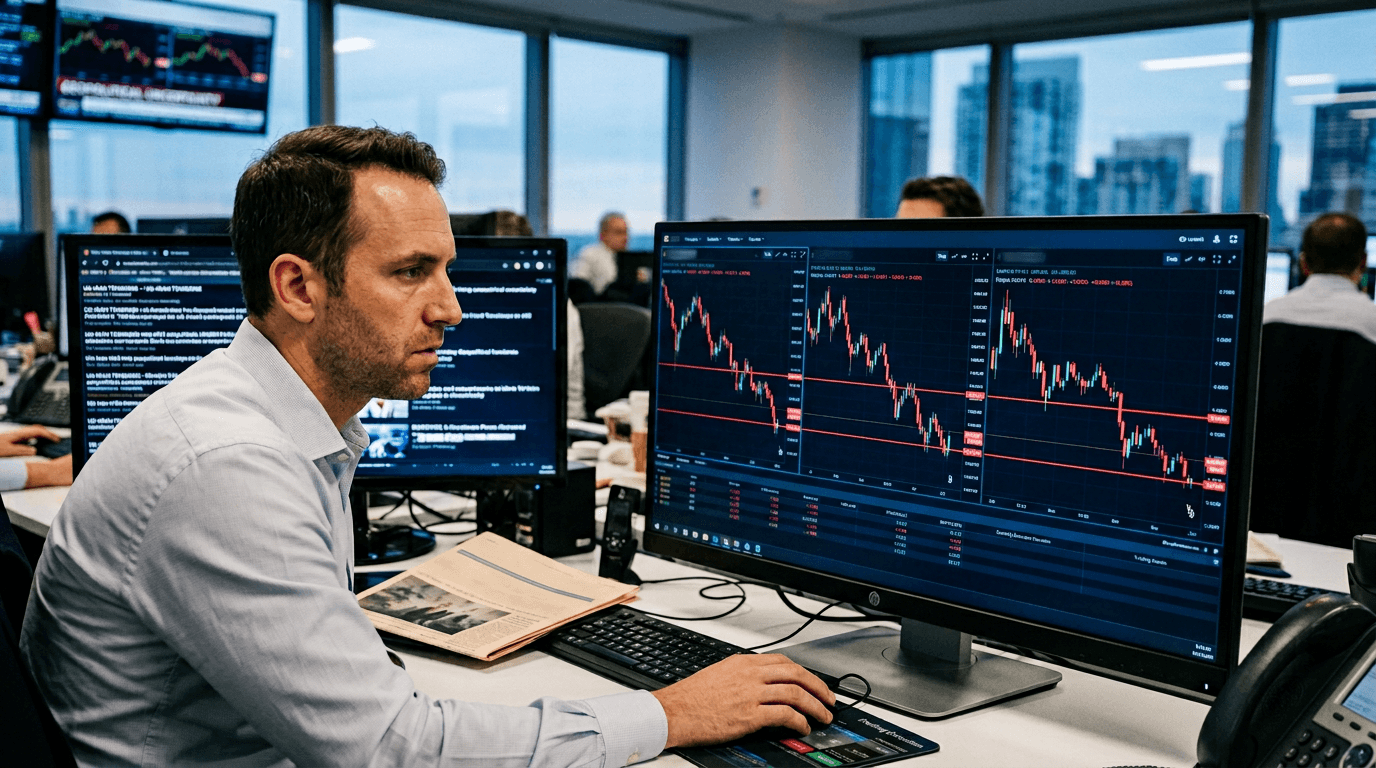
The cryptocurrency market is currently navigating through a complex landscape as Bitcoin, Ethereum, and Ripple hover near vital support levels amid escalating geopolitical tensions between the United States and Iran. With Bitcoin holding its ground above $71,000, Ethereum testing the $2,000 threshold, and XRP finding footing around $1.35, traders face an environment where geopolitical events are as influential as technical analyses.
The Current Market Landscape
Digital assets are experiencing a phase of consolidation, marked by a cautious approach from traders. Bitcoin has found a foothold around $72,271, recovering from a late-March low of $68,500. Meanwhile, Ethereum has stabilized at approximately $2,213.76, and XRP remains steady around $1.35. This period of consolidation reflects a market that is neither overly optimistic nor entirely pessimistic, but rather one that is proceeding with caution in a volatile environment. Many participants are holding back significant investments until clearer signals emerge.
The Crypto Fear and Greed Index, although improved from March's low of 10, stands at 14, highlighting the ongoing anxiety and risk aversion in the market. This low reading underscores the heightened sensitivity to geopolitical risks and macroeconomic pressures, which overshadow traditional technical indicators.
Critical Support Levels Under Pressure
Bitcoin's current position at $71,000 is more than a psychological marker; it is a critical technical battleground for traders. Below this, the $65,729 support level is crucial, as breaking it could lead to a rapid decline toward $62,510 and test the significant $60,000 level. The concern lies not just in the support levels but in the weak recovery efforts and lackluster buying interest during rallies. Bitcoin's consolidation below the $70,000 mark and key exponential moving averages between $72,000 and $86,000, with immediate support at $67,800, further highlights its vulnerability.
Ethereum faces similar challenges, struggling to surpass the $2,149 resistance, indicating a lack of buyer confidence at higher prices. The pullback toward $1,967, with $1,747 as the next critical point, reflects a deeper market uncertainty. With key exponential moving averages positioned above $2,193, the downward trend persists. A break below $2,000 could push prices into the $1,930-$1,980 range, necessitating close monitoring of this level.
XRP also encounters significant technical challenges, testing the descending wedge's lower boundary near $1.35 weekly support. The $1.30 level serves as the next line of defense, with $1.13 as the final critical threshold before further deterioration. Having recently dipped to $1.33, Ripple remains at risk if support fails to hold.
Geopolitical Shocks Override Technical Analysis
The ongoing US-Iran conflict, now in its sixth week, has significantly influenced market dynamics. The escalation in late February 2026, following President Trump's military actions, led to sharp declines in the crypto market—Bitcoin dropped 6.4%, Ethereum 8%, and XRP 9%. These movements were part of a broader market de-risking trend, affecting traditional assets as well.
The April 7 ceasefire, brokered by Pakistan, provided temporary relief, with Bitcoin rising 2.2% to $71,416 and Ethereum gaining 1.8%. However, the ceasefire's temporary nature and the requirement for Iran to reopen the Strait of Hormuz offered only short-lived optimism. The fragility of this truce was evident when talks collapsed on April 13, causing Bitcoin to fall from highs near $74,000 to intraday lows around $70,570. This highlights how geopolitical headlines have become the primary drivers of price movements.
Strategic Trading Approaches For Uncertain Times
Navigating the current environment requires flexibility rather than rigid strategies. Short-term traders should maintain tight stops at crucial support levels, ready to exit if key zones are breached. Position traders might consider accumulating near support levels, anticipating that eventual monetary policy easing will favor cryptocurrencies. Conservative investors should wait for clear signals of either sustained de-escalation or negotiation failures before increasing exposure.
During this period of geopolitical uncertainty, capital preservation and disciplined risk management are paramount. Traders should focus on developments in ceasefire negotiations, institutional capital flows, and technical support levels. The next significant market catalyst is likely to arise from geopolitical events rather than traditional market indicators. By staying adaptable and respecting key support levels, traders can protect their capital and navigate through potential shocks.