
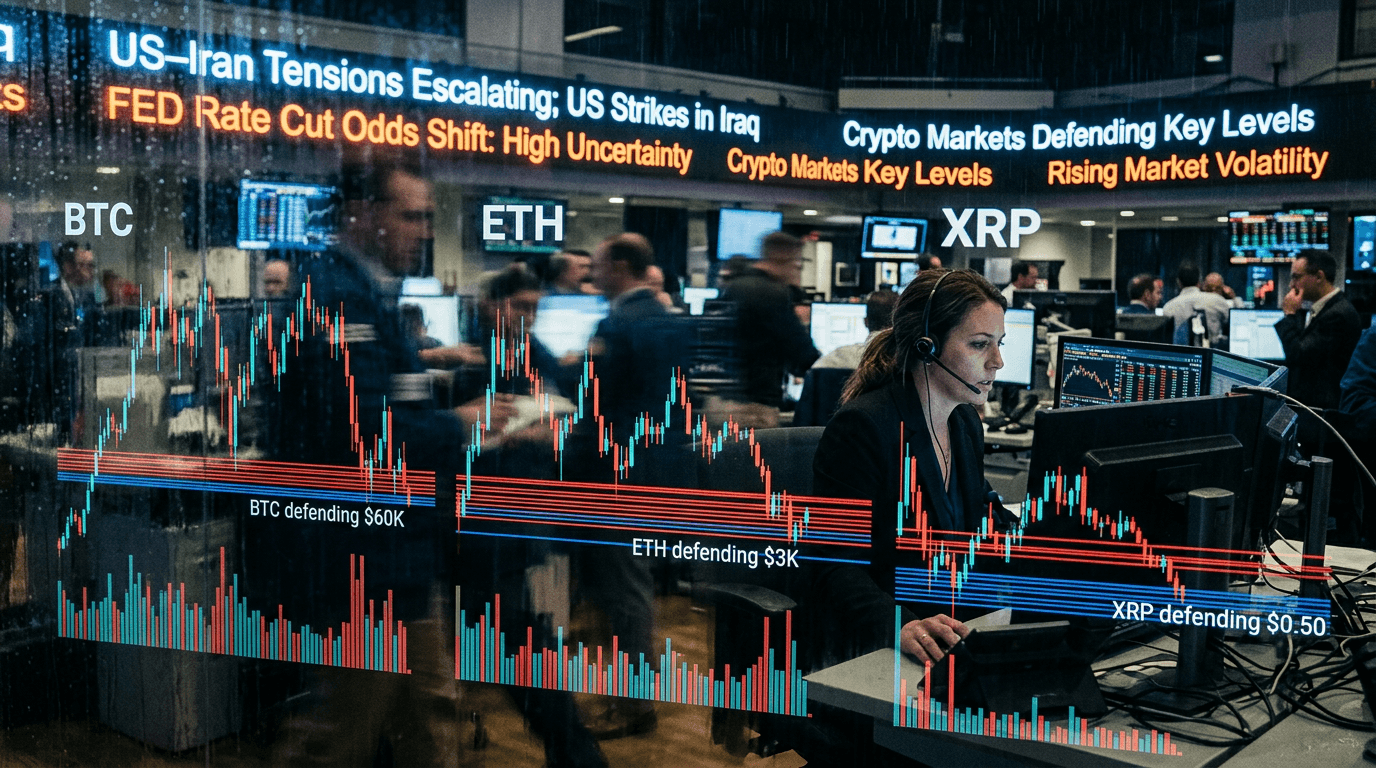
Major cryptocurrencies are back in “wait-and-see” mode. After a modest 2% pullback, Bitcoin, Ethereum and XRP are holding above key technical support zones, even as geopolitical headlines, shifting Federal Reserve expectations and mounting regulatory scrutiny keep risk appetite on edge. Price action is choppy rather than panicked, suggesting traders are not abandoning the space, but they are demanding a higher premium for bearing short‑term uncertainty.
Market Context: Crypto Holds The Line
Bitcoin is currently stabilizing above the 71,000 dollar area, defending a broader support band that begins near 70,000 dollars and extends into the high‑60,000s. Ethereum is trading just above the psychologically important 2,000 dollar level, while XRP continues to consolidate around the 1.40 dollar region after recent swings. The fact that all three assets have respected these zones after the latest flush lower underscores that dip‑buyers are still active, but they are being far more selective about entry points.
What is notable is the character of this correction. Rather than a cascade of forced liquidations, the move lower has looked more like an orderly de‑risking. Spot volumes have picked up around support, but without extreme funding imbalances or widespread derivatives stress. This suggests that, for now, the market views the sell‑off as an adjustment to a noisier macro backdrop, not the start of a new bearish cycle.
Macro And Geopolitics: Why Risk Sentiment Is Fragile
The main driver of this caution is a rapid swing in broader risk sentiment tied to the US–Iran conflict and its impact on energy markets. Tensions in the Middle East have pushed crude oil back into the mid‑80s per barrel and, at times, toward the 100 dollar mark during peak escalation fears. For investors, higher oil prices translate directly into upside risks for inflation and a more complicated path for central banks.
At the same time, the latest US Producer Price Index (PPI) release came in weaker than expected, hinting at cooling pipeline inflation pressures. This contradictory mix—energy‑driven inflation fears on one hand and softer PPI on the other—has injected uncertainty into Fed rate expectations. Traders are now less confident about aggressive rate cuts, but they are also less convinced that further tightening is likely. As a result, policy expectations are oscillating around each new data point, and crypto prices are reacting in kind.
Adding to the noise is renewed regulatory scrutiny across the digital asset space. Ongoing debates over token classifications, exchange compliance and the long‑term status of crypto ETFs are creating an environment where headlines can suddenly reprice individual coins or the entire sector. In combination, geopolitics, macro data and regulation are acting like overlapping shockwaves, keeping investors cautious even as long‑term narratives for blockchain adoption remain intact.
Technical Picture: Key Levels For Btc, Eth And Xrp
In this kind of environment, technical levels often serve as anchors for decision‑making. For Bitcoin, the 70,000 dollar handle is the key line in the sand. A sustained hold above this region keeps the medium‑term uptrend intact, with resistance now clustered near the 72,500 to 73,000 dollar zone where the 50‑day exponential moving average and prior local highs converge. A decisive break higher would reopen the path toward the mid‑70,000s, while a clean break below 70,000 dollars could expose 67,800 and then the 65,000 to 66,000 dollar support band.
Ethereum is wrestling with its own inflection area. The 2,000 to 2,050 dollar corridor aligns with a confluence of the 50‑, 100‑ and 200‑day EMAs, making it a high‑importance battleground between bulls and bears. A failure to defend this range would shift focus toward the 1,900 to 1,950 dollar region and the broader SuperTrend support around 1,980 dollars. On the upside, ETH needs to reclaim 2,200 dollars and then the March highs near 2,380 to signal that the recent drawdown was merely a pause in a larger advance.
XRP’s structure is different but equally instructive. The token is consolidating sideways around 1.40 dollars, with immediate support at 1.38 to 1.40 dollars and a deeper floor closer to 1.34 dollars. While momentum indicators are largely neutral, the pattern of higher consolidation bases suggests patient accumulation by longer‑horizon participants. If XRP can break back above the 1.49 to 1.50 dollar resistance cluster—where descending moving averages currently sit—it would confirm that buyers have absorbed recent supply and are ready to push for another leg higher.
Volatility And Derivatives: What Options Are Signaling
Beyond spot and basic chart levels, options markets provide another window into sentiment. Implied volatility on Bitcoin and Ethereum options has ticked higher, with traders pricing in the possibility of larger realized swings over the coming weeks. This does not guarantee a sharp move, but it reflects a collective expectation that the calm, grinding uptrend of earlier months is giving way to a more reactive, headline‑driven regime.
For directional traders, higher volatility means wider intraday ranges and greater slippage risk, especially when stops are placed too tightly. For options traders, however, this environment can create both opportunities and pitfalls. Buying options becomes more expensive as volatility rises, but selling options carries greater risk of being caught on the wrong side of a sudden spike. The key is alignment: strategies must match one’s conviction about whether the market is overpricing or underpricing future volatility relative to likely macro and geopolitical catalysts.
Practical Strategies For Traders In A Choppy Market
In a landscape where Bitcoin, Ethereum and XRP are all holding significant supports but sentiment remains fragile, risk management needs to be as important as market direction. Position sizing should reflect not just a trader’s conviction but also the higher volatility backdrop—smaller individual trades with clearly defined invalidation levels can help avoid large drawdowns from unpredictable headlines.
Time horizon also matters. Short‑term traders may focus on support‑resistance rotations, fading extremes as long as key levels hold and cutting quickly if they break. Swing and position traders, by contrast, might prefer to wait for confirmation: a daily close back above resistance for entry, or a decisive breakdown below support before turning defensive. Patience can be a competitive advantage when markets are crowded around the same psychological levels.
Event awareness is another practical edge. Mapping out forthcoming macro releases—such as inflation prints, jobs data and central bank meetings—alongside known geopolitical risk dates allows traders to anticipate when volatility may spike. Reducing leverage ahead of these events or using options as partial hedges can protect capital while preserving upside if markets move favorably.
Conclusion And Key Takeaways
The current phase of crypto price action is less about euphoria or capitulation and more about resilience under pressure. Bitcoin, Ethereum and XRP are all defending critical support zones despite a tougher backdrop of geopolitical tension, mixed macro data and regulatory overhangs. That combination has shifted the market from trend‑following complacency to more active, event‑driven trading.
For market participants, the message is clear. Respect the key levels that have emerged as battlegrounds, understand that volatility is likely to remain elevated as long as the US–Iran conflict and Fed uncertainty dominate headlines, and adjust strategies to prioritize capital preservation without abandoning selective risk‑taking. In doing so, traders position themselves not just to survive the current chop, but to participate when the next decisive move finally emerges from this compressed, tense equilibrium.