
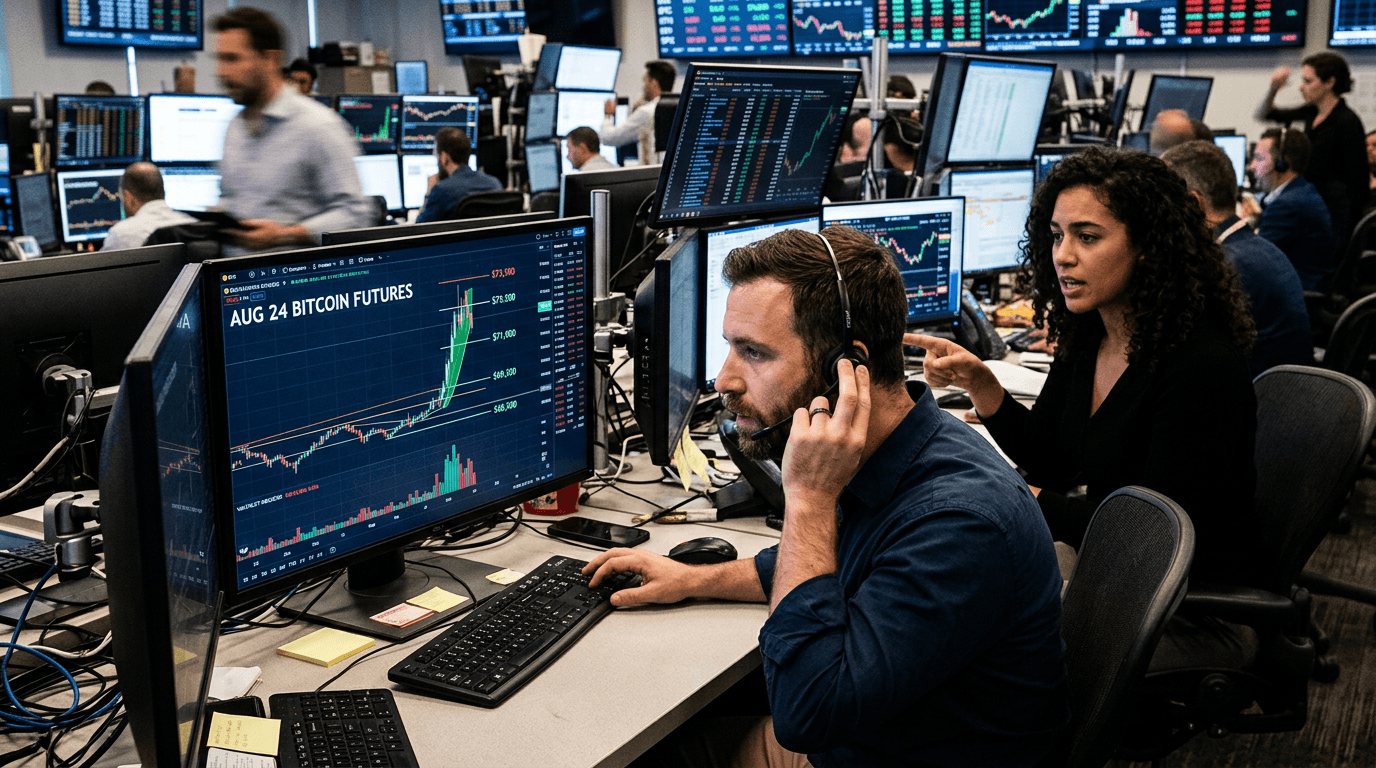
Bitcoin futures traders were served another reminder this week that in crypto, volatility is a feature, not a bug. August Bitcoin futures surged 22.73% week-to-date to trade near 77,570, marking their strongest weekly performance since 2023 and unfolding within an unusually wide intraday range between roughly 72,670 and 79,625[2][11]. That kind of move in a major derivative contract is enough to reset positioning across the entire crypto complex[2].
What Happened In Bitcoin Futures This Week
August Bitcoin futures (BTCQ26) rallied by about 14,366 points on the week to finish around 77,570, translating to a 22.73% weekly gain[2]. For a contract that already trades at elevated price levels, this is an outsized percentage move, especially when concentrated in a single week[2].
During the most active session, the contract spanned an intraday range of roughly 72,670 to 79,625, underscoring how fast order books can thin out when volatility spikes and stops begin to hit[2]. Such swings can produce large mark-to-market fluctuations for anyone trading on margin, particularly in large contract sizes.
On CME, standard Bitcoin futures are sized at 5 BTC per contract, quoted in USD per bitcoin, with a minimum tick size that translates into meaningful dollar increments per contract move[10][11]. When prices are oscillating by thousands of dollars in a single day, each tick and each contract begin to matter a lot for risk management[10][11].
From a broader perspective, Bitcoin futures have delivered double-digit percentage moves over many multi-month windows, but a single-week gain of more than 20% stands out even in a historically volatile asset class[1][13][14]. Moves of that magnitude tend to force both discretionary and systematic traders to reassess their positioning, hedges, and margin utilization across crypto and correlated macro assets[2][14].
WHAT DROVE THE RALLY – SHORT SQUEEZE MEETS POLICY HOPES
This week’s move was not just a quiet grind higher; it was described as the best week for August Bitcoin futures since 2023, powered in part by more than $3 billion in short-position liquidations[2]. When heavily shorted markets start to rise, forced buying from margin calls and liquidations can turn a normal rally into a violent short squeeze[2].
A key catalyst came from the policy front. Headlines around a White House crypto summit and a push for the CLARITY Act helped improve sentiment about the regulatory outlook for digital assets[2]. For a market that has often traded as a barometer of regulatory risk, any sign of clearer rules or friendlier policy can invite aggressive risk-taking.
Interestingly, the rally in Bitcoin futures coincided with strong gains in traditional “risk-off” hedges like precious metals. Gold futures were up about 5.30% on the week, while silver gained around 6.82%[2]. That combination – Bitcoin ripping higher alongside gold and silver – suggests traders were not simply rotating into crypto but were broadly repricing macro risk and potential policy shifts across asset classes[2].
Under the surface, crypto derivatives markets have shown episodes where realized volatility runs ahead of implied volatility, often coinciding with shifts in futures basis and funding rates[9][14]. When realized volatility sustains higher levels, it can attract more short-volatility strategies to rebalance or cover, adding fuel to sharp directional moves[9][14].
Why This Volatility Matters For Traders
A 22% weekly move in a large, margined futures contract is not just a headline; it is a stress test of every trader’s risk framework[2][10]. At current price levels, a single standard Bitcoin futures contract can represent hundreds of thousands of dollars in notional exposure[7][10]. Even modest leverage on such notional can translate into large P&L swings.
Futures traders must also contend with “gap risk” – the danger that prices open significantly higher or lower after a period when the futures market is closed but the underlying spot market continues to trade[14]. In Bitcoin, where spot markets trade 24/7 globally, the variance between the Friday futures close and the Sunday reopen has historically been a notable source of dislocation[14].
Historical analysis of Bitcoin markets shows that average daily moves in spot can exceed 3% on weekdays, with typical weekday swings in the 2–3% range[14]. When futures are layered on top of an underlying with that kind of baseline volatility, large weekly moves like this one become not just possible but statistically plausible[14].
For discretionary traders, this environment rewards having clearly defined stop-loss levels, predetermined maximum drawdowns, and an understanding of how portfolio volatility scales with leverage. For systematic or algorithmic traders, it emphasizes the need to recalibrate models when realized volatility shifts regime and to monitor slippage and execution risk more closely during extreme sessions.
Using Simulated Trading To Navigate Extreme Moves
One of the challenges with markets like Bitcoin futures is that the learning curve can be expensive. Mistimed leverage, poorly sized trades, or underestimated gap risk can lead to outsized losses in a very short period of time. That is where simulated finance (SimFi) environments can become valuable.
In a high-quality trading simulator, traders can rehearse strategies that account for 10–20% weekly swings without putting real capital at risk. They can test how different position sizes behave when the market gaps against them, or how a portfolio of correlated assets responds when Bitcoin, gold, and silver all move sharply in the same week.
SimFi platforms allow traders to stress test: - How quickly margin utilization rises during a one- or two-day surge. - How trailing stops or volatility-based position sizing might have performed in an intraday range similar to 72,670–79,625. - How diversification into other assets or time frames could smooth equity curves when a single futures contract dominates risk.
Just as importantly, simulated trading helps traders build psychological resilience. Experiencing a simulated $10,000 intraday swing on a position can prepare traders emotionally for the real-world pressure of volatile sessions, making it easier to stick to predefined risk rules instead of reacting impulsively.
Key Takeaways And Trader Checklist
This week’s Bitcoin futures surge delivers several practical lessons that traders can apply immediately.
1) Respect the speed of futures moves. A 22.73% weekly move in a major contract is a reminder that crypto derivatives can reprice dramatically in a short period, especially when short positioning is crowded and liquidity thins out[2].
2) Track catalysts beyond crypto. Policy headlines such as regulatory initiatives or legislative proposals can ignite large moves, particularly when they surprise a market that has been pricing in uncertainty or negative outcomes[2].
3) Watch cross-asset signals. Seeing Bitcoin futures soar alongside strong gains in gold and silver hints at a broader macro repricing rather than isolated crypto enthusiasm, which can affect correlation and hedging assumptions[2].
4) Build a volatility-aware playbook. Knowing how your strategy performs when realized volatility jumps, intraday ranges widen, and gaps become more frequent is not optional in Bitcoin futures; it is core to survival[9][14].
5) Practice in a risk-free environment. Before committing real capital to strategies that rely on leverage, shorting, or tight stops, test them in a simulated market that can replicate extreme weeks like this one.
Ultimately, this week’s Bitcoin futures rally is a case study in how quickly sentiment, positioning, and policy narratives can combine to reshape risk in the crypto derivatives space[2][9][14]. Traders who treat episodes like this as learning opportunities – and who refine their frameworks in both live and simulated environments – will be better prepared for the next volatile session, whenever it arrives.