
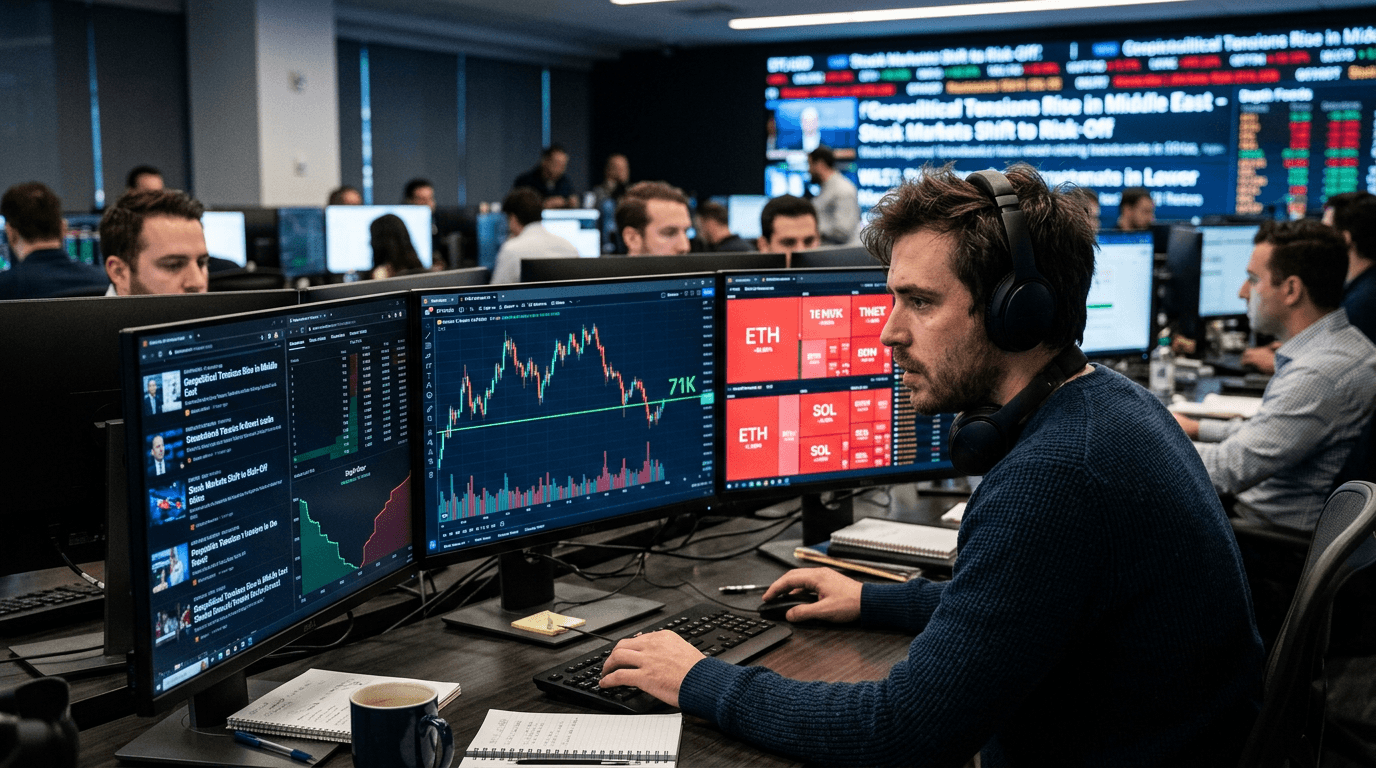
Bitcoin has managed to hold its ground at the $71,000 support level despite mounting concerns about escalating tensions in the Middle East, signaling resilience even as geopolitical uncertainty continues to weigh on broader cryptocurrency markets. The cryptocurrency's ability to defend this critical price point reveals a battle between bullish long-term conviction and the immediate bearish pressures stemming from risk-off sentiment gripping global financial markets.
The Technical Picture: Support Holding Strong
Bitcoin's consolidation near $71,000 represents a significant technical milestone after the recent 2% pullback that swept through the crypto market. This support level has become increasingly important as it prevents the cryptocurrency from retreating further and potentially triggering a cascade of liquidations in leveraged positions. Traders are closely monitoring whether BTC can maintain this floor, as a breakdown below $71,000 could accelerate selling pressure toward the next major support levels.
Ethereum, meanwhile, continues to trade in the region of $2,000, exhibiting similar consolidation patterns as Bitcoin. XRP has also remained near key support levels, suggesting that while the broader market has experienced meaningful pullbacks, the largest cryptocurrencies have established defensive positions that are holding up reasonably well given current market conditions. This behavior typically indicates that institutional holders and sophisticated traders view current levels as attractive entry points rather than capitulation zones.
Geopolitical Headwinds: The Iran War Factor
The extension of US-Iran war tensions represents a significant macroeconomic concern that extends well beyond cryptocurrency markets. Historically, geopolitical conflicts create what financial markets call "risk-off" environments, where investors flee from higher-risk assets and gravitate toward traditional safe-haven investments like government bonds, gold, and US dollars. Cryptocurrencies, despite their growing institutional adoption, are still perceived as risk assets in these scenarios, making them vulnerable to sharp selloffs when global tensions escalate.
Oil prices have reflected these tensions, with crude falling 30% as markets digest the implications of the conflict. This decline in energy prices typically suggests recession concerns and demand destruction fears, which further reinforce risk-off positioning across asset classes. For Bitcoin specifically, this creates a paradox: while the conflict might theoretically support alternative assets outside traditional monetary systems, the immediate market reaction favors de-risking across all speculative positions.
Market Sentiment And The Broader Selloff Context
The 2% pullback in cryptocurrencies occurred within a broader market turmoil that extends well beyond digital assets. Stock markets, commodities, and foreign exchange markets have all experienced disruption from the escalating Middle East situation. What's notable is that cryptocurrency's performance relative to equities has been relatively stable, suggesting that crypto is not amplifying losses in the way it sometimes does during high-volatility periods.
This measured reaction reflects several important dynamics. First, many institutional investors holding cryptocurrency positions have explicit risk management protocols that prevent panic selling during geopolitical shocks. Second, the narrative around Bitcoin as "digital gold" or uncorrelated asset class has gained enough traction that some investors view dips during geopolitical uncertainty as buying opportunities rather than danger signals.
What Traders Should Monitor
Looking ahead, several key metrics warrant close attention. First, watch whether Bitcoin can hold $71,000 during the coming days of heightened uncertainty. A break below this level could trigger additional selling, particularly among algorithmic traders and stop-loss orderers. Second, monitor volatility in the implied volatility index (VIX equivalent) for crypto markets. When geopolitical risk-off sentiment intensifies, volatility typically increases, creating both risk and opportunity for traders.
Third, pay attention to cryptocurrency futures open interest and funding rates. If traders aggressively increase leverage during this dip, it could set up the market for a violent move in either direction once the initial geopolitical shock passes. Fourth, track correlation between Bitcoin and traditional risk assets like equities. If crypto begins rising while equities struggle, it would suggest investor confidence in the alternative asset class is strengthening.
Navigating Uncertainty With Conviction
The fact that Bitcoin is holding $71,000 despite external pressure demonstrates that underlying demand for cryptocurrency remains intact. Market participants should remember that geopolitical shocks, while creating short-term volatility, typically don't represent fundamental changes in crypto adoption trends or long-term value propositions.
For traders and investors, this environment requires discipline. Those bullish on cryptocurrency should recognize that buying opportunities often emerge during fear-driven selloffs. Those holding positions should ensure proper risk management is in place, particularly given elevated volatility and potential for rapid moves in either direction.
The current market setup reflects a crypto industry that has matured enough to absorb external shocks without complete capitulation. Bitcoin's defense of $71,000 amid challenging headlines suggests the market has genuine structural support at current levels, even if sentiment remains challenged by factors outside the cryptocurrency ecosystem itself.