
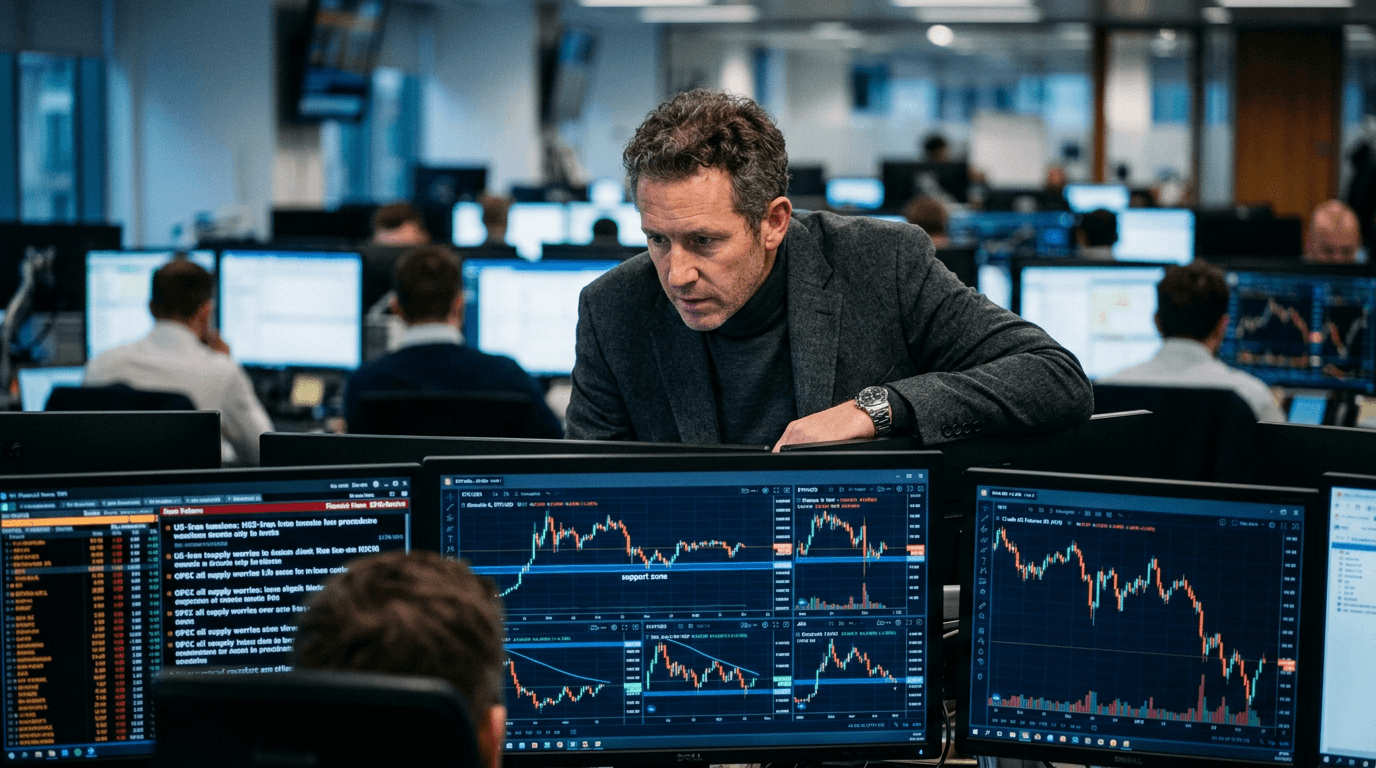
Crypto markets have entered a watchful phase as Bitcoin consolidates above the $71,000 zone and major altcoins digest a modest pullback driven by renewed US‑Iran tensions. After an initial risk‑off move of roughly 2% to the downside, prices are stabilizing, but the tone is cautious as traders weigh geopolitical headlines, surging oil prices, and key technical support levels across the digital asset landscape.
Macro Backdrop: Tensions, Oil, And Risk Sentiment
The latest flare‑up between the US and Iran is reinforcing a familiar pattern in global markets: geopolitical stress leads to risk aversion, higher energy prices, and tighter financial conditions. Rising oil prices tend to feed directly into inflation expectations and, by extension, central bank policy, which remains a core driver of liquidity in both traditional and crypto markets.
For Bitcoin and large‑cap altcoins, this backdrop creates a tug‑of‑war. On one side, elevated uncertainty pushes investors to unwind leverage and cut exposure to volatile assets. On the other, some see crypto as a hedge against geopolitical and monetary instability. The net result in the near term is often a choppy consolidation phase where directional conviction is low and intraday swings are driven more by headlines than fundamentals.
This cautious mood is visible beyond crypto. Equities, high‑beta tech names, and cyclical sectors tend to soften when geopolitical risk rises, while gold, defensive stocks, and select currencies attract inflows. Crypto is still largely trading in that “risk asset” bucket, so episodes like the current US‑Iran tensions often translate into defensive positioning rather than aggressive dip‑buying.
Bitcoin, Ethereum, And Altcoin Technical Landscape
Despite the pullback, Bitcoin holding above roughly $71,000 suggests that the market still respects this area as an important short‑term pivot. It sits near the upper end of the recent trading range and is close enough to recent highs that traders are closely watching whether this level acts as support or gives way to a deeper retracement.
Ethereum hovering near the $2,000 zone after its own ~2% decline paints a similar picture. The $2,000 area is psychologically important and often used as a reference for risk management, especially in leveraged positions. A sustained break below could open up room toward prior congestion zones, while a firm hold would reinforce the idea that the recent move is more of a shakeout than a trend reversal.
Major altcoins—think names like Solana, XRP, and other top‑20 assets—are typically more sensitive to risk‑off moves than Bitcoin. In periods of geopolitical stress, liquidity often concentrates in BTC and ETH, leaving altcoins with thinner order books and more pronounced swings. For traders, this means that marginal headlines can have an outsized price impact in the altcoin space compared with the relatively more stable majors.
A practical takeaway here is to anchor decisions around clear technical zones. For Bitcoin, levels around $71,000 and then the low‑$60,000s remain key reference points for many market participants. For Ethereum, $2,000 and the mid‑$1,800s are often treated as critical support bands. In altcoins, horizontal levels built by prior ranges and high‑volume nodes on the chart carry added importance when volatility spikes.
SAFE HAVEN OR HIGH‑BETA? WHAT THIS EPISODE SHOWS
Every major geopolitical shock revives the debate about whether Bitcoin is a “digital safe haven” or a high‑beta macro asset. The current reaction—an initial risk‑off drop followed by cautious consolidation near support—leans toward the latter interpretation, at least in the short term.
In practice, Bitcoin often behaves like a leveraged play on global liquidity conditions. When central banks are easing and risk appetite is strong, capital flows into crypto tend to expand. When geopolitical stress raises the odds of tighter financial conditions or prolonged uncertainty, capital can quickly rotate out of speculative assets, including digital currencies.
Over longer horizons, narratives about censorship resistance, sovereign risk, and monetary debasement can support strategic allocations to Bitcoin. But for traders operating on days‑to‑weeks timeframes, the dominant factor in episodes like US‑Iran tensions is usually the risk‑off impulse rather than the hedge narrative. Recognizing this distinction helps avoid misaligned expectations—thinking a war scare will immediately send Bitcoin parabolic, for example, has historically been a poor assumption.
Trading Implications: Risk Management In A Geopolitical Market
For active traders, the key question is not whether the market reacts to geopolitical events—it clearly does—but how to position around that reality. Several practical principles stand out in the current environment:
First, volatility can emerge suddenly and cluster around news flow. That means position sizing becomes more critical than usual. Running lower leverage or smaller nominal exposure through periods of headline‑driven risk can help avoid forced liquidations during fast moves.
Second, liquidity often migrates toward the majors. During stress, depth in BTC and ETH pairs tends to exceed that of altcoins, and slippage can be significantly higher in smaller names. Traders may choose to concentrate activity in higher‑liquidity assets until volatility normalizes.
Third, scenario planning matters. Building simple frameworks—what happens if tensions escalate, de‑escalate, or stabilize—can guide conditional strategies. For example, an escalation scenario might call for tighter stops and reduced leverage, while a de‑escalation could support gradual re‑risking into clearly defined support zones.
Finally, attention to cross‑asset signals is a useful edge. Watching oil, gold, and major equity indices alongside crypto can reveal whether the current move is isolated or part of a broader risk‑off or risk‑on regime. In the present case, rising oil and fragile equity sentiment reinforce the cautious stance many crypto traders are taking.
SIMULATED FINANCE: STRESS‑TESTING YOUR STRATEGY
For traders using SimFi platforms like E8 Markets, this kind of environment is an ideal laboratory for testing how strategies behave under geopolitical stress without putting real capital at risk. Simulated markets can replicate fast moves, gapping conditions, and liquidity changes, allowing traders to experiment with adjustments in leverage, stop placement, and diversification.
One high‑value exercise is to run historical and hypothetical scenarios: How would your current Bitcoin strategy have performed during prior Middle East flare‑ups or other macro shocks? What happens if oil spikes another 10%, or if a surprise diplomatic breakthrough flips risk sentiment back to bullish overnight?
Another practical use of SimFi is testing risk overlays. Traders can layer rules such as volatility triggers for de‑leveraging, maximum position sizes tied to news risk, or cross‑asset filters that restrict new entries when correlations spike. By iterating on these rules in a simulated environment, traders build muscle memory and confidence that can translate more smoothly into live trading when conditions become challenging.
CONCLUSION: CAUTIOUS BUT OPPORTUNITY‑RICH LANDSCAPE
Bitcoin and major altcoins trading cautiously after a pullback amid US‑Iran tensions reflects a market that is alert, but not panicked. Prices are still holding above key support zones, yet the combination of rising oil, fragile risk sentiment, and headline uncertainty argues for disciplined risk management rather than aggressive speculation.
For traders, the opportunity lies in preparation. Understanding how geopolitical risk flows through oil, inflation expectations, central bank policy, and ultimately crypto prices is essential. Anchoring decisions around well‑defined technical levels, adapting position sizing to volatility, and stress‑testing strategies in simulated environments can turn a period of uncertainty into a valuable learning and positioning phase.
The current episode is a reminder that crypto does not trade in a vacuum. It is wired into global macro dynamics, and the ability to navigate that intersection—especially when tensions rise—is what separates reactive trading from informed, resilient decision‑making.