
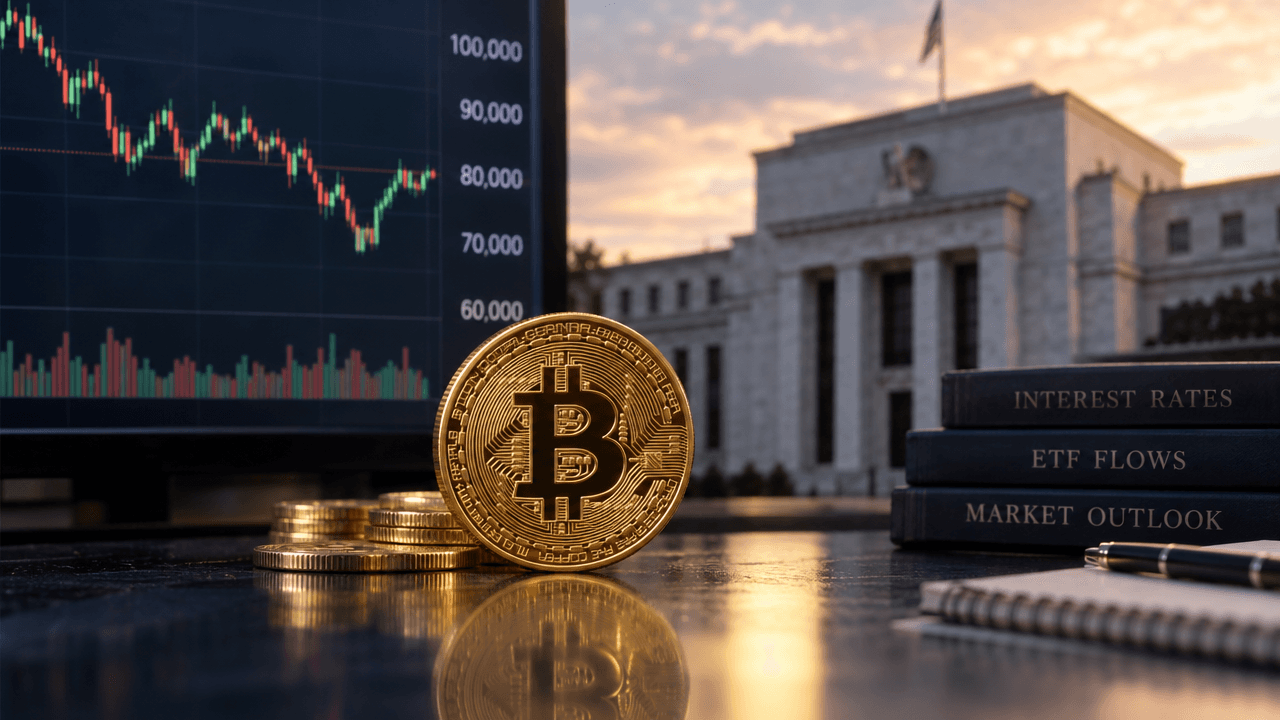
Bitcoin is holding close to the $80,000 mark as traders await the Federal Reserve’s October 27–28 policy meeting, keeping the cryptocurrency market in a cautious holding pattern. The price level has become an important psychological and technical reference point, with investors weighing support from institutional demand against renewed concerns about interest rates, inflation, and liquidity.
The Fed decision is the central event for markets this week. A two-day Federal Open Market Committee meeting is scheduled for October 27 and 28, followed by a press conference. [2] While the meeting itself may not produce an immediate policy surprise, the Fed’s statement and guidance could significantly influence expectations for the months ahead.
WHY $80,000 MATTERS
Bitcoin’s ability to remain near $80,000 suggests that buyers have not abandoned the market despite a challenging macroeconomic backdrop. The level is more than a round number. It represents a visible reference point for traders, options markets, and investors assessing whether the latest pullback is a healthy consolidation or the beginning of a deeper decline.
Recent market analysis identified resistance near $81,390 and support around $78,000. [12] That range gives traders a practical framework for interpreting short-term price action. A sustained move above resistance could signal renewed momentum and encourage buyers to target higher levels. A decisive break below support, however, could expose Bitcoin to additional selling pressure.
For long-term investors, the key lesson is that a price near a major round number often reflects a temporary balance between buyers and sellers. It does not, by itself, confirm either a bullish reversal or a bearish breakdown. Confirmation generally requires a combination of price, volume, derivatives positioning, and broader risk sentiment.
THE FED’S RATE SIGNAL
Interest rates remain central to Bitcoin’s short-term performance because the cryptocurrency often behaves like a high-volatility risk asset. When investors expect lower rates, financial conditions can become more supportive for assets such as technology stocks and crypto. When rates are expected to remain high or rise, capital may shift toward cash, bonds, or other defensive holdings.
Market coverage ahead of the meeting indicated that policymakers were widely expected to keep rates unchanged, while hotter inflation data had increased attention on the possibility of a future rate increase. [9] That combination creates a difficult environment for Bitcoin: an immediate hold may already be priced in, but a hawkish message could still pressure prices.
Traders should therefore focus less on the headline decision alone and more on the Fed’s language. Three questions matter:
Does the committee describe inflation as improving, persistent, or accelerating?
Does Chair Kevin Warsh emphasize that policy is restrictive enough?
Does the guidance make a December rate increase appear more or less likely?
A rate hold accompanied by cautious, data-dependent language could limit volatility. A rate hold paired with stronger warnings about inflation could weigh on Bitcoin even without an actual rate change.
Etf Flows Signal Hesitation
Institutional flows provide another important piece of the market picture. The supplied market brief reported no net flows for U.S. spot Bitcoin ETFs on October 26, suggesting limited near-term conviction among investors. Other reporting based on ETF flow data described a $110.3 million net inflow on the same date, with the entire amount attributed to BlackRock’s iShares Bitcoin Trust. [7] The conflicting figures underline why traders should check the methodology, timing, and data source behind daily flow headlines.
Regardless of the discrepancy, the broader message is that ETF demand has not produced an unambiguous acceleration in buying. A single day of inflows or flat activity should not be treated as a trend. Investors should examine several consecutive sessions and compare flows with price performance.
Strong inflows combined with stable or rising prices can indicate durable demand. Conversely, weak flows while Bitcoin remains elevated may suggest that buyers are becoming selective. For SimFi traders, ETF data is most useful as confirmation rather than as a stand-alone signal.
What Traders Should Watch Next
The first priority is Bitcoin’s reaction to the Fed announcement. A rapid move in either direction can create false breakouts, particularly when liquidity is thin and leveraged positions are crowded. Traders may prefer to wait for the initial volatility to settle before interpreting the direction of the move.
The second priority is the $78,000 to $81,390 zone. A close above resistance, supported by increasing volume, would provide stronger evidence of renewed demand than a brief intraday spike. Similarly, a break below support followed by a failed recovery could indicate that sellers are gaining control.
The third priority is correlation with other markets. If Bitcoin rises while equities, technology stocks, and other speculative assets weaken, that could signal crypto-specific strength. If all risk assets fall together, the move is more likely to reflect changing expectations for rates or liquidity.
Finally, traders should manage position size around the event. The potential reward from predicting a short-term breakout may be attractive, but the risk of sudden reversals is also elevated. Defined stops, limited leverage, and a clear invalidation level are more valuable than trying to guess every headline.
The Bigger Picture
Bitcoin’s position near $80,000 reflects a market waiting for confirmation. Buyers are defending a psychologically important level, but ETF activity and macroeconomic uncertainty suggest that conviction remains uneven. The Federal Reserve’s October meeting could provide the catalyst that breaks the current range, yet the lasting direction will depend on how markets interpret the policy outlook.
For investors and SimFi traders, the most practical approach is to separate signal from noise. Watch the Fed’s guidance, monitor sustained ETF flows, respect key price levels, and avoid treating one volatile session as a complete market thesis. Bitcoin may be close to $80,000, but the next major move will likely be determined by expectations for liquidity and interest rates rather than the round number alone.