
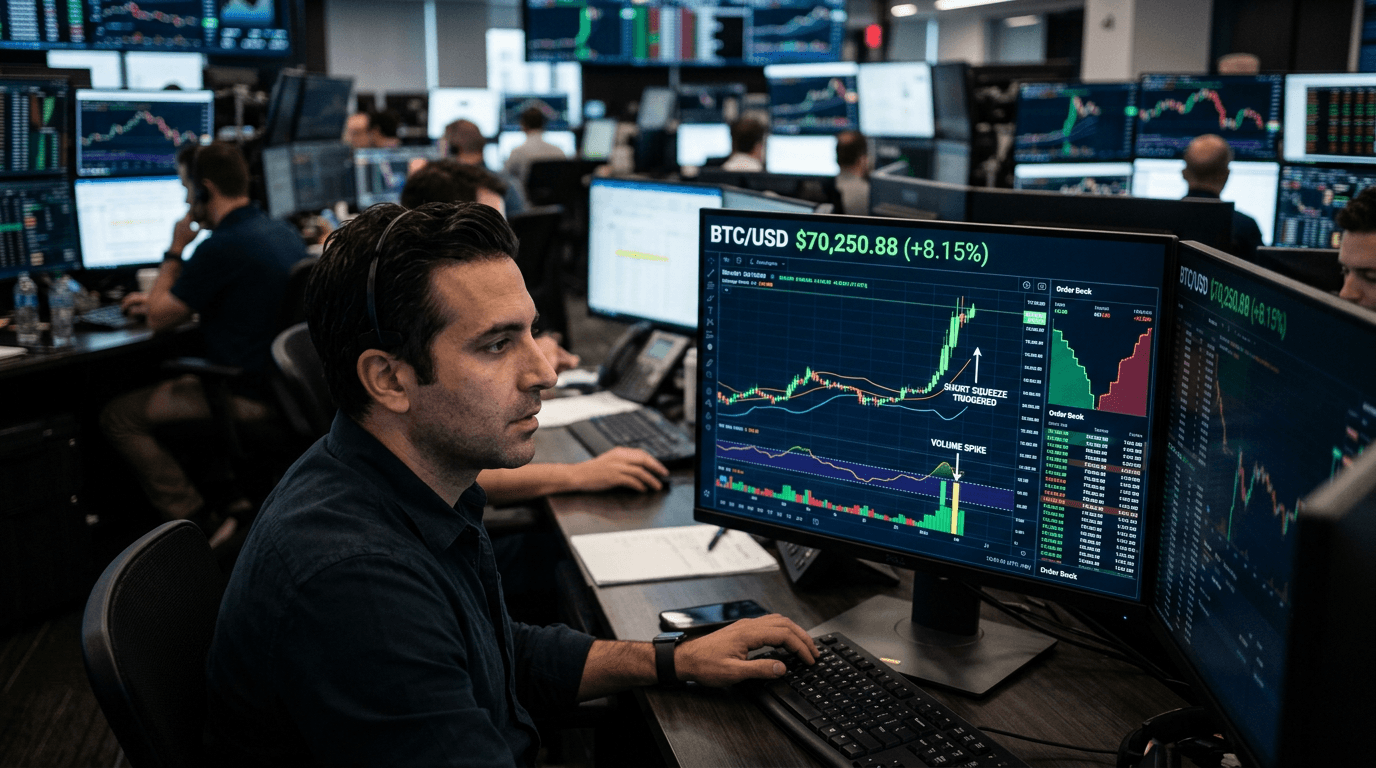
Bitcoin’s rebound back above the low‑$70K area has quickly shifted the narrative from fear to renewed optimism, as a wave of short liquidations and surging volumes ripples across the broader crypto complex.[3][11] With BTC reclaiming the ~$72K region and intraday spikes pushing toward the mid‑$70Ks on some venues, traders are once again confronting a market where leverage, sentiment, and liquidity can change the landscape in a matter of hours.[1][3]
What Just Happened In Bitcoin
After a sharp drawdown that pushed prices lower and drove sentiment into “extreme fear,” Bitcoin has staged a swift recovery, reclaiming the low‑$70K zone and squeezing out crowded short positions.[1][3] On major derivatives platforms, this rally was accompanied by hundreds of millions to over a billion dollars in short liquidations within a very short time window, marking one of the largest squeeze events since at least 2021.[3][11]
Intraday, BTC has seen accelerations that took price from the high‑$60Ks through prior resistance bands toward the $72K–$75K region before partially retracing, underscoring just how quickly positioning can flip when liquidity is thin and leverage is elevated.[1][3][6] This move is not happening in isolation: total trading volumes in BTC, ETH, and XRP have climbed to their highest levels since around June, reflecting a broad-based resurgence in activity rather than a single-asset anomaly.[5][12][14]
At the same time, measures of crypto sentiment such as the Crypto Fear & Greed Index have rebounded from “extreme fear” into more neutral “fear” territory, aligning with the price recovery and signaling that some sidelined capital is tentatively re‑entering the market.[1][7] That mix of price strength, rising volume, and improving sentiment is a classic recipe for more volatile, headline-driven sessions in the days ahead.[3][11]
How Short Squeezes Fuel Sharp Crypto Rallies
A short squeeze occurs when traders who are betting against the market are forced to buy back their positions as price moves higher, accelerating the rally. Crypto markets are particularly prone to these dynamics because perpetual futures and other leveraged derivatives allow traders to take large notional positions with relatively small margin.[3][11] When too many traders lean to one side—often visible via elevated open interest and heavily negative funding rates—the market becomes structurally vulnerable to a squeeze.[3][15]
Recent analysis has highlighted periods where Bitcoin open interest has climbed toward multi‑week highs while funding rates turned deeply negative, meaning short sellers were paying longs to keep positions open.[15] In that environment, even a modest burst of spot buying or ETF inflows can push price just high enough to trigger liquidations on overleveraged shorts.[10][15] Those forced buys cascade through the order book, liquidating more short accounts and turning a normal bounce into a sharp, often outsized rally.
The latest rebound above the low‑$70Ks has all the hallmarks of this pattern: extended downside, growing short conviction, followed by a high‑velocity reversal with large short liquidations and rapid intraday price extension.[3][11] For traders, the key lesson is that positioning and leverage can be as important as charts or headlines when assessing near‑term risk.
Why Volumes And Sentiment Matter More Than Price Alone
Price grabs attention, but volume and sentiment often tell the more actionable story. The current upswing in BTC, ETH, and XRP volumes to their highest levels since June suggests that new and returning participants are actively trading, not just passively watching the move.[5][12][14] High volume on an up‑move typically indicates stronger conviction behind the trend and amplifies the impact of any forced liquidations.
Short liquidation totals running from hundreds of millions to over $1 billion in a single session highlight just how much leverage was concentrated on the bearish side before the rebound.[3][11] When those positions get flushed, it not only drives price higher but also temporarily reduces selling pressure, as many of the most aggressive bears have been forced out of the market.
Sentiment has also staged a meaningful shift. After spending time in “extreme fear,” sentiment indicators have climbed back toward more neutral territory as Bitcoin holds higher ranges and some macro overhangs ease.[1][7][8] That does not guarantee a straight-line rally, but it often corresponds with a transition from capitulation to accumulation, where dips become more actively bought and sharp pullbacks are shorter-lived than during the prior downtrend.[1][7]
For traders, watching the interaction of price, volume, and sentiment provides a more holistic view: price shows what is happening, volume shows how many are participating, and sentiment reveals how traders are likely positioned for the next move.
Implications For Leveraged And Simulated Traders
For traders using leverage, this episode is a clear reminder that crowded positioning cuts both ways. When shorts dominate, upside moves can be violent; when longs crowd in near highs, downside unwinds can be equally brutal. Managing position size, margin, and liquidation levels is crucial in markets where a 5–10% intraday swing is a realistic scenario.
Simulated trading environments like E8 Markets’ SimFi framework allow traders to experience these dynamics without the risk of real capital. By trading simulated BTC and ETH perpetuals during high‑volatility sessions, traders can see in real time how funding rates, open interest, and liquidation cascades interact with their PnL, margin, and risk metrics.
Key practical exercises in a simulated environment include:
- Testing different leverage levels to see how quickly volatility can push an otherwise “good idea” into liquidation.
- Practicing dynamic stop‑loss placement that accounts for average true range and intraday volatility rather than arbitrary fixed distances.
- Stress‑testing strategies under scenarios of sudden volume surges and rapid sentiment shifts—such as a surprise short squeeze or a sharp reversal of a prior trend.
By rehearsing these situations in a risk‑free setting, traders can refine their execution and emotional discipline so they are better prepared when similar conditions emerge in live markets.
How To Navigate The Next Phase
With Bitcoin back above the low‑$70Ks and leverage once again a key driver of intraday swings, traders should focus less on predicting the exact next tick and more on preparing for a wider range of outcomes.[3][11][15] That starts with a structured process:
- Monitor positioning indicators such as funding rates and open interest to identify when one side of the market has become crowded.
- Track volume and liquidity conditions; thin order books can magnify both squeezes and selloffs.
- Define scenarios in advance—continuation of the squeeze, range consolidation, or sharp mean reversion—and map out how your strategy responds in each.
- Use simulated trading to run “what if” drills, including sudden 10–15% moves and funding regime shifts, to ensure your risk management holds up.
In this phase of the cycle, opportunity and risk are rising together. Traders who treat the current rebound as a chance to improve process—rather than chase every candle—will be better positioned whether BTC breaks to new highs or returns to test lower support.
Conclusion
Bitcoin’s rebound above the low‑$70K region is more than a headline move; it is a real‑time case study in how positioning, leverage, volume, and sentiment can collide to produce powerful short squeezes.[3][11][15] The surge in BTC, ETH, and XRP activity, alongside recovering sentiment, suggests that risk appetite is returning, but it also raises the stakes for anyone trading with significant leverage.[5][12][14]
For developing and experienced traders alike, this is an ideal moment to step back, analyze the mechanics behind the move, and use simulated environments to refine strategy and risk management. In a market where the next squeeze—up or down—can unfold in minutes, preparation and process remain the most durable edge.