
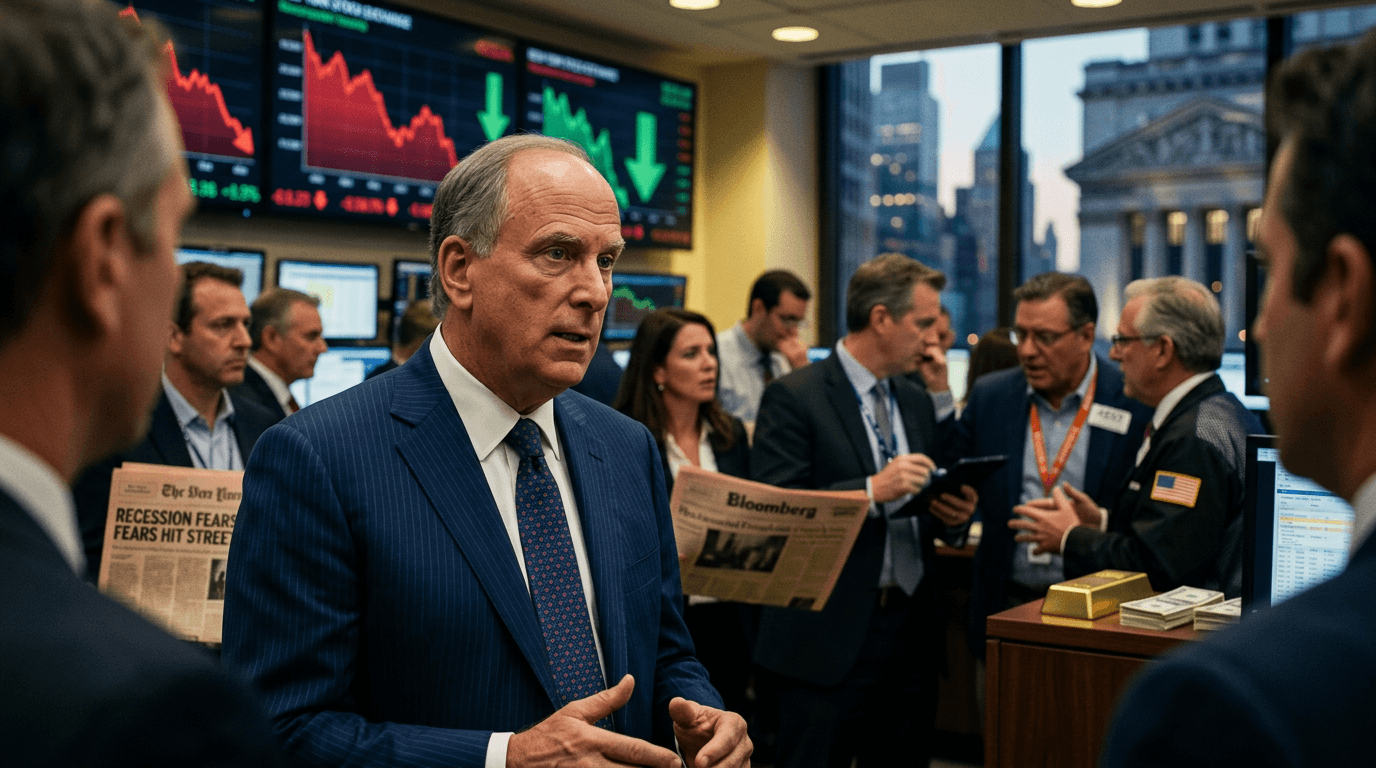
When the head of the world’s largest asset manager says the United States may already be in recession, markets pay attention. Larry Fink, CEO of BlackRock, has warned that the U.S. economy is “very close, if not in, a recession now,” citing weakening underlying data and increasingly cautious conversations with corporate leaders.[2] His comments have landed in an already fragile environment, intensifying risk‑off flows in equity index futures and driving demand for safe‑haven assets.[2] For traders, this is more than a headline – it is a signal that recession risk has moved from theoretical to immediate.
Why Larry Fink's Warning Matters
Not all recession calls are created equal. A random bearish forecast on social media barely registers; a warning from Larry Fink does. As the CEO of BlackRock, which oversees trillions of dollars in assets, Fink sits at the intersection of markets, corporate America, and global policymakers.[2] When he says “most CEOs I talk to say we’re probably in a recession right now,” he is effectively transmitting the collective sentiment of boardrooms across sectors.[2]
His perspective is rooted in real‑time feedback from industries that tend to feel turning points early, such as airlines, transportation, and consumer‑facing businesses.[2] These companies see booking trends, discretionary spending patterns, and corporate travel behavior shift before they show up fully in the official data.
Equally important, his comments arrived as markets were already digesting softer U.S. data and signs of a late‑cycle slowdown.[2] That made his warning a catalyst: not necessarily new information by itself, but a powerful confirmation that the slowdown narrative is now firmly in the mainstream.
ARE WE ALREADY IN A RECESSION? LOOKING PAST THE HEADLINES
Whether the U.S. is “officially” in recession is more complex than a single quote suggests. Economists typically look at a broad range of indicators – GDP, employment, industrial production, income, and spending – rather than just one metric. The National Bureau of Economic Research (NBER), which formally dates U.S. recessions, often only labels a downturn months after it has started.
Fink’s point is less about checking every technical box and more about how the economy feels on the ground.[2] CEOs are flagging:
- Slower demand growth in cyclical sectors
- More cautious hiring plans and tighter budgets
- Pressure on margins as pricing power fades while costs remain elevated[2]
This combination can coexist with some still‑solid macro data, especially in the labor market, yet still reflect a recession‑like environment for businesses that are sensitive to growth inflections.
For traders, the key takeaway is this: you do not need an official recession call to experience recessionary market dynamics. If corporate leaders act as if a downturn is here – cutting capex, slowing hiring, guiding cautiously – earnings expectations, valuations, and risk appetite will adjust accordingly.
How Markets React: Risk-off, Safe Havens, And The Usd
The initial reaction to Fink’s comments followed a classic risk‑off pattern.[2] Equity index futures slipped as investors reduced exposure to cyclical risk assets and moved toward more defensive positioning.[2] At the same time, demand for U.S. Treasuries picked up, pushing yields lower as investors sought safety and as markets increased the probability of future Federal Reserve rate cuts to counter a potential downturn.[2]
The currency and commodities response fits the same playbook. Traders rotated into safe‑haven assets, including the U.S. dollar, gold, and select currencies like the Japanese yen, with cross‑currency basis moves reflecting a bid for dollar and yen funding.[2] Safe‑haven demand tends to rise when growth uncertainty spikes and risk sentiment deteriorates.
However, the dollar’s story is more nuanced. While risk aversion often supports the greenback, expectations for more aggressive Fed easing can temper that strength.[2] If the market starts to price a deeper or earlier cutting cycle, rate differentials can move against the dollar even as volatility and risk‑off behavior increase. That push‑and‑pull is exactly what traders are now trying to navigate.
For volatility, the implication is straightforward: when recession risk becomes a central narrative, day‑to‑day moves around data releases, Fed speeches, and earnings updates tend to grow larger. Fink’s comments add another layer of sensitivity to each new piece of macro information.[2]
What Traders And Investors Should Do Now
Whether you are trading in a simulated environment or deploying real capital, Fink’s warning is a prompt to reassess risk, not to panic. A disciplined response focuses on preparation, not prediction.
A few practical steps stand out:[2]
- Stress‑test your portfolio or strategies under different recession scenarios Model both a mild downturn and a deeper contraction. How would your P&L have behaved in past recessionary or late‑cycle periods such as 2001–2002 or 2008–2009? Use that as a guide for current positioning.[2]
- Reduce excessive concentration in the most cyclical or leveraged exposures Sectors and names that rely heavily on cheap financing or strong growth expectations are most vulnerable if earnings are revised down and credit spreads widen.[2]
- Diversify intelligently Consider diversification across geographies, sectors, and asset classes, but avoid assuming that all correlations will behave “normally” in stress. In risk‑off episodes, many assets move together.[2]
- Prioritize liquidity In credit and smaller‑cap equities, liquidity can evaporate quickly when volatility rises, causing outsized price gaps. Ensure position sizes are aligned with realistic exit assumptions under stress.[2]
- Tighten risk management and trade planning In an environment where headlines and data can trigger sharp swings, position sizing, stop‑loss placement, and scenario planning become more important than maximizing short‑term returns.
Key Focus Areas For The Weeks Ahead
Fink’s warning is a high‑profile signal, but markets will ultimately be driven by the data and the Federal Reserve’s response.[2] Traders should focus less on debating his exact recession call and more on tracking the information that will confirm or challenge it:
- Growth data High‑frequency indicators like employment reports, retail sales, ISM/PMI surveys, and consumer confidence will show whether weakness is broadening across the economy.[2]
- Inflation and wages If inflation cools as growth slows, the Fed gains more room to cut rates; if inflation stays sticky, policymakers face a tougher trade‑off and may not be able to ease as much as markets hope.[2]
- Corporate earnings and guidance Listen closely to management commentary on demand trends, pricing power, margins, and capital spending. This is the real‑time scoreboard of the CEO sentiment that Fink has highlighted.[2]
- Financial conditions Watch credit spreads, bank lending surveys, and funding markets for signs that access to capital is tightening. Worsening financial conditions can turn a slowdown into something more severe.[2]
For traders in both simulated and live environments, the message is clear: recession risk is no longer a distant tail scenario; it is an active driver of prices and volatility.[2] That does not guarantee a deep downturn, but it does mean that positioning, risk management, and scenario planning need to assume a more challenging macro backdrop.
In that sense, Fink’s warning is less a prediction than a risk‑management cue. You do not control whether the economy is already in recession – but you do control how prepared your trading and investment process is for that possibility.