
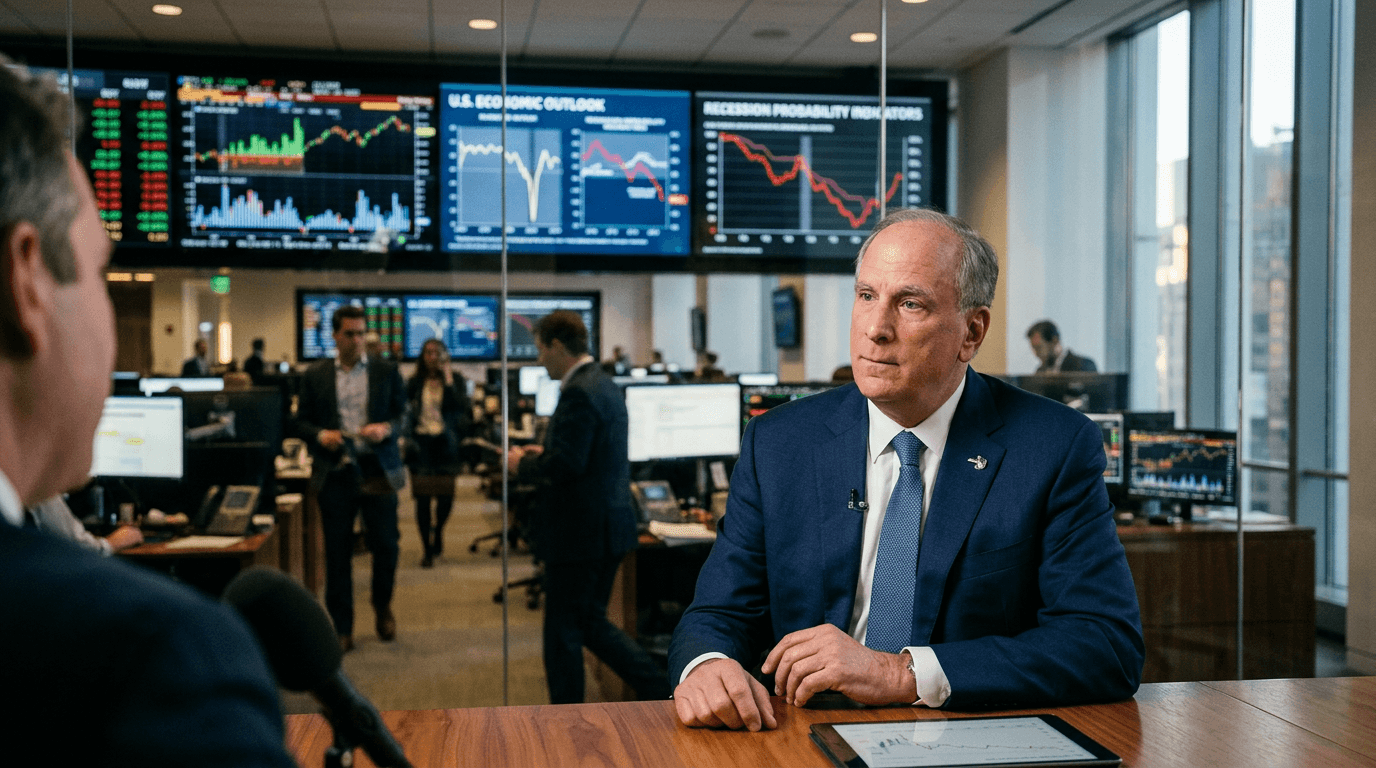
When the CEO of the world’s largest asset manager says the U.S. is “very close, if not in, a recession now,” markets listen. Larry Fink’s latest warning doesn’t just reflect his view; it channels what he’s hearing from hundreds of corporate leaders globally. The result has been an immediate shift in tone across risk assets, with equities and credit turning more defensive, safe havens catching a bid, and volatility spiking as investors reassess what a downturn could mean for growth and earnings.
What Fink Is Really Saying
Larry Fink is not an economist making a theoretical call; he’s a capital allocator sitting at the center of global flows. When he suggests the U.S. may already be in recession, he’s effectively transmitting what corporate CEOs, CFOs, and portfolio managers are seeing in real time: softer demand, margin pressure, and growing uncertainty.
Officially, a recession is typically defined by a broad decline in economic activity lasting more than a few months, often captured by GDP, employment, and production data. But by the time the data confirms it, markets have usually moved.
Fink’s comments line up with weaker business and consumer sentiment readings, softer manufacturing surveys, and ongoing trade and geopolitical tensions. The message is not just “growth is slowing” but “the slowdown might already have crossed the line.”
For traders, the key insight is that this is a sentiment shock anchored in real-world feedback from corporate America. Even if the data doesn’t yet scream “recession,” markets will trade as if the risk is materially higher.
Why Recession Fears Hit Risk Assets
Risk assets are fundamentally claims on future cash flows. Recession fears attack both sides of that equation: how much companies will earn and how much investors are willing to pay for those earnings.
On the earnings side, slower growth usually means:
- Lower revenue as demand weakens
- Margin compression as costs stay sticky while pricing power fades
- Rising defaults and downgrades in the riskier parts of the credit market
On the valuation side, uncertainty pushes investors to demand a higher risk premium. That can mean lower P/E multiples in equities and wider spreads in corporate bonds, especially in high yield.
This helps explain the defensive tone across
- Equities: Rotation out of cyclical sectors (industrials, consumer discretionary, small caps) into defensives (utilities, staples, healthcare) and quality large caps with strong balance sheets.
- Credit: Wider spreads on high-yield and lower-rated investment-grade bonds, as investors price in a higher default risk.
- Equities and credit futures: Choppier price action, false breaks, and sharper intraday moves as positioning gets adjusted rapidly.
For traders, it’s not just the direction that matters, but the dispersion beneath the surface: different sectors, factors, and credit qualities will react very differently to a rising recession probability.
Safe Havens, Volatility, And Cross-asset Flows
Every recession scare has a familiar pattern: capital seeks safety. Fink’s comments reinforced moves that were already underway.
Safe-haven demand typically shows up in:
- Government bonds: U.S. Treasuries, German Bunds, and other high-quality sovereigns often rally as investors seek certainty and potential policy easing.
- Currencies: The U.S. dollar and Japanese yen often benefit from risk-off flows, particularly vs. higher-yielding or emerging-market currencies.
- Gold and other perceived stores of value: As real growth expectations soften and policy uncertainty rises, gold can attract hedging flows.
At the same time, volatility tends to climb:
- Equity volatility: Indices like the VIX tend to rise as investors rush to hedge downside via index options or reduce leverage.
- Credit volatility: Credit indices and CDS spreads become more sensitive to news, and liquidity can dry up faster in stressed segments.
- Cross-asset volatility: Correlations between asset classes can change abruptly, making previously stable relationships less reliable.
For traders, this environment rewards flexibility and respect for volatility. Fixed stop levels that worked in calm conditions may be too tight or too loose now; sizing and intraday risk controls become more important than ever.
How Traders Can Position Around Recession Risk
You don’t need to predict the exact recession start date to trade this environment effectively. You do need a framework.
1. Trade scenarios, not certainties Consider at least two core scenarios:
- Soft landing: Growth slows but avoids a deep contraction, earnings dip modestly, and policy support kicks in.
- Hard landing: Growth contracts clearly, unemployment rises, earnings fall sharply, and credit stress emerges.
Price action across indices, sectors, and yields will differ under each scenario. Simulated trading environments are a useful place to test these scenarios, stress different strategies, and understand how your approach behaves under stress.
2. Focus on relative strength and quality In equities, recession risk usually favors:
- Quality balance sheets: Low leverage, strong cash flows, and stable margins
- Defensive sectors: Staples, utilities, healthcare, and some mega-cap tech with recurring revenues
- Factor tilts: Quality and low volatility over high beta and pure growth at any price
In credit, investors tend to move up in quality, favoring investment grade over high yield and reducing exposure to the most cyclical issuers.
3. Respect liquidity and leverage When volatility jumps, liquidity often thins at the worst possible moment. That makes risk management central:
- Reduce leverage: Smaller position sizes help you survive the noise and stay in the game.
- Use futures and options thoughtfully: Equity index and credit futures can be efficient tools to express macro views or hedge exposures, but they also amplify mistakes.
- Be tactical: Shorter holding periods with clearly defined invalidation levels can reduce the risk of being trapped in rapid sentiment swings.
4. Watch the macro signposts that matter Instead of reacting to every headline, anchor your view in a few key indicators:
- Labor market: Payroll growth, unemployment rate, jobless claims
- Activity data: PMIs/ISM surveys, industrial production, retail sales
- Earnings revisions: Are analysts cutting estimates broadly and quickly?
- Credit conditions: Bank lending standards, credit spreads, and default trends
Fink’s view is one input; how these indicators evolve will either validate or challenge his recession call.
Looking Ahead: Signals Vs Noise
Larry Fink’s warning is a signal that the perception of recession risk among major decision-makers has shifted meaningfully. That alone is market-relevant, regardless of when official data confirm a downturn.
For traders, the key is not to react emotionally to a big headline, but to translate it into a disciplined approach:
- Acknowledge higher macro risk and volatility
- Shift your focus toward quality, defensiveness, and liquidity
- Test your strategies under different recession scenarios in a risk-free or simulated environment
- Let data and price action tell you whether the market is trending toward a soft landing or something more severe
Recessions, when they occur, are part of the market cycle, not an anomaly. They reset valuations, expose weak balance sheets, and create both risk and opportunity. By combining macro awareness with robust risk management and systematic testing, you can navigate the uncertainty more confidently—whether the recession has already begun or is still around the corner.