
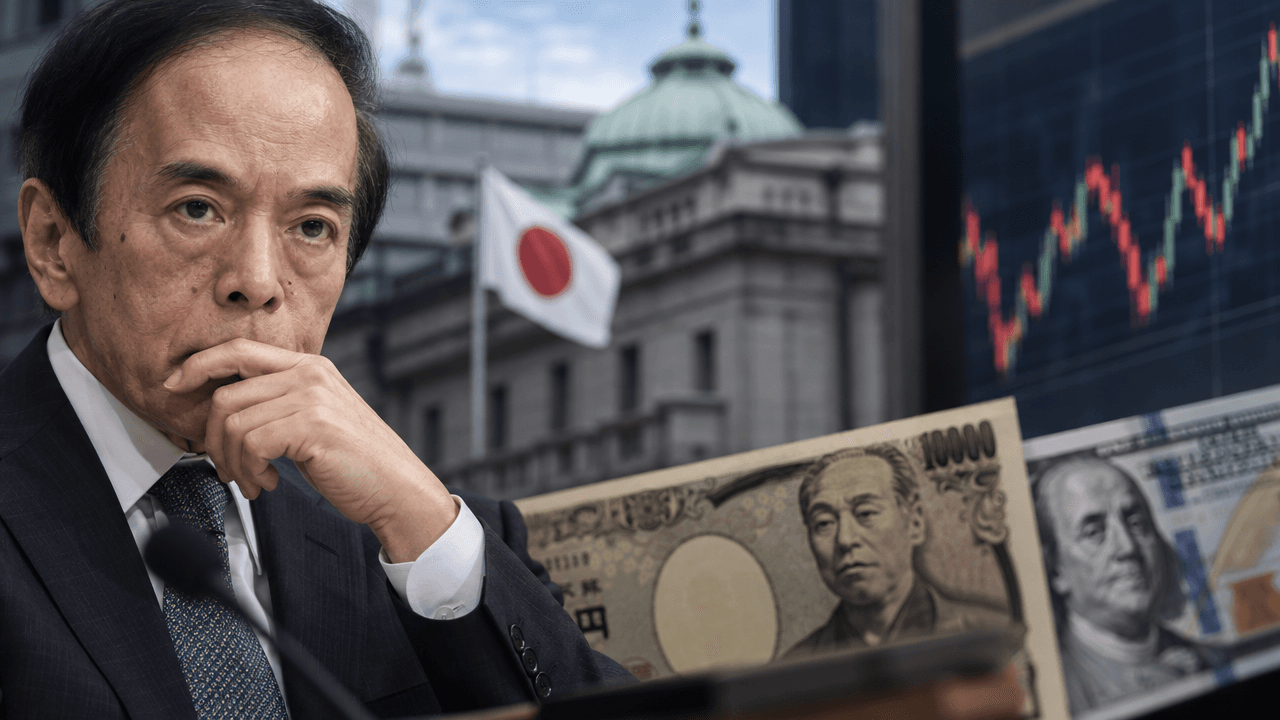
The Bank of Japan has kept its policy rate at 1.25%, but the decision was far from a signal that tightening is over. The 8–1 vote, the highest Japanese policy rate since 1995, was accompanied by language suggesting that additional increases remain possible. For traders, the message is clear: the BoJ may be pausing, but it has not abandoned its hawkish direction. [1][4]
The decision was broadly expected, yet the details matter. Board member Hajime Takata voted against the hold and proposed raising the policy rate to 1.50%. His dissent highlighted a growing view within the central bank that underlying inflation has reached the BoJ’s 2% target and that monetary policy should move closer to a neutral setting. [4][12]
Why The Boj Held Rates
The BoJ’s decision reflects a balance between improving inflation conditions and uncertainty surrounding economic growth. After two consecutive 25-basis-point rate increases in June and September, policymakers chose to assess how higher borrowing costs affect households, businesses, and financial markets. The 1.25% rate is already the highest in more than three decades, meaning the impact of recent tightening has not yet fully filtered through the economy. [2][7]
At the same time, the central bank’s assessment of inflation has become more confident. Officials indicated that underlying inflation is generally consistent with the 2% price stability target, a significant development given that the target was adopted in 2013. Persistent labor shortages and a moderate wage-price cycle are also supporting the case for gradually higher rates. [11][12]
Holding rates steady therefore does not necessarily represent a dovish shift. Instead, it can be viewed as a tactical pause that gives policymakers more time to evaluate incoming data before deciding whether another hike is warranted.
What Makes The Message Hawkish
The strongest hawkish signal came from the dissenting vote. A policymaker calling for an immediate move to 1.50% indicates that the debate is no longer centered on whether Japan can normalize policy, but on how quickly that process should happen. Takata argued that the economy had entered a new phase because underlying inflation had reached the target. [4][6]
The broader policy language also kept the door open to further rate increases. Recent summaries of BoJ opinions suggested that some officials see scope for faster hikes, particularly if inflation remains persistent or exchange-rate movements create additional price pressure. Policymakers are also monitoring overseas developments, financial conditions, and demand linked to artificial intelligence investment. [2][5]
This creates an important distinction for traders. A central bank can leave rates unchanged while still tightening financial expectations. If investors believe future hikes are becoming more likely, Japanese bond yields can rise and the yen can strengthen even without an immediate policy adjustment.
IMPLICATIONS FOR THE YEN AND USD/JPY
The hawkish stance may provide support for the Japanese yen, particularly if upcoming economic data confirms strong wages, resilient consumption, and persistent inflation. A higher expected path for Japanese interest rates reduces the appeal of borrowing yen to purchase higher-yielding assets elsewhere, potentially weakening the carry trade.
That relationship is especially relevant for USD/JPY. If the Federal Reserve is expected to ease policy while the BoJ continues moving gradually toward higher rates, the interest-rate gap between the United States and Japan could narrow. A smaller differential generally removes one source of support for the dollar-yen exchange rate.
However, the yen’s response is unlikely to be one-directional. The market had already anticipated the 1.25% decision, so the initial reaction may depend more on forward guidance than on the rate itself. A clearly hawkish interpretation could push USD/JPY lower, while any suggestion that the BoJ will delay further hikes could trigger a sharp rebound in the pair.
Recent yen gains following hawkish BoJ communications demonstrate how quickly expectations can shift. The yen strengthened beyond 158 per dollar after market participants interpreted central-bank commentary as increasing the possibility of another rate increase, potentially as soon as December. [10]
What Traders Should Watch Next
The next major focus will be the data that determines whether the BoJ’s confidence in inflation is justified. Wage growth is particularly important because sustained pay increases can support household spending and make price pressures more durable. Traders should also monitor core and underlying inflation, consumer activity, corporate pricing behavior, and the central bank’s assessment of financial conditions.
The December policy meeting may attract increased attention if inflation remains near target and economic activity holds up. The lone vote for a 1.50% rate suggests that at least one policymaker already believes the BoJ is moving too slowly. A change in the balance of votes would be a meaningful signal for bond and currency markets.
For USD/JPY traders, risk management is essential. The pair can react violently when policy expectations change, especially around central-bank announcements and Japanese inflation data. Rather than relying solely on the headline rate, traders should compare the actual decision with the market’s expectations, analyze the vote split, and study the language used to describe future policy.
Practical Takeaways For Simfi Traders
First, distinguish between a rate hold and a dovish decision. The BoJ held at 1.25%, but the dissenting vote and continued references to future hikes preserve a hawkish bias.
Second, monitor expectations instead of reacting only to the current policy rate. Currency markets price future interest-rate paths, not simply today’s number.
Third, treat USD/JPY as an event-driven market. A hawkish surprise can produce yen strength and a lower exchange rate, while a less aggressive outlook can generate a rapid dollar rebound.
Finally, manage position size around policy announcements. Even when the decision matches consensus, changes in guidance or voting behavior can create substantial volatility.
Conclusion
The Bank of Japan’s 1.25% decision is best understood as a pause within an ongoing normalization cycle. The 8–1 vote, the dissenting call for 1.50%, and the central bank’s confidence that inflation is aligned with its target all point to a more assertive policy environment than Japan has experienced for many years.
For financial markets, the key question is no longer whether the BoJ has begun tightening. It is whether policymakers will accelerate the process. That uncertainty is likely to keep the yen and USD/JPY highly sensitive to inflation, wages, economic growth, and every new signal from the central bank.