
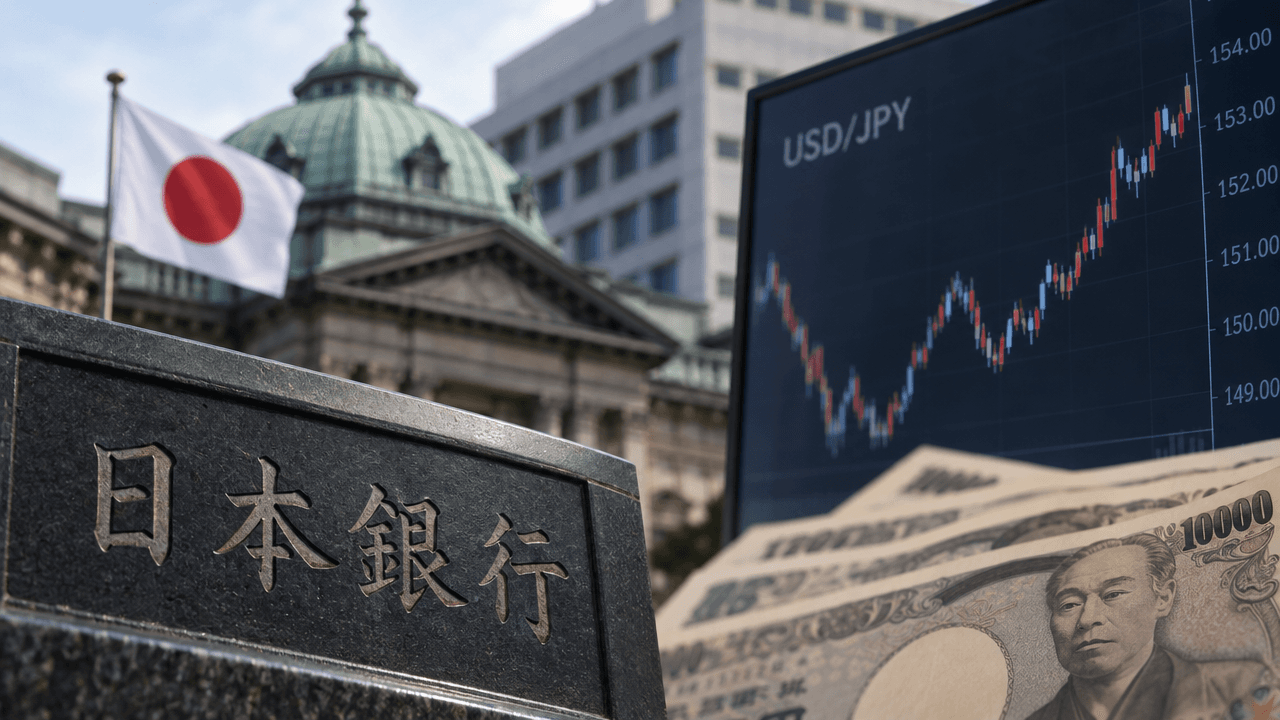
The Bank of Japan has kept its benchmark interest rate unchanged at 1.25%, but the decision was far from a signal that tightening is over. Instead, policymakers left the door open to a December increase by acknowledging that underlying inflation has reached the central bank’s 2% objective and that financial conditions remain accommodative. [1][5]
For traders, the message is clear: the timing of the next hike remains uncertain, but the direction of policy is still gradually less supportive. That combination helped keep USD/JPY near the 157–158 area, where markets are balancing expectations for higher Japanese rates against persistent demand for the U.S. dollar. [5]
The Rate Decision And The Dissent
The BoJ’s policy board voted 8–1 to maintain the overnight call rate at approximately 1.25%. The decision matched expectations, allowing the central bank to assess the economic effects of its previous increases rather than deliver back-to-back hikes. [1][3]
However, the dissenting vote added a hawkish element. Board member Hajime Takata argued for an increase to 1.5%, showing that at least one policymaker believes the economy can tolerate faster normalization. A dissent in favor of higher rates can be important because it reveals that the debate inside the central bank is no longer centered on whether policy should tighten, but on how quickly it should happen. [3]
The current rate is also significant in historical terms. At 1.25%, Japanese borrowing costs are at their highest level since 1995, according to market reporting. The BoJ has already raised rates by 25 basis points in both June and September, making the October pause a period of evaluation rather than a clear reversal of policy. [12]
Inflation Has Changed The Policy Discussion
The most important development was the BoJ’s assessment that underlying inflation is now broadly consistent with its 2% target. This marks a major change from the long period in which Japan struggled to generate stable price growth and policymakers focused primarily on escaping deflation. [5]
Reaching the target does not automatically require an immediate rate increase. The central bank must still determine whether inflation can remain stable without excessive wage pressure, weakening consumption, or an abrupt slowdown in business activity. Nevertheless, the inflation milestone removes one of the main arguments for maintaining exceptionally easy policy.
Governor Kazuo Ueda indicated that the BoJ will consider rates at every meeting, including the next gathering in December. He did not promise a specific timetable, but the statement suggested that policy has entered a phase in which inflation risks deserve greater attention. [5]
The BoJ’s challenge is to prevent inflation from becoming entrenched while avoiding an unnecessarily aggressive tightening cycle. This explains why officials may prefer to communicate flexibility rather than commit publicly to a predetermined series of increases.
Why December Matters
Markets are now treating the BoJ’s December 17–18 meeting as a major event. [2] A rate increase to 1.5% would confirm that the central bank is comfortable continuing its normalization process. It could also encourage traders to reduce yen-funded carry trades, in which investors borrow cheaply in yen to purchase higher-yielding assets elsewhere.
A December hike would probably support the yen initially, particularly if the Federal Reserve is moving toward lower rates or if U.S. economic data begins to soften. Higher Japanese yields would reduce the interest-rate advantage enjoyed by dollar assets, making USD/JPY vulnerable to a sharper decline.
A delay until January, however, would not necessarily mean that the BoJ has become dovish. If officials continue to emphasize that inflation is aligned with target and that future hikes remain possible, markets could interpret a delay as a timing decision rather than a change in direction.
For that reason, traders should watch the language of the December statement, the governor’s press conference, Japanese wage data, consumer spending, and inflation reports. The policy rate itself will matter, but forward guidance may create the larger market reaction.
USD/JPY AND MARKET VOLATILITY
USD/JPY remaining near 157–158 illustrates the competing forces affecting the currency pair. The prospect of a December BoJ hike supports the yen, while the dollar continues to benefit from yield differentials, liquidity, and demand for defensive assets. [5]
A sustained move above the recent range could indicate that markets are prioritizing U.S. yields or viewing the BoJ as too cautious. A decisive move lower could signal that traders are increasing expectations for a December hike or unwinding carry positions ahead of the meeting.
In a simulated trading environment, this is an opportunity to focus on scenarios rather than predictions. Traders can map potential support and resistance levels, define risk before entering, and test how the pair behaves after inflation releases or central bank comments. A strong strategy should account for both a December hike and a hold, rather than relying on a single forecast.
Practical Takeaways For Traders
First, do not interpret an unchanged rate as a neutral policy outcome. The inflation assessment, the hawkish dissent, and the explicit focus on future meetings all keep tightening expectations alive.
Second, distinguish between expectations and confirmation. A December hike may be widely anticipated, but markets can still react sharply if the BoJ delays action or offers less hawkish guidance than expected.
Third, monitor USD/JPY through the interest-rate differential. Japanese policy cannot be analyzed in isolation; Federal Reserve expectations and U.S. Treasury yields remain equally important.
Finally, manage event risk carefully. Central bank meetings can produce rapid price swings, wider spreads, and false breakouts. Using smaller position sizes, predefined stops, and scenario-based plans can help traders remain disciplined.
Conclusion
The BoJ’s October decision was a pause, not a policy reset. By holding rates at 1.25% while recognizing that underlying inflation has reached the 2% objective, the central bank preserved flexibility but kept the prospect of a December hike firmly in view. [1][5]
For USD/JPY traders, the next major move will depend on which force dominates: Japan’s gradual policy normalization or the dollar’s continuing yield advantage. Until December provides a clearer signal, disciplined scenario planning will be more valuable than attempting to predict every short-term price movement.