
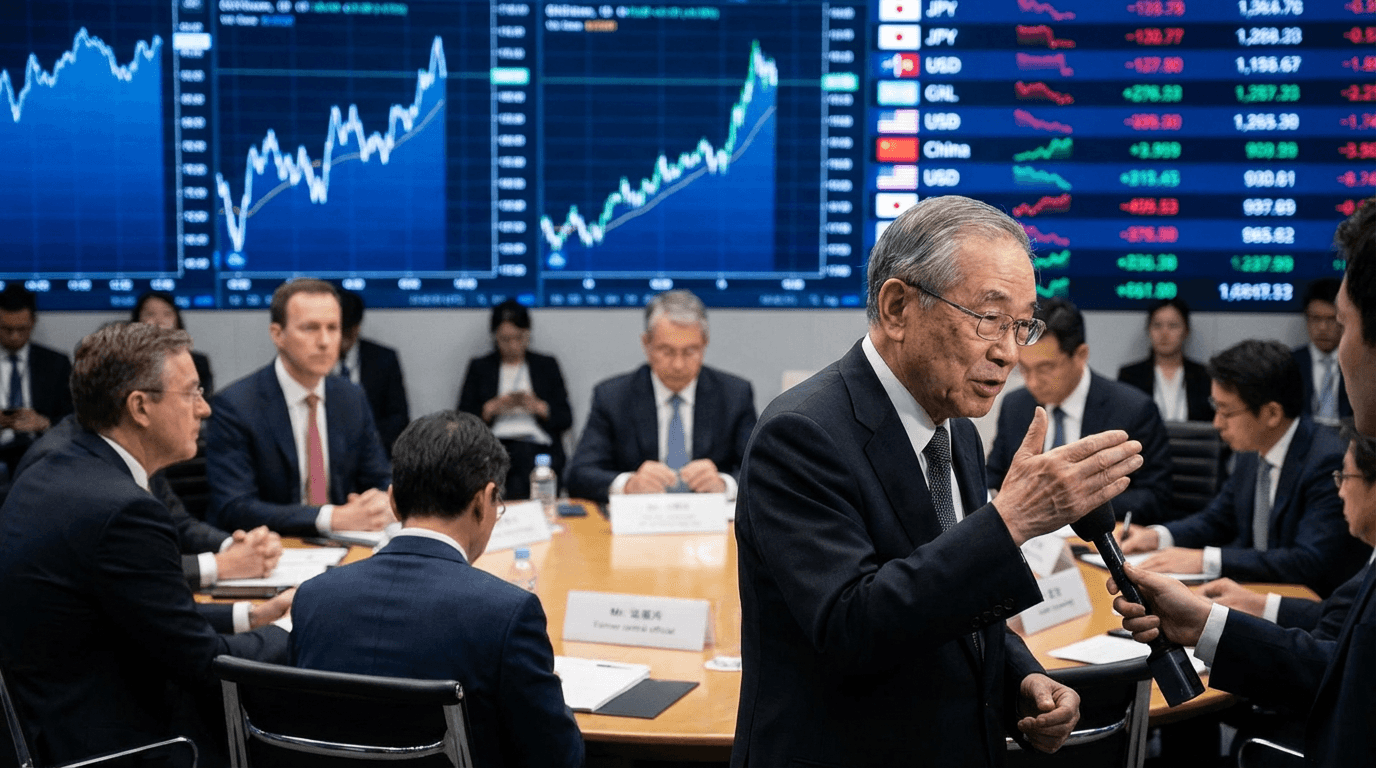
The Bank of Japan stands at a critical crossroads as it weighs whether to accelerate its monetary policy normalization beyond market expectations. According to former BOJ board member Makoto Sakurai, a continued decline in the yen could force the central bank's hand into raising interest rates as early as March, just months after lifting rates to 0.75% in December. This potential acceleration reflects growing tensions between currency stability and inflation control, presenting both risks and opportunities for market participants closely monitoring Japan's economic trajectory.
Currency weakness has emerged as the primary driver reshaping Japan's policy outlook. Since Prime Minister Sanae Takaichi took office in October 2025, the yen has depreciated roughly 8% against the dollar, reaching an 18-month low of 159.45 in January before recovering somewhat to around 155 per dollar. This depreciation creates a political and economic squeeze, raising import costs for households and businesses while complicating the inflation picture for policymakers. Sakurai's commentary underscores how foreign exchange dynamics have become inseparable from the BOJ's tightening cycle, fundamentally reshaping how investors should evaluate near-term policy trajectories.
The Yen Depreciation Puzzle
The yen's weakness reflects deeper structural challenges in Japan's economy and the policy divergence with other major economies. Higher interest rates in the United States and other developed nations have made dollar-denominated assets more attractive, drawing capital away from yen-based investments. Recent "rate checks" from American officials, widely interpreted as signaling a preference for a stronger yen, highlight how currency management has become a bilateral concern ahead of an anticipated summit between Prime Minister Takaichi and President Donald Trump potentially occurring around the BOJ's March 18-19 policy meeting.
Sakurai argues that while direct currency intervention provides only temporary relief from selling pressure, rate hikes offer a more durable mechanism for stabilizing the yen. Each basis point increase makes yen-denominated deposits more attractive to investors, potentially reversing some depreciation pressure. This logic creates a compelling case for accelerated tightening if currency weakness persists, though it also illustrates the tension between supporting the exchange rate and managing broader economic risks.
MARCH VS. APRIL: THE TIMING QUESTION
While most economists surveyed by Reuters expect the BOJ to reach 1% by the end of June, financial markets are pricing approximately 70% odds of a rate hike by April, with some probability assigned to a March move. Sakurai acknowledges that April represents the more logical timing from a communication and forecasting perspective, since it allows the central bank to incorporate updated quarterly growth and inflation projections into its decision-making framework.
However, renewed yen weakness before the March summit could alter this calculus. Sakurai suggests the BOJ could justify an earlier hike by citing expectations of robust wage increases in Japan's annual spring labor negotiations. Strong wage settlements would strengthen the argument that inflation is becoming increasingly demand-driven and sustainable rather than temporary, providing political cover for accelerated tightening.
The Japanese Bankers Association chair independently echoed this assessment, stating there is a "reasonable possibility" of a rate hike in either March or April, indicating consensus building among key stakeholders regarding the timing and necessity of further tightening.
Inflation And Import Costs: The Dual Pressure
Japan's inflation outlook presents another critical consideration. While the BOJ ended its decade-long ultra-loose monetary regime in 2024 and has since raised rates multiple times, inflation has remained above the central bank's 2% target for nearly four years. Government fuel subsidies have dampened some price pressures, but currency weakness directly counteracts these efforts by raising the cost of imported energy and food.
A weaker yen amplifies these imported inflation pressures precisely when the BOJ is trying to achieve its price stability mandate. This creates a self-reinforcing cycle where currency depreciation necessitates rate hikes, which in turn can gradually stabilize the currency. Understanding this dynamic is essential for traders attempting to position for BOJ outcomes, as it reveals why policymakers view rate hikes as preferable to one-time currency intervention.
Risks And Constraints On Tightening
Despite the case for accelerated tightening, Sakurai counsels against moving too quickly. Rapid rate increases could strain Japan's financial system, particularly regional banks and small businesses vulnerable to higher borrowing costs. Additionally, a potential shift of household savings into interest-bearing deposits once rates exceed 0.5% could complicate the BOJ's monetary policy implementation by reducing money supply growth.
Sakurai's long-term framework suggests the BOJ may require approximately two rate hikes in both 2026 and 2027 to reach a neutral policy rate of roughly 1.75%, a measured pace that balances normalization with financial stability concerns.
Implications For Market Participants
For traders and SimFi platform participants, the BOJ's March decision carries outsized significance. A hike would likely strengthen the yen, potentially disrupting positioning in foreign exchange markets. Conversely, a hold would reinforce expectations for April tightening while suggesting currency concerns are manageable. The interplay between these outcomes and broader market volatility makes the March 18-19 meeting a critical inflection point for Japanese asset prices and currency dynamics throughout 2026.