
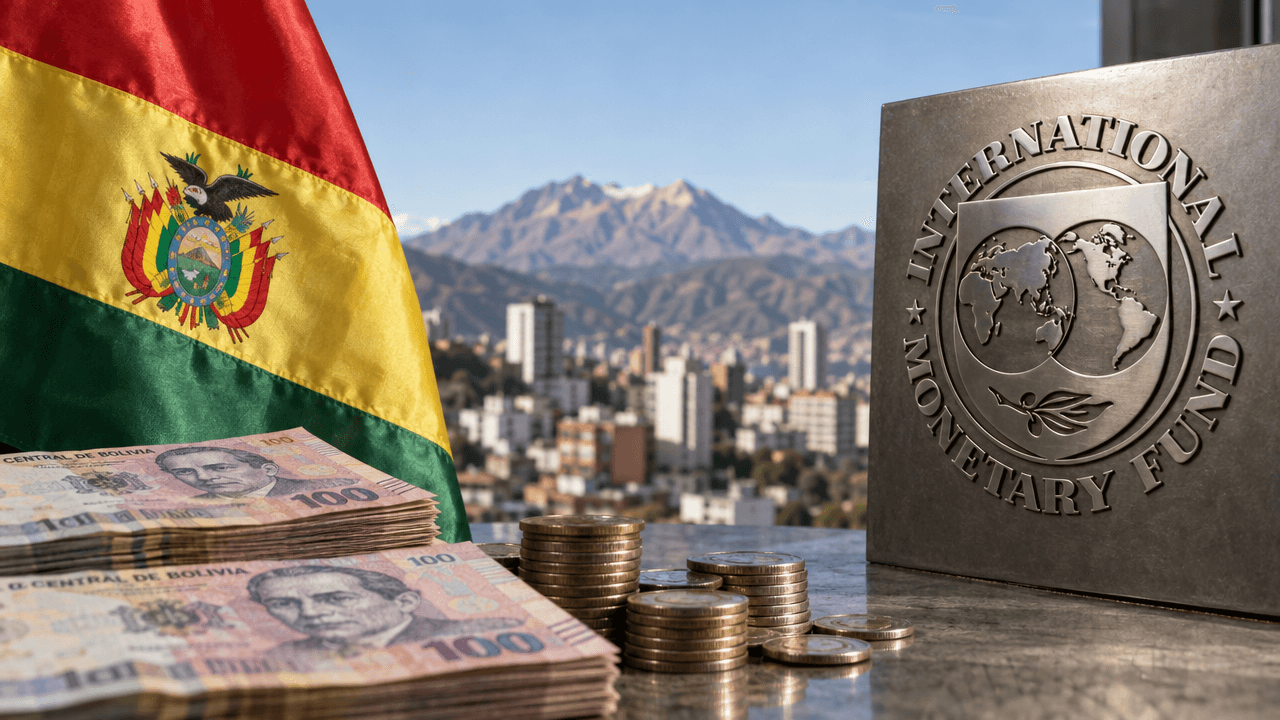
Bolivia’s approval of a $1.9 billion International Monetary Fund (IMF) program marks a turning point for a struggling economy facing foreign-currency shortages, widening fiscal gaps, and shrinking reserves.[1][2][10][13] For emerging-market FX and sovereign-credit traders, this is a classic case study of how policy decisions, funding lines, and political risk can quickly shift risk profiles and market sentiment.[1][9][12][13]
BOLIVIA’S MACRO BACKDROP: WHY THE IMF DEAL WAS NEEDED
In recent years, Bolivia has wrestled with a deepening shortage of foreign currency, especially U.S. dollars, which has constrained imports and put pressure on the local financial system.[1][2][10][13] At the same time, international reserves have eroded and fiscal accounts have deteriorated, limiting the state’s ability to support growth or defend its currency.[1][2][10][13]
A key driver of these imbalances has been large fuel subsidies and a managed pricing regime that kept domestic fuel prices artificially low, even as global energy costs rose.[4][15] These subsidies weighed heavily on public finances and contributed to reserve depletion, because the government needed hard currency to import fuel and other essentials while selling domestically at below-market prices.[4][15]
WHAT THE $1.9 BILLION IMF DEAL PROVIDES
The agreement with the IMF centers on a 36‑month program under the Fund’s Extended Fund Facility (EFF), which targets countries with deeper, more structural balance-of-payments problems.[1][8][11][13][14] The facility is sized at about 1,369 million Special Drawing Rights (SDR), equivalent to roughly $1.9 billion, disbursed in tranches over three years subject to periodic reviews and policy benchmarks.[8][11][14]
Crucially, the IMF program is expected to catalyze more than $5 billion in additional financing from multilateral lenders including the World Bank and the Inter-American Development Bank, along with other bilateral partners.[1][9][10][12][13] That larger financing envelope is designed to rebuild reserves, ease the dollar shortage, and provide budget support while reforms are implemented.[1][2][9][13]
The policy package focuses on restoring macro stability, reducing fiscal and external vulnerabilities, strengthening social safety nets, and paving the way for more private-sector-led growth.[2][12][13] Conditionality includes tighter monetary and fiscal discipline, a more flexible exchange-rate regime, and a phased removal of fuel subsidies, which together aim to realign prices and improve the sustainability of public finances.[4][13][15]
Political And Social Risk: Implementation Is Everything
Bolivia’s Congress has now approved the IMF loan agreement, delivering a legislative victory for President Rodrigo Paz and clearing the domestic hurdle before the program goes to the IMF’s Executive Board for final sign‑off.[1][3][6][10][12] This makes the package Bolivia’s first multi‑year arrangement with the Fund since 2006, underscoring the depth of the current crisis and the scale of the policy reset.[12][13]
However, implementation risk is significant. Trade unions and social movements have already warned that the austerity measures and subsidy cuts embedded in the program could trigger renewed protests and social unrest.[3][6][15] Ending generous fuel subsidies by around 2027 is politically sensitive, as it will likely raise transport and living costs in the near term, even if it stabilizes the macro picture over time.[4][15]
The reform agenda will also test the cohesion of Paz’s governing coalition, which must balance investor confidence and fiscal repair against social stability and distributional concerns.[12] For traders, this tension between macro stabilization and political fragility is a key source of headline risk and volatility.
Market Implications For Emerging-market Fx And Credit
From a sovereign-credit perspective, an IMF anchor typically reduces long‑term default risk by providing external funding and a rules‑based framework for adjustment.[1][2][12][13] Over the medium term, this can be positive for spreads, as investors gain more visibility on fiscal trajectories, reserve coverage, and policy direction.[1][9][13]
Yet the near term can be choppy. Removing fuel subsidies, shifting toward more flexible FX management, and tightening fiscal policy can initially weigh on growth and real incomes, potentially intensifying political tensions.[4][13][15] In many emerging markets, such adjustment phases have led to wider spreads and FX volatility before the benefits of stabilization are priced in.
Beyond Bolivia, the deal sends a signal to investors that commodity‑exporting emerging economies under pressure may be more willing to re‑engage with multilateral institutions and accept tougher conditionality. That can influence regional sentiment, especially for countries with similar profiles of dwindling reserves, quasi‑fixed exchange rates, and large subsidy bills, even if their specific risk dynamics differ.
Practical Takeaways For Traders And Simfi Participants
For FX traders, the Bolivian case underlines the importance of tracking reserve levels, funding pipelines, and policy commitments alongside price action. External financing packages can change the narrative around a currency’s sustainability, but only if reforms are credible and social unrest contained. Monitoring the pace of IMF disbursements, political developments around subsidy removal, and any shift in the exchange‑rate regime can provide early signals of whether volatility is likely to increase or fade.[1][4][6][13][15]
Sovereign-credit and macro traders can treat Bolivia as a live example of “IMF premium” versus “political discount.” Over time, the presence of a structured program and multilateral support may compress spreads as default risk declines, but any flare‑up in protests or legislative resistance could widen spreads and reprice risk.[1][3][6][12][15] Scenario analysis that considers both successful implementation and reform slippage can help frame position sizing and hedging strategies.
In a simulated finance environment, events like Bolivia’s IMF deal are ideal testbeds for building and stress‑testing macro trading frameworks. Participants can model different paths for reserves, fiscal balances, and growth under varying assumptions about how quickly subsidies are removed and how markets respond. They can then observe how those scenarios translate into hypothetical FX moves, sovereign spreads, and risk‑asset correlations, without capital at stake.
Conclusion: A Necessary Step With Uncertain Payoff
Bolivia’s $1.9 billion IMF agreement is a necessary step toward stabilizing an economy strained by currency shortages, fiscal deficits, and falling reserves, but it is far from a guaranteed cure.[1][2][10][13] The program offers a substantial financing backstop and a framework for reform, while opening the door to more than $5 billion in additional multilateral support.[1][9][10][12][13] Yet its success will hinge on politically difficult measures, particularly fuel subsidy removal, and the government’s ability to manage social and coalition risks.[3][6][12][15]
For emerging‑market FX and credit markets, the deal is likely to be moderately market‑moving: it reduces tail risks over the medium term but introduces new short‑term uncertainties around implementation. For traders and SimFi users alike, the key is to treat Bolivia not only as a single‑country story, but as a broader lesson in how funding, politics, and policy design interact to shape risk and opportunity in emerging markets.