
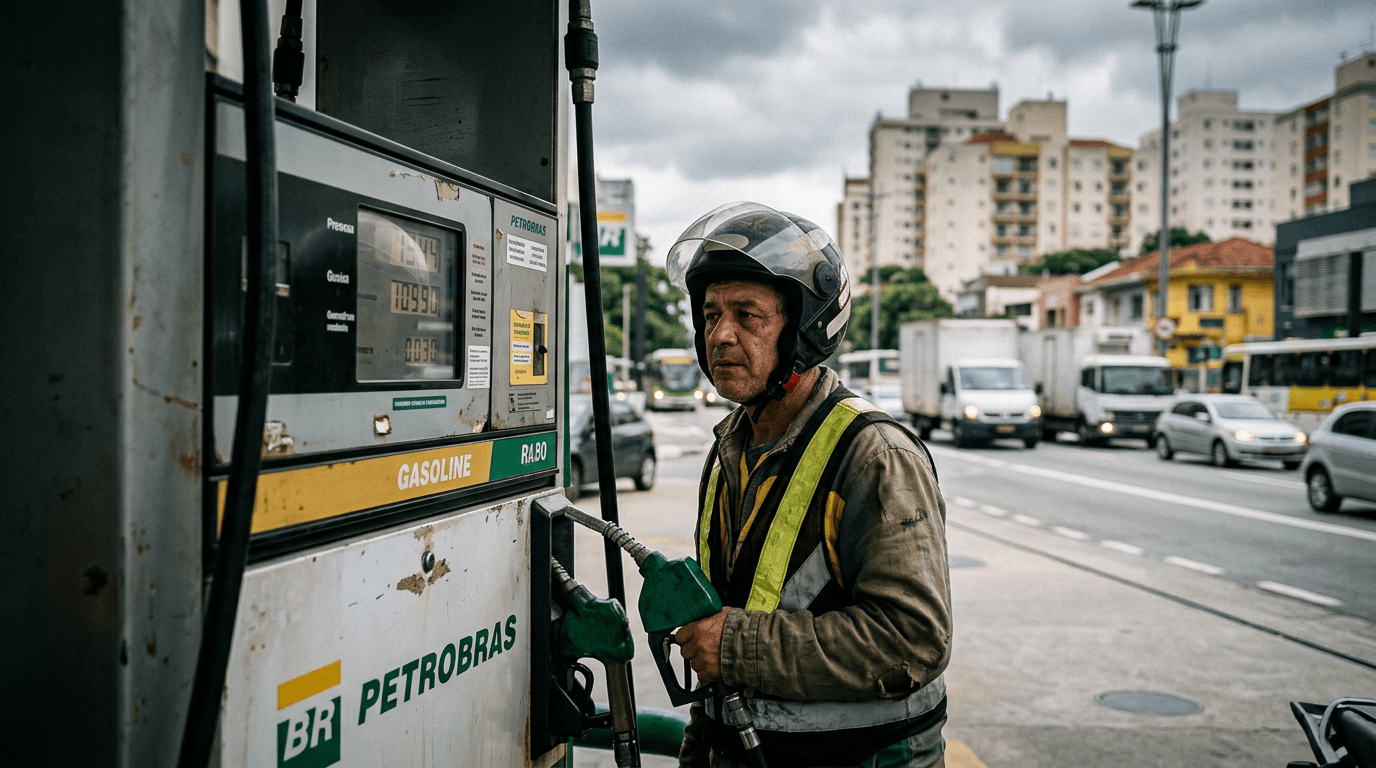
Brazil’s decision to delay scrapping its gasoline subsidy is a textbook example of how geopolitics, commodities, and domestic politics collide in emerging markets. Finance Minister Dario Durigan confirmed that the move to remove the subsidy has been pushed to next week, explicitly citing uncertainty from the U.S.-Israeli war against Iran that has driven oil prices higher again[1]. For traders, this is not just a local fuel-price story; it is a signal about Brazil’s fiscal stance, inflation risk, and the near-term path of the real.
Market Context: Oil Shocks And Policy Uncertainty
Brazil introduced a gasoline subsidy in response to the global energy shock triggered by conflict in the Middle East, authorizing economic support to producers and importers of petroleum-based fuels via decree[4][8]. The subsidy is set at 0.44 real per liter of gasoline and was initially designed as a temporary two‑month measure to “alleviate the economic repercussions” of the oil price spike[4]. Officials even floated the possibility of extending it if market conditions remained stressed[4].
In June, the narrative appeared to be shifting toward normalization. The Finance Ministry signaled that subsidies for diesel and gasoline would be phased out if crude prices stabilized around $80 per barrel, amid progress toward a U.S.-Iran agreement to ease tensions[5][6]. That guidance implied a path back to market pricing and a lighter fiscal burden once energy markets calmed. The current escalation of war involving Iran reverses that logic: rising oil prices and renewed uncertainty have prompted Brazil to postpone the decision and keep support in place for now[1].
WHAT THE GASOLINE SUBSIDY DOES – AND WHY IT MATTERS
The gasoline subsidy effectively acts as a buffer between global oil prices and domestic consumers. By compensating producers and importers at 0.44 real per liter, the government can limit the pass‑through of higher crude prices to the pump[4][8]. This helps contain headline inflation and protect household purchasing power, a critical concern in a country where fuel costs have direct and visible political consequences.
At the same time, subsidies carry a clear fiscal cost. Earlier estimates placed the monthly cost of gas subsidies in the hundreds of millions of dollars[3], and Brazil has begun to unwind some of this support by terminating a diesel subsidy of 0.35 real per liter from 1 July[10]. Keeping gasoline subsidies in place for longer while oil remains elevated means the government must either absorb higher spending or offset it elsewhere through taxes, spending cuts, or borrowing.
Durigan also noted that Brazil will increase the ethanol blend in gasoline from 30% to 32% in the coming days[1]. Raising the share of domestically produced ethanol is another way to reduce reliance on imported oil and mitigate price shocks, though it does not eliminate exposure to global energy markets. For traders, the combined use of subsidies and blend adjustments signals a government keen to smooth volatility rather than allow full market pass‑through.
Fx And Rates: How Traders Read The Signal
News that Brazil is delaying subsidy removal is immediately relevant for FX desks and fixed‑income traders. First, it touches on inflation expectations. Maintaining subsidies can temporarily dampen measured inflation by keeping fuel prices lower than they would otherwise be. That may reduce near‑term pressure on the central bank to tighten policy more aggressively, all else equal.
Second, the decision adds nuance to Brazil’s fiscal outlook. Subsidies are not permanent structural programs, but repeated extensions can raise questions about fiscal discipline and political willingness to normalize prices once conditions improve. Markets watch whether such measures remain clearly time‑bounded or drift into open‑ended support. A perception that Brazil is leaning more heavily on fiscal buffers during periods of external shock can affect the risk premium demanded on its bonds and, by extension, the valuation of the real.
For the currency, the impact is two‑sided. On one side, avoiding a sudden jump in gasoline prices can support domestic demand and reduce inflation volatility, which is positive for macro stability. On the other, prolonged subsidies may be seen as a fiscal negative, particularly if the war‑driven oil surge proves persistent. FX traders will weigh these elements against broader drivers such as global risk appetite, U.S. rates, and commodity export revenues.
Scenarios Ahead: Oil, Subsidies, And The Real
The key variable driving Brazil’s fuel policy is the path of oil prices under Iran‑related conflict risk. If the war stabilizes and crude drifts back toward the previously referenced $80 per barrel area, the government has already signaled an intention to phase out fuel subsidies “carefully”[5][6]. In that scenario, traders might expect a gradual removal of the gasoline subsidy, more predictable fuel inflation, and a slightly clearer fiscal trajectory.
If, however, the conflict escalates further and oil moves higher, Brazil faces a harder trade‑off. Extending or even expanding subsidies would shield consumers but raise fiscal costs and complicate medium‑term consolidation plans. Allowing full pass‑through would preserve public finances but risk a politically sensitive fuel spike and higher inflation. The current decision to wait one more week reflects the desire to gather more information about the war’s trajectory before committing[1].
For the real, this news is best viewed as part of a broader risk regime. An environment of elevated oil prices and geopolitical tension tends to increase global risk aversion and volatility, which can weigh on emerging‑market currencies. Brazil’s combination of commodity exporter status, active fuel management, and evolving fiscal signals will determine whether the real is seen as relatively resilient or more vulnerable compared with peers.
Takeaways For Simulated And Real-world Traders
For traders using simulated finance platforms as well as those in live markets, Brazil’s handling of gasoline subsidies amid an Iran‑driven oil surge offers several practical lessons.
First, macro headlines that appear “local” can carry global pricing implications. A delayed subsidy decision in Brazil interacts with oil futures, EM FX, local rates, and even consumer‑linked equities. Understanding these linkages helps traders build more coherent macro narratives rather than reacting to single data points in isolation.
Second, policy guidance is conditional. In June, officials confidently tied subsidy removal to oil stabilizing around $80[5][6]. A few weeks and a war escalation later, that guidance has been revised in practice. Simulated traders can use scenarios like this to practice adapting positions when policymakers respond to new information instead of treating prior statements as fixed commitments.
Third, temporary measures often become tests of credibility. Brazil’s decree explicitly framed the gasoline subsidy as short‑term relief for a Middle East energy shock[4]. How decisively the government unwinds that support when conditions allow will shape market perceptions of discipline and predictability. Tracking these follow‑through moments is central to understanding risk premia in EM assets.
Finally, this episode underlines the importance of integrating geopolitical analysis into trading frameworks. Oil markets do not move in isolation, and neither do currencies or fiscal policies. War risk, diplomacy, and sanctions can quickly alter the assumptions underpinning valuations. Whether in simulated or live trading, building scenarios around geopolitical developments and mapping them to energy prices, inflation, and policy responses is increasingly essential.