
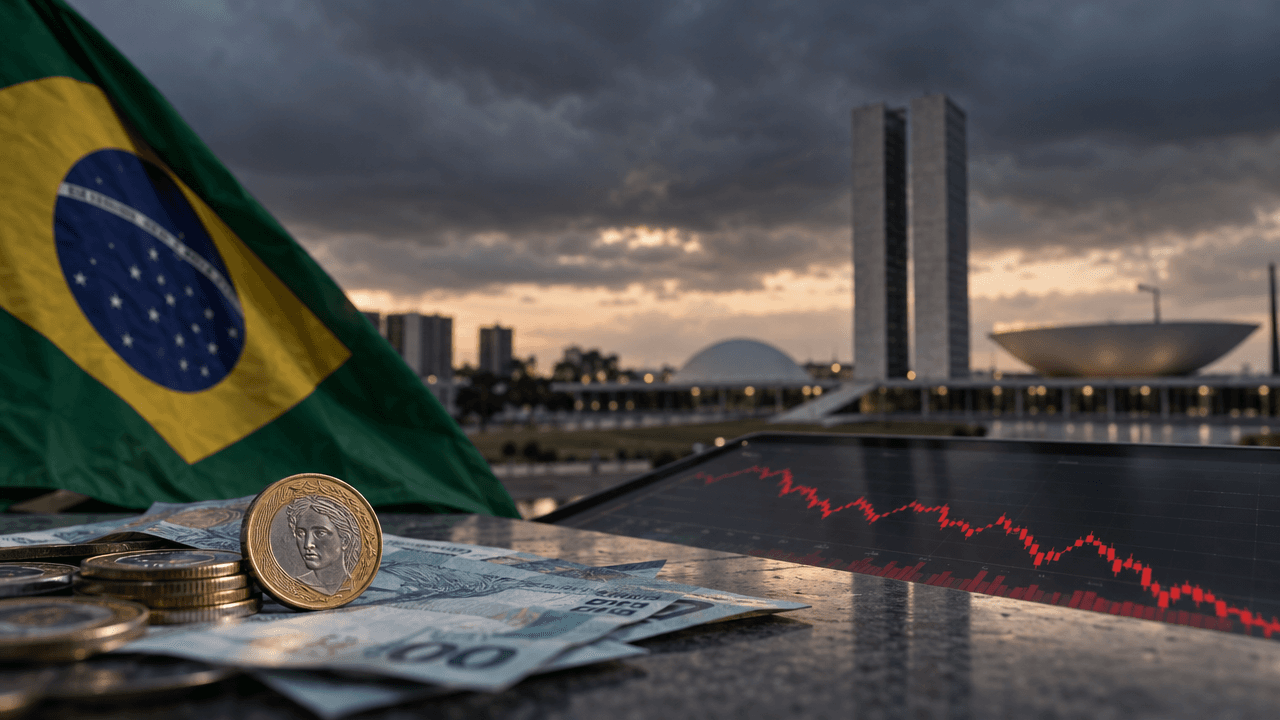
Brazil’s financial markets delivered a sharp reminder that political expectations can move prices faster than economic data. After Luiz Inácio Lula da Silva secured an unexpected reelection victory over right-wing challenger Flávio Bolsonaro, the Brazilian real weakened more than 8% against the U.S. dollar, while the Bovespa suffered a dramatic reversal. The benchmark index reportedly fell 18.12% for the week, erasing a substantial portion of its recent gains.
The reaction was not simply a response to the election result itself. It reflected the sudden unwinding of trades built around an anticipated shift to the political right, tighter fiscal management, and potentially more business-friendly economic policies. When those expectations failed to materialize, investors moved quickly to reduce exposure to Brazilian assets.
Why The Market Reversal Was So Sharp
Markets price expectations, not just events. In the weeks leading up to the runoff, investors had increasingly positioned for a Bolsonaro victory after the right-wing candidate performed strongly in the first round. That view supported gains in Brazilian stocks and helped create a more favorable backdrop for the real.
Lula’s victory overturned that consensus almost instantly. The real fell approximately 8% against the dollar in one session, its largest daily decline in decades according to market reports. The currency briefly weakened even further during volatile early trading. [2][3]
The Bovespa also came under intense pressure. Trading was temporarily halted after the index fell 10%, activating a circuit-breaker mechanism designed to slow disorderly selling. The index ultimately closed about 13.9% lower on the day, its steepest daily decline since the early stages of the COVID-19 crisis. [4][11]
For traders, the episode illustrates how crowded positioning can amplify a political surprise. Investors who had bought Brazilian assets in anticipation of a particular outcome were suddenly competing to exit at the same time.
Fiscal Policy At The Center Of Investor Concerns
The most important market question is now how the incoming administration will manage public spending, debt, and the fiscal framework. Investors are not necessarily reacting to a single policy announcement. Instead, they are reassessing the likely direction of economic policy over the president’s next term.
Concerns about fiscal discipline can affect several markets simultaneously. If investors expect government spending to rise without a credible plan to stabilize debt, they may demand higher yields on Brazilian bonds. Higher yields increase borrowing costs for the government, companies, and consumers. They can also make equities less attractive because future corporate cash flows are discounted at higher interest rates.
The election shock was accompanied by a rise in interest-rate futures and sharp increases in some domestic bond yields, with certain yields moving above 15%. [2] That response suggests investors were demanding additional compensation for inflation, fiscal, and political risk.
A weaker real can intensify these concerns. Currency depreciation makes imported goods and foreign-currency liabilities more expensive, potentially adding to inflationary pressure. If the central bank responds by keeping interest rates higher for longer, economic growth and interest-sensitive sectors may suffer.
What The Selloff Means For Equity Investors
The Bovespa is not a single economic bet. It contains exporters, banks, energy companies, commodity producers, and domestically focused businesses. Each group can respond differently to a political shock.
Exporters and companies that earn substantial revenue in dollars may receive some protection from a weaker real because foreign earnings translate into more local currency. Commodity producers can also benefit if global commodity prices remain firm. However, political risk can still reduce valuations across the market when investors fear higher taxes, regulatory intervention, or weaker growth.
Banks and consumer-oriented companies may be more exposed to domestic conditions. Higher interest rates can reduce loan demand, increase credit risks, and pressure household spending. Companies dependent on government contracts or regulated prices may face additional uncertainty while investors wait for policy details.
The size of the decline also matters. A steep one-week fall can create opportunities for long-term investors, but a low share price does not automatically mean an asset is cheap. Valuations must be considered alongside earnings expectations, debt levels, currency exposure, and the probability of policy changes.
Lessons For Simfi Traders
This episode offers several practical lessons for simulated finance and real-market traders.
First, avoid treating political forecasts as certainties. A trade based on an election expectation should include a defined invalidation point, because polls, coalitions, and voter turnout can produce outcomes that markets have not fully priced.
Second, monitor correlations. The real, stocks, bonds, and interest-rate futures all moved together because they were responding to the same change in expectations. A portfolio that appears diversified by asset class may still carry concentrated political risk.
Third, understand liquidity. During a fast selloff, prices can gap through stop levels, spreads can widen, and circuit breakers can delay execution. Traders should test how their strategy behaves under extreme volatility rather than relying only on normal-market performance.
Finally, distinguish headline volatility from lasting trend changes. The first reaction may be driven by positioning and forced selling. The next phase will depend on cabinet appointments, fiscal proposals, legislative support, central-bank policy, and external conditions such as U.S. interest rates and commodity prices.
The Broader Emerging-market Warning
Brazil’s reversal highlights why emerging-market assets can experience larger moves than developed-market assets after political surprises. These markets often combine higher interest rates, greater currency sensitivity, less predictable policy environments, and lower liquidity.
That combination creates both risk and opportunity. Investors may eventually return if the new administration provides credible fiscal guidance and preserves institutional stability. Conversely, continued policy uncertainty could keep the real under pressure and prolong the equity market’s risk premium.
The key takeaway is that election-driven rallies can reverse quickly when they depend on a narrow political assumption. For traders, the strongest defense is preparation: define risk before entering, track cross-asset signals, reduce leverage during major events, and wait for policy evidence rather than trading headlines alone.
Brazil’s post-election selloff was therefore more than a one-day market shock. It was a repricing of political risk across currency, equities, bonds, and interest rates. The next direction will depend not on the election result alone, but on whether policymakers can restore investor confidence through clear and credible economic decisions.