
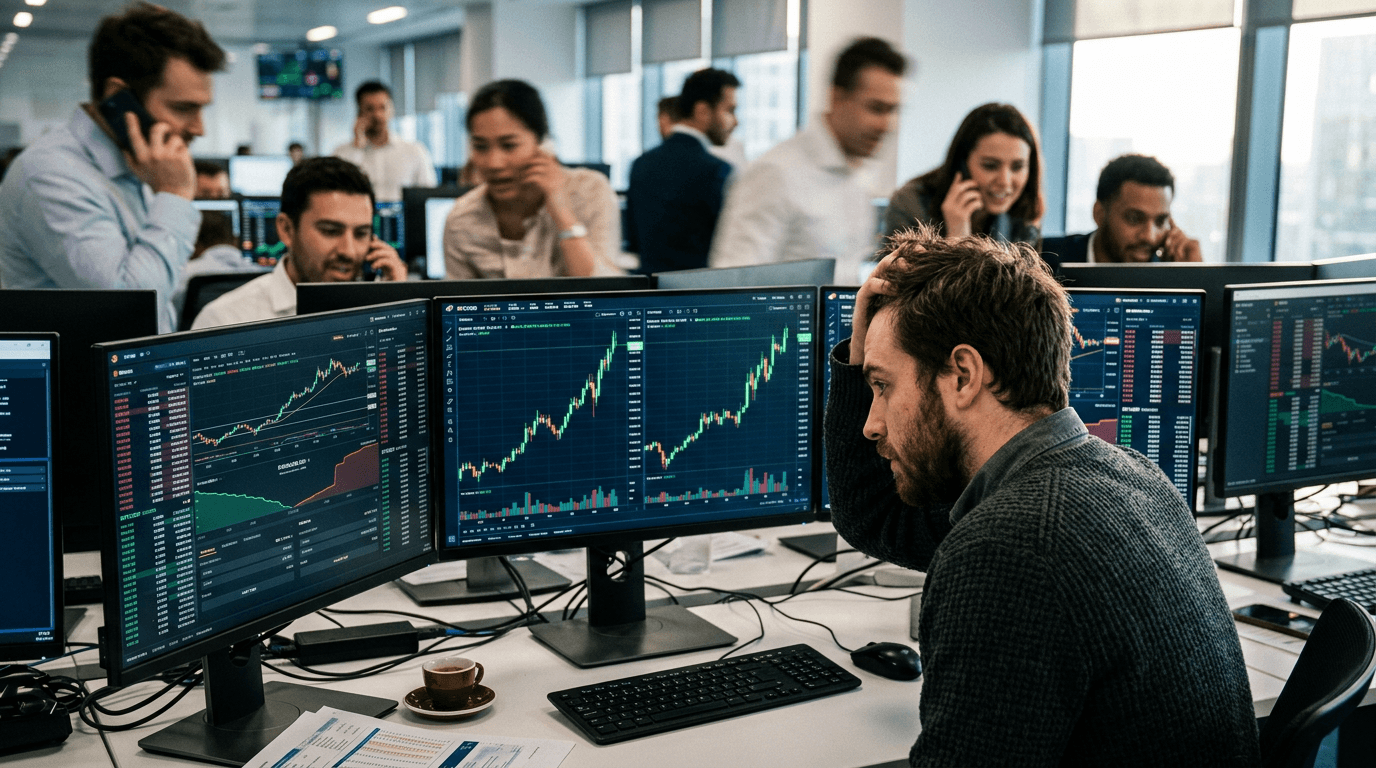
A sharp, broad-based rally has swept across the crypto market, with major coins climbing roughly 3–5% in the last day, Ethereum up around 4–5%, and Zcash leading with a surge above 15%, while total market capitalization has risen to about $2.8 trillion on more than $100 billion in 24‑hour trading volume.[5][9][15] This move has not been driven solely by fresh spot demand, but by a powerful short squeeze that forced more than $100 million in bearish positions to liquidate, fueling a shift back toward risk-on sentiment in futures and perpetuals.[5][9][15]
What Is Driving The Latest Crypto Surge
The core driver of this rally is positioning, not a single headline or macro catalyst.[5][9] A large cluster of traders were leaning short across major coins, expecting continued consolidation or downside after recent volatility, and had built up leveraged bearish exposure in derivatives markets.[5][9][15] Once prices began to break higher, these shorts were pushed into loss territory, triggering forced liquidations as margin thresholds were breached and risk engines automatically closed positions.[5][9][15]
As liquidations hit, exchanges executed market buy orders to cover those positions, which added further upward pressure on prices and accelerated the move.[6][8][9] This feedback loop is typical of a short squeeze: rising prices force shorts to buy, which pushes prices higher still, leading to more liquidations and a self-reinforcing rally that can overshoot fair value in the short term.[4][6][11] The result is a fast, broad push higher across the crypto complex, with both large-cap names and selected altcoins participating as shorts scramble to exit.[5][9][15]
Understanding Short Squeezes In Crypto
A short squeeze in crypto occurs when traders who sold an asset short are forced to buy it back at higher prices as the market moves against them.[4] Because many crypto traders use leverage, losses can mount quickly and margin calls are more common, making squeezes especially violent compared with traditional markets.[6][8][11] When liquidation thresholds are crossed, exchange risk engines automatically close positions, often via market orders that execute into the existing order book and push prices higher.[6][8][9][11]
Recent history shows how extreme these events can become: short liquidation waves of $1–2.7 billion over 24 hours have been recorded in Bitcoin and the broader crypto market, with over $1 billion in BTC shorts wiped out in about an hour during major squeezes.[6][8][9][12][15] In those episodes, total crypto liquidations reached up to roughly $2.7 billion, with shorts accounting for the overwhelming majority of forced closures, demonstrating the vulnerability of crowded bearish positioning.[8][9][12][15] Today’s move is smaller in scale, but the same mechanics are at work, providing a live case study in how positioning and leverage can dominate short-term price action.[5][9][15]
Why This Matters For Active Traders
For active traders, the latest rally is a reminder that market structure often matters more than narrative in the short term.[5][9] When funding rates, open interest, and positioning show a market heavily tilted to one side, the risk of squeezes or cascades rises sharply, regardless of whether the fundamental story looks bullish or bearish.[6][8][11][12] Bears caught in this move are being forced to cover into rising prices, while nimble participants who recognized the squeeze early have benefited from the momentum.[5][9][15]
The surge has also reinforced risk-on behavior in crypto futures and perpetual swaps, where traders are willing to take on more leverage after seeing prices break higher.[5][9][15] That can set the stage for further volatility in both directions, as new leveraged longs join the market and create the possibility of a long squeeze if prices reverse.[6][8][11] For anyone trading actively—whether on live markets or in a simulated environment—the key takeaway is that risk management must account not only for price levels but for structural vulnerabilities created by crowded leverage.[4][6][11]
How Simulated Finance Can Turn Volatility Into A Learning Edge
In a SimFi environment like E8 Markets, events like this short squeeze are ideal scenarios to practice decision-making without real capital at risk. Traders can simulate being on both sides of the move: managing a short that suddenly goes against them, or riding long momentum while imposing disciplined exit rules. This allows participants to see, in real time, how liquidation cascades impact order books, slippage, and execution quality.
Simulated trading also offers a controlled way to test different levels of leverage and margin allocation under stress. By replaying volatile periods and adjusting position size, stop-loss placement, and hedging strategies, traders can quantify how quickly drawdowns accelerate when leverage is too high, and how much more survivable a squeeze becomes with conservative sizing. Over time, this builds an internal playbook of responses to rapid, squeeze-driven rallies before facing them with real capital.
PRACTICAL PLAYBOOK FOR THE NEXT 24–72 HOURS
In the near term, traders should treat this rally as structurally fragile rather than automatically sustainable. One practical step is monitoring funding rates and perpetual swap premiums: if they flip from deeply negative to sharply positive, it indicates a swing from crowded shorts to crowded longs and raises the risk of a future long squeeze if prices stall. Similarly, tracking open interest can reveal whether new leverage is entering the system or if the move is mostly driven by short covering, which often fades quickly.
On a strategy level, SimFi traders can challenge themselves to design three scenarios: continuation (the rally extends), consolidation (prices range and chop), and mean reversion (a sharp pullback). For each scenario, building entry, exit, and risk parameters in the simulated environment sharpens response time and discipline. Emphasis should be placed on reducing position size in periods of elevated volatility, using staggered profit-taking rather than betting on calling the exact top, and ensuring every leveraged trade has a predefined invalidation level.
Conclusion: Turning Short Squeezes Into Skill Builders
Broad crypto rallies driven by short squeezes are as much about positioning and leverage as they are about fundamentals, and today’s 3–5% surge across major coins illustrates that point clearly.[5][9][15] While short-term price action can be exhilarating, the traders who endure are those who respect how quickly liquidations, margin calls, and crowd behavior can reshape markets.[4][6][8][11][12] By using simulated environments to rehearse responses to squeezes, traders can convert volatile episodes from dangerous surprises into structured learning opportunities.
Whether this particular move evolves into a sustained trend or fades as short covering exhausts itself, the underlying lesson remains: in crypto, understanding market structure is not optional, it is a core edge.[5][9][12][15] For E8 Markets users, the current environment is a timely invitation to study how squeezes unfold, refine risk management frameworks, and prepare—calmly and systematically—for the next wave of volatility.