
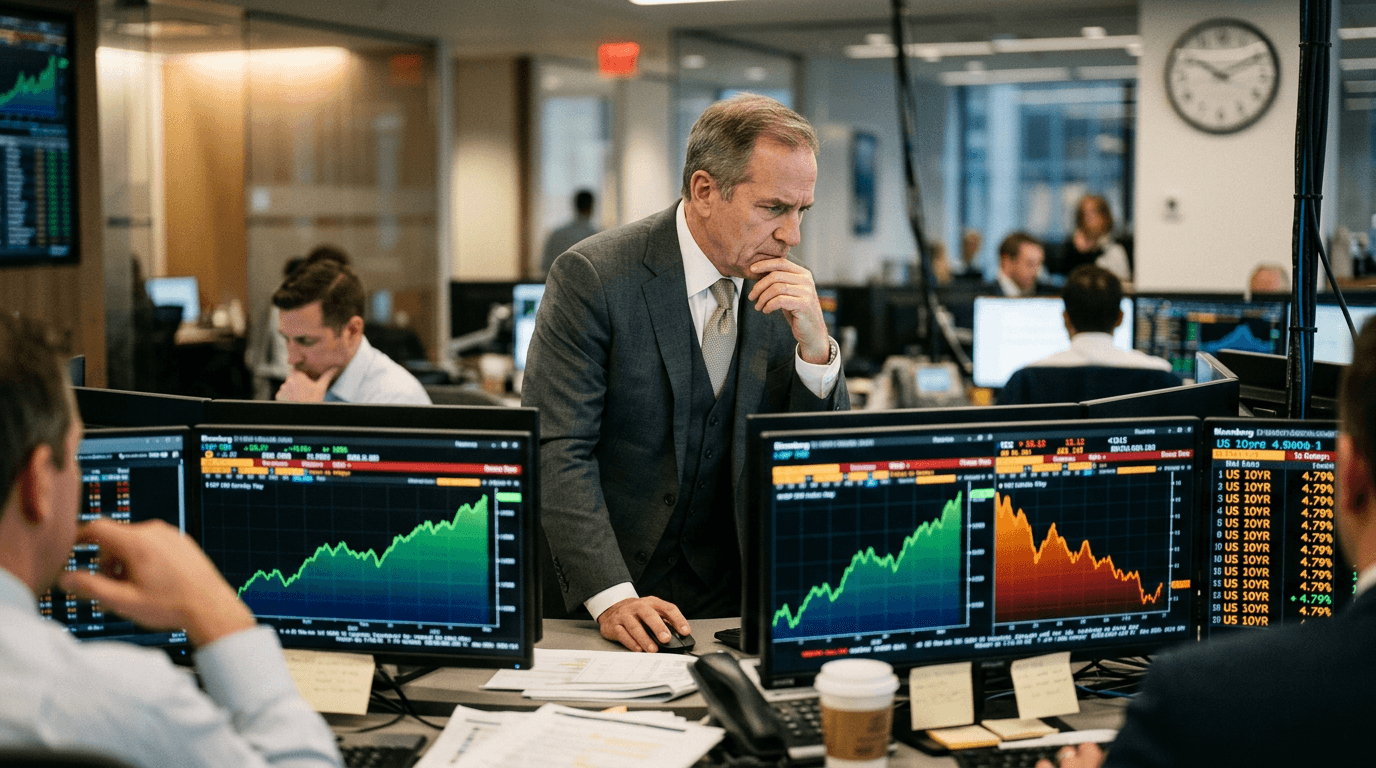
Wall Street closed its latest session with a quietly bullish tone: the major U.S. equity indices edged higher while the VIX, often dubbed the market’s “fear gauge,” dropped nearly 7% to around 15, its lowest level in weeks, even as the 10-year Treasury yield hovered near 4.8%.[9][14] For traders, this mix of firmer yields, rising equities and falling volatility is a nuanced signal that deserves more than a quick headline scan.
Market Snapshot: Calm On The Surface
The S&P 500, Dow Jones Industrial Average and Nasdaq Composite all posted modest gains, reinforcing a narrative of resilience in U.S. equities despite elevated borrowing costs.[9][12] The move was not a euphoric rally, but a steady grind higher driven by selective strength across large-cap sectors.[9][12] At the same time, index futures reflected this cautiously optimistic tone, with S&P and Nasdaq contracts stabilizing after recent rate-driven swings.[9]
The volatility story was even more striking. The VIX fell nearly 7% on the day, sliding to roughly 15, a level last seen several weeks ago and well below its recent spikes.[9][14] Historically, readings in the mid-teens are associated with calmer trading conditions and tighter intraday ranges in major indices.[7][4] This combination of modest equity gains and a sharp drop in implied volatility suggests traders are pricing in a period of relative stability rather than imminent stress.[9][14]
The Vix: What A Drop To 15 Really Means
The VIX measures the market’s expectation of S&P 500 volatility over the next 30 days, derived from options prices rather than realized price moves.[7] A decline toward 15 implies option traders are demanding less premium for downside protection, reflecting reduced near-term fear about large swings in the index.[7][4] When the VIX falls while equities rise, it typically signals growing confidence in the market’s ability to absorb macro news without dramatic dislocations.[4][10]
However, a low VIX is not the same as no risk. Historically, extended periods of subdued implied volatility can encourage investors to increase leverage, sell options for income, or crowd into similar trades, leaving markets vulnerable if a shock arrives.[4][11] For equity traders on a SimFi platform, this environment is ideal for practicing how portfolio risk can appear tame on the surface yet be building beneath in terms of positioning and correlation exposures.
Firm Yields, Calm Markets: A Mixed Message
The most interesting part of this session is that the calm in equities and volatility arrived despite the 10-year Treasury yield holding close to 4.8%, near its recent highs.[9][12][14] Yields at this level imply a higher discount rate for future cash flows, putting pressure on valuations for growth and long-duration assets.[9][14] Yet equities have continued to find buyers, suggesting investors are increasingly comfortable with a “higher-for-longer” rate backdrop.[12][14]
Fixed income commentary in recent days highlights a flattened curve and yields in the 4.7–4.8% range for key U.S. maturities, underscoring that elevated borrowing costs are not a one-off event but a structural feature of the current regime.[12][14] Credit spreads, meanwhile, have remained relatively contained, indicating that bond investors are not yet pricing in a sharp deterioration in corporate balance sheets.[14] For traders, the message is that the market currently views higher yields as manageable rather than destabilizing—at least for now.[12][14]
Cross-asset Ripple Effects: Fx, Crypto And Risk Sentiment
The interplay of higher equities, lower volatility and firm yields is filtering through to broader risk sentiment in FX and crypto markets.[9][14] In currencies, sustained U.S. yields near 4.8% tend to support the dollar, pressuring carry trades and emerging-market FX that had benefited from earlier rate-cut expectations.[9][14] Yet the calmer tone in equities and the drop in the VIX can temper haven demand, creating a more balanced backdrop where relative growth and policy expectations drive FX moves rather than pure risk aversion.[12][14]
Crypto markets are also sensitive to this regime. When the VIX falls and equities grind higher despite elevated yields, speculative assets often see a pickup in risk-taking as traders assume macro stress is fading.[9][14] At the same time, the higher real yield environment challenges narratives around non-yielding assets, creating dispersion within the crypto complex between “macro-sensitive” tokens and those driven by idiosyncratic flows.[9][14] This cross-asset environment is ideal for simulated traders to test how portfolio P&L reacts when traditional and digital assets respond differently to the same macro signals.
How Simulated Traders Can Turn This Into An Edge
For SimFi users, this market snapshot offers several actionable lessons. First, practice reading the three-way relationship between equities, the VIX and Treasury yields, rather than focusing on any single indicator in isolation.[7][9][14] Build scenarios where equities rise but volatility falls and yields stay high, and contrast them with environments where all three move in the same direction, to understand how risk/reward profiles change.
Second, use simulated index futures and options to test different volatility regimes. A VIX near 15 implies lower option premiums and narrower expected ranges—ideal conditions to experiment with strategies like credit spreads, covered calls or structured hedges without real capital at stake.[7][5] Incorporate yield assumptions into your scenario building, stress-testing how equity valuations respond if the 10-year breaks above or below key levels around 4.8%.[9][12][14]
Third, extend the analysis across FX and crypto pairs. Build simulated portfolios where U.S. yield moves drive shifts in dollar strength, then observe how those FX moves feed back into global equity and crypto performance.[9][12][14] This multi-asset perspective is critical for modern trading, where macro factors rarely stop at one asset class.
Conclusion: Calm, But Not Complacent
The latest session’s pattern—equities edging higher, the VIX sinking toward 15, and Treasury yields holding near 4.8%—paints a picture of a market that is calm but still fundamentally priced for tighter financial conditions.[9][12][14] Traders appear comfortable with the current rate environment, at least in the near term, and are marking down the probability of an imminent volatility shock.[9][14] For both live and simulated traders, the key is to treat this calm as an opportunity to prepare, not a reason to forget about risk.
By studying how prices, volatility and yields interact in real time, SimFi participants can sharpen their ability to navigate future inflection points—whether they come from central bank decisions, economic data or unexpected geopolitical events.[12][14] The present backdrop may look benign, but the real edge lies in understanding how quickly sentiment can shift, and being ready for that transition before it shows up in the VIX.