
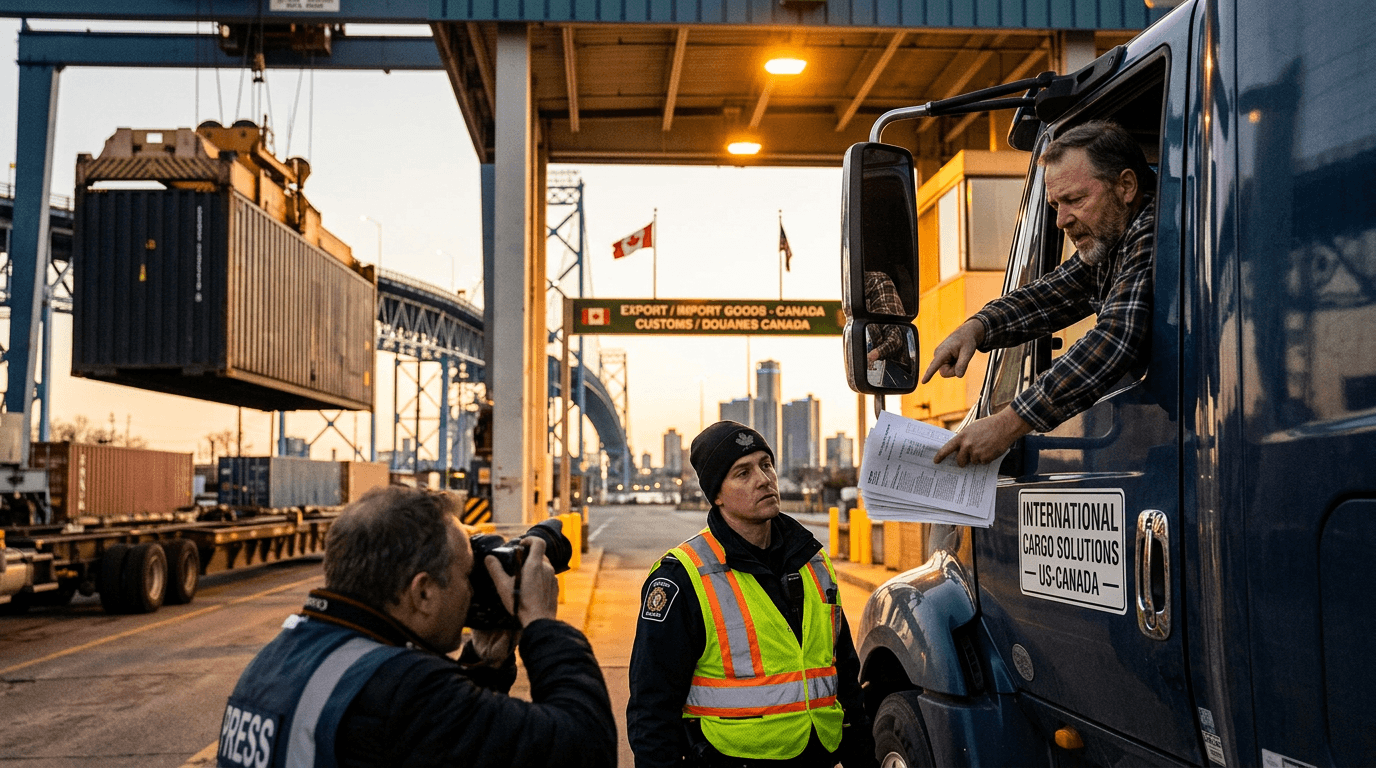
Canada’s decision to impose retaliatory tariffs on roughly $20 billion of U.S. goods marks a sharp escalation in North American trade tensions and a fresh risk factor for markets already grappling with slower global growth and tighter financial conditions.[1][5][10] The move, framed as a “dollar-for-dollar” response to new U.S. duties on Canadian exports, raises the stakes for companies deeply integrated into cross-border supply chains and forces traders to reassess the outlook for equity indices, FX pairs like USD/CAD, and broader risk sentiment.[1][4][10]
Backdrop: How We Got Here
The latest tariffs come against the backdrop of a renewed U.S.–Canada trade dispute that has simmered since Washington raised levies on key Canadian products, including steel and other industrial goods.[1][4] In response, Ottawa has chosen a symmetrical approach, matching the approximate value of U.S. tariffs with its own measures on American imports.[1][5][10]
This is not the first time the two countries have engaged in tit-for-tat trade actions in recent years, with earlier rounds in 2025 involving Canadian countermeasures on tens of billions of dollars of U.S. imports, particularly in steel, aluminum, and autos.[3][9][15] While some of those earlier tariffs were later rolled back as talks progressed, significant duties on U.S. steel, aluminum, and vehicles remained in place even before this latest announcement, leaving the relationship on a fragile footing.[3][15]
The collapse of recent trade talks appears to have been the immediate catalyst, with Ottawa emphasizing that it is defending Canadian workers and industries rather than initiating a trade war.[4][10] Nonetheless, the scale and scope of the new measures underscore how quickly an already tense situation can escalate when political and economic pressures converge on both sides of the border.[1][4][5]
What The New Tariffs Target
Canada’s new counter-tariffs cover approximately C$28 billion, or about $20 billion, of annual U.S. imports, applying surtaxes of 15%, 25%, and 50% across roughly 700 product categories.[1][5] The measures take effect on September 8, giving businesses only a short window to adjust contracts, inventories, and pricing strategies.[1][4][5]
The heaviest 50% tariffs are aimed at steel and aluminum products, as well as finished goods such as furniture and clothing that rely heavily on those inputs.[1][5] This design directly mirrors the sectors hit by U.S. tariffs on Canadian exports, signaling a deliberate attempt to maximize political and economic leverage rather than simply raising revenue.[1][4][5]
A 25% tranche targets a mix of consumer and industrial goods, including appliances, cheese and other dairy products, some seafood, and certain steel and aluminum derivatives.[1][5][10] By hitting both household items and intermediate goods, these tariffs raise costs for Canadian importers and consumers while simultaneously squeezing U.S. producers that depend on the Canadian market.[1][5]
The 15% tariffs, meanwhile, focus on electronics, tools, and machinery, including equipment such as forklifts and air conditioning units.[1][5] This segment affects capital spending decisions for Canadian firms and adds friction to investment plans at a time when many companies already face higher borrowing costs and uncertain demand.[1][5]
For investors, the sectoral tilt of the tariffs is as important as their aggregate size. Steelmakers, industrial manufacturers, consumer durables, and select consumer staples companies with high Canada exposure are most directly in the crosshairs, while logistics firms and retailers face second-round effects through supply chain disruptions and higher import costs.
Market Reaction: Equities, Fx And Risk Sentiment
Equity markets typically treat trade escalations as risk-off events, and this development is no exception, particularly for North American indices with heavy weights in industrials, materials, autos, and consumer discretionary names. The new tariffs add another drag on earnings visibility for companies that rely on cross-border supply chains or derive a significant share of revenue from Canada–U.S. trade.
For equity index futures, traders will focus on how deeply the tariffs cut into margins and volumes for affected sectors, and whether management teams guide lower in upcoming earnings calls. Names in steel, machinery, appliances, and autos could see valuation discounts widen if investors price in prolonged trade frictions rather than a short-lived spat.
In FX, USD/CAD becomes a key barometer of market sentiment toward the dispute. Trade tensions can be a double-edged sword for the Canadian dollar: weaker growth prospects and risk-off flows tend to support the U.S. dollar, while the perception of Canada taking a disciplined, rules-based approach under the CUSMA framework may cushion the blow to CAD over time.[15] Short-term moves will likely track headlines and changes in perceived escalation risk more than hard data.
Broader risk sentiment also matters. Renewed tariffs between two closely integrated economies can reinforce a narrative of deglobalization and supply chain fragmentation, adding to risk premia across global assets. If investors come to see this conflict as part of a wider pattern of U.S. trade assertiveness, they may demand higher risk premia for export-oriented sectors worldwide, not just in North America.
What This Means For Traders And Investors
For traders, the key is to translate headline risk into specific exposures and time horizons. Not every company or asset class is equally sensitive to these tariffs, and the market often overshoots initially before repricing more rationally as details emerge.
In equities, focus on: 1) Revenue and production exposure to Canada–U.S. trade, especially in steel, industrial machinery, appliances, furniture, clothing, and dairy-related consumer products.[1][4][5] 2) Pricing power and supply chain flexibility. Companies that can quickly shift sourcing, pass costs to customers, or re-route sales may weather the storm better than those tied to fixed cross-border flows. 3) Policy optionality. Some firms may benefit from domestic substitution, gaining market share if importers face persistent tariffs.
In fixed income, higher trade uncertainty can pressure corporate spreads for affected sectors, particularly high-yield issuers with limited balance sheet flexibility. Sovereign and provincial bonds may see safe-haven demand if risk-off sentiment intensifies, though the growth hit from tariffs could also influence expectations for future monetary policy.
In FX and rates, traders should monitor: 1) Shifts in growth and inflation expectations in Canada versus the U.S., which influence relative rate paths. 2) Market pricing of policy responses, including potential fiscal measures or targeted support for impacted industries.[1] 3) Correlations between USD/CAD and broader risk proxies like equity volatility, which can strengthen during trade flare-ups.
Practical Takeaways For Simulated And Live Traders
Whether trading in a simulated environment or with real capital, this episode offers a concrete case study in how trade policy shocks propagate through markets.
Key practical takeaways: 1) Map the transmission channels. Tariffs influence markets through earnings, sentiment, and macro expectations. Identify which channel is most relevant for each asset you trade. 2) Use scenario analysis. Build simple scenarios—de-escalation, managed stalemate, and further escalation—and consider how each would affect equity sectors, USD/CAD, and volatility. 3) Watch the calendar. The September 8 implementation date is a natural focal point for volatility as markets move from anticipation to realized impact.[1][4][5] 4) Separate short-term noise from long-term trend. Initial headline-driven moves can be sharp but may retrace if the policy path clarifies. Longer-term impacts depend on whether tariffs become embedded or are quickly rolled back. 5) Practice risk management in SimFi first. Simulated finance platforms allow traders to test strategies for trading news shocks—such as hedging sector exposure or trading FX breakouts—without real capital at risk.
For longer-term investors, maintaining diversification and avoiding concentrated bets on trade-sensitive names can help reduce portfolio volatility. Tilting toward companies with domestic demand drivers or diversified geographic exposure may also mitigate trade-related risks.
Conclusion
Canada’s retaliatory tariffs on $20 billion of U.S. goods are more than a diplomatic message; they are a material economic shock to tightly woven North American supply chains and a fresh source of uncertainty for global markets.[1][5][10] By targeting sectors like steel, aluminum, appliances, electronics, and consumer goods with tariffs as high as 50%, Ottawa has signaled that it is prepared to match Washington’s moves and absorb the short-term costs of confrontation.[1][4][5]
For traders and investors, the challenge is to move beyond the headline and understand how this policy shift alters earnings prospects, risk premia, and cross-asset relationships. Those who systematically track exposures, build scenarios, and practice disciplined risk management—whether in a SimFi environment or in live markets—will be better positioned to navigate whatever comes next.