
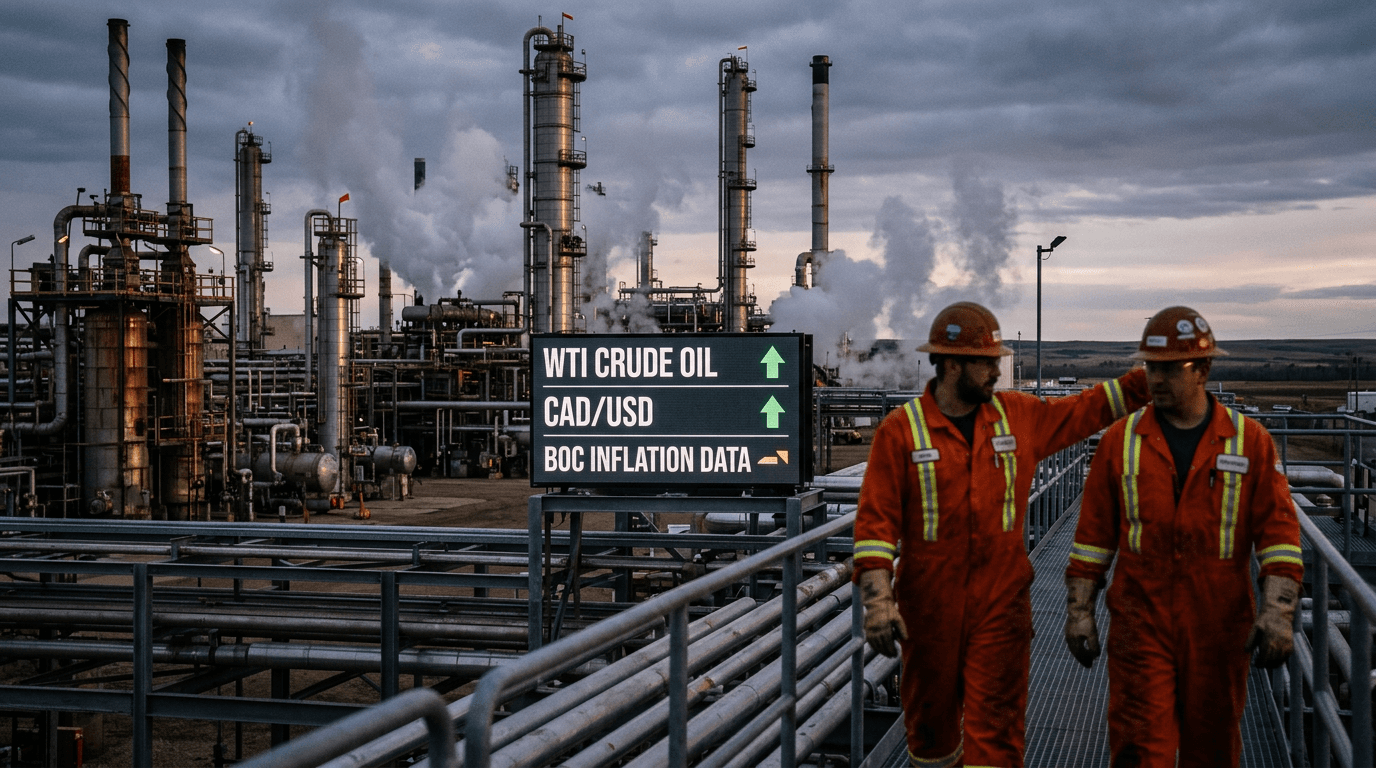
The Canadian dollar is back on traders’ radar as oil prices jump on Iran-related supply fears, giving the commodity-linked “loonie” a clear boost against many major currencies.[2][5] Crude benchmarks like WTI and Brent have surged to multi-week highs as markets price in the risk that conflict could disrupt key Middle East supply routes, particularly around the Strait of Hormuz.[5][7][14] With Canada standing among the world’s largest oil exporters, this spike in energy prices is feeding directly into FX markets, inflation expectations, and the outlook for Canadian monetary policy.[2][10][12]
Loonie Rides The Oil Wave
In recent sessions, the Canadian dollar has firmed modestly versus the U.S. dollar as crude oil rallied on geopolitical tensions, reversing part of its earlier weakness from recent lows.[2][5][7] USD/CAD has drifted lower—reflecting a stronger CAD—while WTI trades several percent higher on the day, near levels last seen weeks ago.[5][7][14] Oil is a critical Canadian export, and higher prices improve the country’s terms of trade, supporting export revenues, corporate earnings, and, by extension, the currency.[2][3][12]
This move is not a runaway rally, but it is notable because CAD is outperforming many peers in an environment otherwise dominated by risk-off sentiment and safe-haven demand for the U.S. dollar.[2][6][12] Where other G10 currencies are struggling against a stronger USD, Canada’s direct benefit from higher energy prices is helping offset some of those pressures.[12][14] For traders, that relative resilience is where the opportunity lies: CAD may not be surging, but it is holding up better than much of the FX complex.
Takeaway: Oil-linked support is giving CAD a performance edge in a risk-averse market, making CAD-crosses more attractive for relative value trades.
Why Oil Matters So Much For The Canadian Dollar
Canada’s economy is deeply intertwined with the energy sector. Crude oil and related products represent a major share of export revenues, and swings in global oil prices materially affect Canada’s trade balance and national income.[2][12] When oil prices rise, Canada often enjoys a wider trade surplus and an improved fiscal and corporate backdrop, traditionally translating into a stronger currency.[2][10][12] Recent trade data underline this dynamic, showing the surplus widening to its largest level since 2022 as energy exports benefit from supply gaps tied to Hormuz disruption.[12]
The loonie has long been viewed as a “petro-currency,” responding positively to higher crude prices. However, this relationship has weakened over the past decade.[11] Analysts note that in supply-driven rallies—where oil spikes because of disruptions rather than booming demand—the CAD reaction tends to be more muted.[11] In such scenarios, global growth concerns and safe-haven flows into the U.S. dollar can partially offset the positive terms-of-trade effect for Canada.[6][9][11]
Today’s move fits that pattern. Oil is higher on fears of disrupted supply routes, not on surging global demand, and that limits the upside for the currency.[11][12] The result is a “supported but not soaring” CAD: stronger than it would otherwise be, yet still constrained by broader risk sentiment and U.S. dollar strength.
Takeaway: Oil matters for CAD, but in supply-shock environments traders should expect support rather than an outsized, linear rally in the currency.
Iran Tensions And The Strait Of Hormuz Risk Premium
The current oil move is driven less by fundamentals like demand growth and more by geopolitical risk centered on Iran.[2][3][14] Tensions and conflict in the Middle East have increased the probability of disruptions to shipping lanes and energy infrastructure, injecting a “risk premium” into crude prices.[2][3][17] Threats to vessels, reported attacks, and warnings around passage through the Strait of Hormuz—a chokepoint that handles roughly one-fifth of the world’s oil supply—have raised the stakes for global energy markets.[3][4][7][14][18]
When markets fear that oil flows could be delayed, diverted, or even temporarily blocked, they price in higher future scarcity, pushing spot and futures prices up.[2][3][17] Canada, as a major exporter, benefits from these higher prices on the revenue side, but the broader global impact is more complex. Higher oil costs can weigh on global growth, lift inflation, and increase volatility across risk assets, from equities to emerging market FX.[10][17]
For CAD specifically, Iran-linked supply fears are a double-edged sword. On one side, they raise export incomes and support the currency; on the other, they fuel risk-off moves that strengthen the U.S. dollar and tighten global financial conditions.[6][9][16] The net effect so far has been a modest but durable bid for CAD relative to peers, supported by energy but capped by geopolitics.
Takeaway: Iran-related supply fears are driving an oil risk premium that supports CAD, but traders must weigh this against the broader risk-off backdrop and safe-haven flows.
Inflation, Bank Of Canada, And Policy Expectations
Higher oil prices do not stop at the FX market—they filter into inflation and central bank thinking. An energy supply shock can extend the inflation impulse beyond what was initially expected, pushing up headline CPI and potentially influencing core inflation via higher transport and input costs.[10] In Canada, this dynamic complicates the Bank of Canada’s policy calculus. If inflation risks re-accelerate or prove more persistent due to energy, the path for rate cuts can become shallower or more delayed.[1][10]
Recent commentary suggests that the Iran-related oil shock is meaningful enough that analysts are revisiting their CAD and rate forecasts.[10] Some now see the loonie gaining additional ground over the year as higher energy prices and a stronger trade position support the currency, even if global growth remains uneven.[10][12] At the same time, bank research points out that CAD upside remains limited in purely supply-led oil rallies, again emphasizing that the currency’s reaction is more contained than in demand-driven booms.[11]
For traders, this interplay matters. If markets start to price in fewer or slower BoC cuts due to energy-driven inflation, Canadian yields could rise relative to peers, further supporting the loonie over the medium term.[1][10] Conversely, if growth worries dominate and central banks everywhere stay cautious, safe-haven flows into the U.S. dollar may overshadow any CAD support from oil.
Takeaway: Watch Canadian inflation and BoC expectations closely—energy shocks can shift the interest rate narrative and create medium-term opportunities in CAD and Canadian rates.
How Traders Can Position Around Cad And Oil
For discretionary and systematic traders alike, this environment offers a rich set of scenarios to model. In FX, USD/CAD and CAD-crosses (such as CAD/JPY and EUR/CAD) are natural instruments to express views on the balance between oil support and global risk sentiment.[2][5][14] CAD has shown relative resilience, suggesting opportunities in long-CAD strategies versus currencies more exposed to risk-off flows, provided risk management is tight.[6][12]
In commodities, energy futures and related equity indices stand at the center of the shock. Higher crude prices support Canadian energy producers and broader resource-linked sectors, a theme that can be explored both in live markets and through simulated finance platforms focused on macro and commodity strategies.[2][12] For traders using SimFi environments, today’s backdrop is a practical laboratory: stress-test portfolios under scenarios of further Middle East escalation, partial de-escalation, or a shift from supply-driven to demand-driven oil dynamics.
Crucially, the CAD–oil link is no longer a simple one-to-one relationship. Sophisticated positioning will account for:
- The source of the oil move (supply risk versus demand growth)[11]
- The reaction of global risk assets and safe-haven currencies like the USD[6][9][16]
- The evolving stance of the Bank of Canada as inflation and growth data roll in[1][10]
By layering these drivers into trade construction—rather than just “buying CAD when oil goes up”—traders can build more robust strategies that reflect modern market realities.
Takeaway: Use CAD and energy markets as a combined macro theme, but integrate geopolitics, safe-haven flows, and central bank signaling into your trade design and risk management.